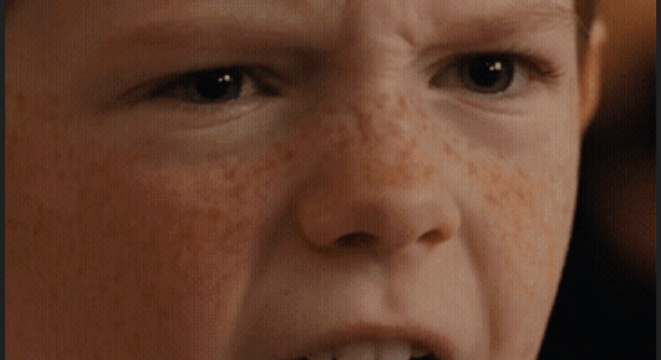
“He’s lying.”
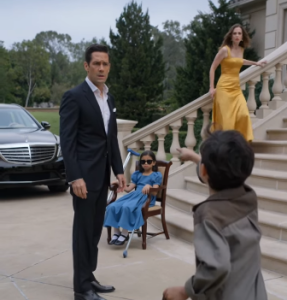
The words came too quickly, sharp enough to cut through the silence hanging over the driveway. But it was not the accusation itself that changed everything. It was the speed behind it. Innocent people usually hesitate first. They look confused. Frightened people defend themselves before they attack.
The father noticed that immediately.
Yet he still said nothing.
His hand tightened around the small medicine bottle while his eyes moved slowly between three people: his trembling daughter clutching her crutch, his wife frozen halfway down the front steps, and the barefoot boy standing near the edge of the driveway like someone who never belonged there but somehow carried the truth no one else had seen.
The evening wind brushed softly through the trees, but nobody moved.
Finally, the father looked at the boy.
“How do you know?” he asked quietly.
The boy swallowed hard before answering. His clothes were dirty, oversized, and worn thin from sleeping outside, but his voice carried a strange honesty that made the silence heavier.
“I sleep behind the back wall sometimes,” he admitted. “Near the kitchen bins. The windows stay open at night.”
The wife shut her eyes for one brief second.
That was enough.
The father saw it.
The boy continued, nervous now but determined to finish what he had started.
“I heard her talking to the cook,” he said. “She said the bitter medicine works better if the girl drinks it before food. She said if the little girl complained about feeling sick, they should tell her it helps her eyes rest.”
The father slowly crouched in front of his daughter.
The little girl tightened her grip on the crutch so hard her knuckles turned white.
“Look at me,” he said softly.
Behind him, his wife stepped down another stair.
“This is ridiculous,” she snapped. “Stop this right now.”
But the father never looked away from his daughter.
“Look at me.”
Several painful seconds passed.
Then the child finally raised her head.
And instead of searching for his voice like a blind child would, she looked directly into his eyes.
The father’s face emptied of expression.
The wife stopped moving entirely.
The little girl began crying silently, tears rolling down her cheeks while her tiny shoulders shook.
“Mama said I had to,” she whispered.
The father’s jaw tightened.
“Had to what?”
The girl stared at the driveway.
“Pretend.”
That single word struck harder than any accusation.
The boy pointed toward the bottle still in the father’s hand.
“She dropped one near the hedge yesterday,” he explained. “I picked it up because she came back looking for it later.”
The father rose to his feet slowly.
Very slowly.
And when he looked at his wife again, the confusion was gone.
Now there was recognition.
Not recognition of what she had done.
Recognition of how long she had been doing it.
Then the little girl whispered the sentence that transformed suspicion into motive.
“Mama said I only have to stay blind until the papers are signed.”
The world seemed to stop breathing.
Even the wind faded into silence.
Because suddenly the medicine bottle was no longer medicine.
It was evidence.
And the father finally understood something terrifying: his daughter’s illness had not happened naturally. It had been carefully timed.
The little girl wiped at her face with trembling fingers while the father stood frozen in the driveway. Memories began crashing into him one after another, each one carrying a detail he had ignored because love had made him trust too easily.
The headaches that appeared suddenly months earlier.
The doctor appointments his wife insisted on attending alone.
The medications she organized personally every single day.
The growing weakness in their daughter’s legs.
The way the child always seemed worse after meals.
And worst of all, the legal documents waiting inside the house.
Papers connected to money.
Property.
Inheritance.
Control.
The father looked back at his daughter, and guilt hit him so hard he nearly lost his balance. Every painful therapy session. Every sleepless night. Every moment his little girl believed something was wrong with her body — all while the people meant to protect her had failed to see the truth.
His daughter had trusted the adults around her.
And one of them had betrayed her.
The wife finally spoke again, but now her voice sounded desperate instead of angry.
“You don’t understand,” she said quickly. “I did this for us.”
The father stared at her as though he no longer recognized the woman standing in front of him.
“For us?” he repeated.
Tears formed in her eyes, but they did not soften the damage already done.
“You were going to lose everything,” she said. “The company, the estate, all of it. Once the custody agreement changed, they would’ve taken control away from you. I was trying to protect this family.”
The father’s expression darkened.
“You poisoned our daughter.”
“She wasn’t dying!” the wife shouted back immediately. “It was controlled. I knew exactly how much to give her.”
The little girl flinched at the sound of her mother yelling.
That movement broke something inside the father completely.
He stepped toward his daughter instantly, kneeling beside her again and pulling her gently into his arms. She buried her face against his shoulder and cried harder than before, years of fear pouring out all at once.
“It’s okay,” he whispered shakily. “You don’t have to pretend anymore.”
The barefoot boy stood awkwardly nearby, uncertain whether he should leave or stay. The father looked up at him with eyes filled not only with shock, but gratitude.
Most people would have stayed silent.
Most people would have walked away from a wealthy family’s problems.
But this child had spoken anyway.
“What’s your name?” the father asked.
“Eli,” the boy answered quietly.
The father nodded slowly.
“Thank you, Eli.”
For the first time since arriving home that evening, the little girl lifted her head slightly.
“I can see you, Daddy,” she whispered through tears.
The father closed his eyes.
Not because he was relieved.
Because he realized she probably always could.
And somewhere inside the enormous house behind them, sitting quietly on polished kitchen shelves and hidden behind careful labels, was the proof that one mother had turned her own child’s health into part of a legal strategy.
The driveway remained silent as the truth settled over everyone standing there.
Nothing about the family would ever be the same again.
But at least the little girl no longer had to live in darkness that never truly belonged to her.