There is a particular kind of silence that settles over a place when everyone has stopped looking. It is not peaceful. It is heavy, and it has a texture, the kind you can almost feel pressing against your chest. That is the silence inside an old wooden shed at the edge of nowhere, where a mother dog stands swaying on legs that no longer want to hold her.
Light barely makes it inside. What little there is comes in thin and grey through the open doorway, falling across a floor of worn pebbles and a cracked, moss-stained threshold. Above her, rough beams stretch across a ceiling that has long since given up. The planks of the walls are stained and weathered, and the window frame has rotted away to almost nothing. Everything here has been forgotten, and she seems to have been forgotten along with it.
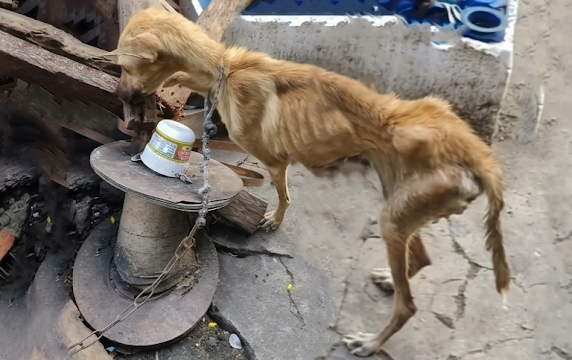
Look at her closely, and you understand why this story is so hard to turn away from. Her skin is thin and bare in patches, sore and reddened, stretched over a frame that has nothing left to give. Every rib is visible. Her spine rises like a ridge down her back, and her hip bones jut out sharply on either side. She is a dog who has been giving more than her body ever had to spare.
And yet, beneath all that hunger, there is a heavy, swollen softness that tells the real story. Her teats hang full and pink beneath her depleted body. She is a mother. Somewhere close by, her babies depend on her, and every drop she has made for them has come out of a body that was already running on empty.
Think about what that means for a moment. A mother who has not eaten enough, who has had no clean water and no warmth, has still been feeding her young. Whatever strength she had, she poured into them. There is nothing dramatic about it, no grand gesture, just a thin, tired dog doing the only thing she knows how to do, one hour after another, until there is almost nothing left of her.
She stands hunched in the middle of that cold shed, her front legs braced stiff and straight as if they are the only thing keeping her upright. Her hind legs are bent and trembling in a half-crouch, the way a body folds when it cannot decide whether to stand or fall. Her tail hangs low. Her heavy, wrinkled head drops toward the ground, her eyes swollen and half closed, and the whole of her posture speaks of total exhaustion.
The shivering never stops. It runs through her whole frail body, from her quaking shoulders down to her shaking paws. This is not the small shudder of a dog who is a little chilly. It is deep and uncontrollable, the kind that comes from hunger and cold and weakness all at once. When a body has no fuel and no shelter, it trembles because it has no other way to cope.
Her breathing is ragged and wet. You can see her hollow ribcage heave with every labored breath, each one a small effort that costs her something she cannot afford. And beneath the sound of that breathing, there is another sound, soft and continuous, a faint whimpering that never quite goes away.
Every so often, that whimper breaks. A thin, cracked cry escapes her, so fragile and so full of weariness that it seems to hang in the cold air before it fades into weak, trembling sobs. It is the kind of sound that makes a person stop whatever they are doing. It is not loud, but it reaches you all the same.
Around her, the shed offers no comfort. Her claws scrape softly against the rough pebble floor as she shifts her weight. The old wood creaks in a cold draft. Otherwise there is only that vast, heavy quiet of a place where nobody is coming. No footsteps, no voices, no bowl set down on the stones. Just an empty building and a dog who has been left inside it.
Then something small and extraordinary happens. Slowly, with great effort, she lifts her head.
It takes everything she has. Her neck trembles under the weight of it. But she raises her face toward the camera, and her dark eyes meet the lens. They are glistening and glazed, heavy with tears. She blinks slowly, the way someone blinks after carrying too much for too long. A single tear rolls down her thin muzzle.
In that gaze, a person watching can read whatever their own heart carries to it. Maybe it looks like weariness. Maybe it looks like a quiet plea for gentleness, for a meal, for someone to look after the little ones she has protected for so long. We cannot know what she feels. But we can know what she needs, because her body tells us plainly: food, clean water, warmth, and a kind pair of hands.
Her head sinks again, trembling, as if the effort of looking has used up the last of her strength. Then, after a moment, she lifts it once more. Her legs buckle slightly against the cold stone of the floor, and still she raises her face toward the camera. It is a small, fragile movement, and it is one of the most moving things you will see.
There is something about this scene that goes beyond sadness. It asks us a question without saying a single word. How many dogs like her are out there right now, in sheds and garages, behind buildings, at the edges of towns where nobody walks? How many mothers are quietly giving their last reserves to their babies while the world looks the other way?
For many of us, especially those who have lived long enough to know what it means to go without, this kind of scene lands differently. We have known hard winters. We have known what it is to stretch a little so that someone smaller can have more. We understand a mother who puts her young ahead of herself, because we have seen it, or done it, or been the child who was fed first.
That is why her story feels so familiar, even though she is a dog in a shed we have never visited. She is a reminder that devotion does not require comfort. It does not wait for good conditions. It shows up in the thinnest, coldest, loneliest places, and it keeps going long after anyone would blame it for stopping.
It is also a reminder of how much difference a single act of attention can make. A dog in this condition cannot ask for help in any way a person would recognize. She cannot knock on a door or make a phone call. She can only stand where she is, tremble, and make small sounds into the silence, and hope, if hope is the right word, that someone passes close enough to hear.
If you have ever wondered what ordinary kindness looks like in practice, it looks like this. It looks like someone who notices a thin shape in the corner of a building and decides not to walk on. It looks like a person who sets down a bowl of water, who calls a local shelter or a rescue group, who asks a neighbor, who refuses to let a suffering animal be somebody else’s problem.
None of it requires heroics. It begins with simply seeing. The weathered shed, the cracked threshold, the grey light in the doorway, all of it is easy to overlook. A mother dog who has stopped asking for much is even easier to miss. But once you have looked into those tear-filled eyes, it becomes very hard to forget them.
Her ribs, her trembling legs, her slow, defeated blink: all of it says the same thing. She has done what she could. She has carried her babies through hunger and cold with nothing to lean on. Now she needs someone to carry her, even for a little while, so that she can rest.
We often say that love is the strongest force there is. Standing in that dark shed, shaking from head to paw and still lifting her head toward the light, she is proof of it. She has no food, no warmth, and no help, and she has not stopped being a mother.
So if you ever find yourself near a place like this, with a thin dog and a quiet whimper and a door left open to the grey light, please do not hurry past. Stop. Look. Listen. The smallest kindness, offered at the right moment, can change everything for a mother and the little lives she has fought so hard to protect.
And if this story touched you, share it. Someone you know may be the very person who needs to be reminded that a gentle heart is exactly what a place like that is missing. Sometimes a single moment of noticing is where every rescue begins.