There are moments when a single look says more than a lifetime of words ever could. This is one of them.
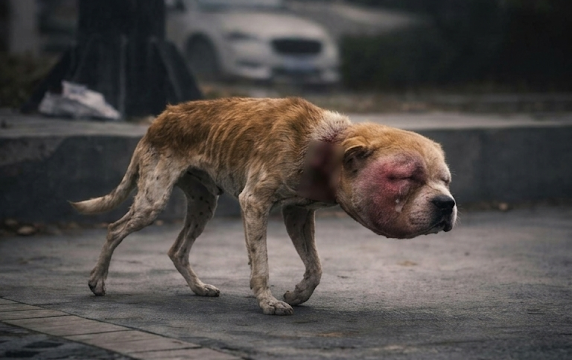
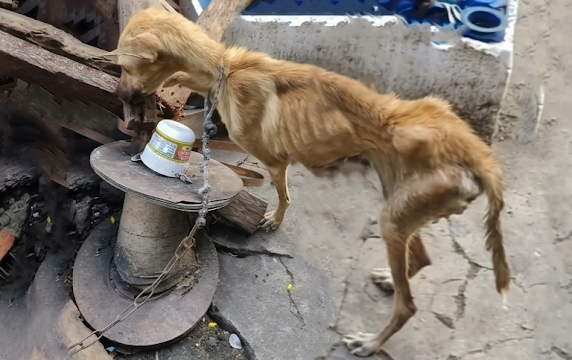
On a cold, grey day, in a quiet corner of an animal yard where no one seemed to be passing by, a frail golden-tan dog stood on a worn slate stepping stone. Her coat was dull and dusty. Her muzzle and paws were white, the kind of soft markings that make you think of a gentle old friend. But what anyone would notice first was the heavy, swollen mass weighing down one whole side of her body and head, pulling her face low and tilting it to one side as if she could no longer lift it on her own.
She stood hunched, swaying slightly, her thin front legs braced stiffly beneath her. They buckled a little with every shift of her weight. Her hind legs trembled. Even standing still seemed to cost her more strength than she had left. Her tongue hung weakly from her mouth as she panted, and her breathing was ragged and wet, her thin ribs rising and falling with every labored breath.
It was the posture of a dog who had been carrying something far too heavy for far too long. Not just the weight on her body, but everything that came with it. The pain. The tiredness. The long, lonely days with no one beside her.
Anyone who has loved an animal knows that dogs rarely complain. They do not announce their suffering or ask for sympathy. They simply keep going, day after day, until their bodies can no longer keep up. That is what made this scene so difficult to look at. She was not making a scene. She was not demanding anything. She was simply standing there, shaking, doing her best to stay upright.
And she was shaking hard. A deep, uncontrollable shiver ran through her whole frail body, from her trembling shoulders all the way down to her quivering paws. Whether it came from the cold, from weakness or from pain, it did not stop. Along with it came a soft, continuous whimper, a sound so quiet you might miss it if you were not listening closely. Every few moments, a thin, broken cry escaped her and faded into weak, trembling sobs.
The place around her only made the picture more heartbreaking. It was an old, quiet yard with a path of dark slate stones set in damp green grass. A weathered wooden kennel house stood nearby. There were wire mesh pens and a rusted cage, and tall green trees faded into the distance beneath a heavy, overcast sky. There was no warmth in the light. There were no voices, no footsteps, no one calling her name. Only the dry rustle of grass in a cold breeze and the heavy silence of a place that seemed to have been forgotten.
Then, slowly and with great effort, she did something that stopped everything.
She lifted her heavy head toward the camera.
Her dark eyes were glistening and glazed, filled with tears. She looked straight into the lens, blinking slowly, and a single tear rolled down her muzzle. It was a look that did not need translation. It was the look of someone who has been waiting a very long time for another living soul to stop, to notice and to care.
For a few seconds she held that gaze. Then her head sank slowly lower, trembling under its own weight. Her legs buckled slightly on the cold stone. It seemed as though even that small effort had taken nearly everything she had left.
And yet, a moment later, she lifted her head again.
That is the part that stays with you. After everything, after all the hurt and exhaustion, she still raised her eyes one more time. It was fragile, and it was tired, but it was there. Some would call it hope. Others might call it simply the last bit of strength a gentle soul refuses to give up.
Many of us in the later chapters of our lives understand that feeling better than we might like to admit. We know what it means to carry a burden quietly. We know what it is like to keep going when we are worn down, because that is simply what you do. We also know how much it means when someone finally sees us, truly sees us, and says, “You do not have to carry this alone.”
This dog could not say those words for herself. She could not pick up a phone or knock on a door or explain what was wrong. All she could do was stand on that cold stone and let her tired eyes speak for her.
It is easy to look away from scenes like this. They are uncomfortable. They make our hearts ache. But there is something important in staying with them for a moment. Every animal in trouble has someone, somewhere, who can make a difference. It might be a neighbor who notices. It might be a stranger who stops the car. It might be a volunteer who gives up a weekend, or a veterinarian who offers a steady hand and a kind word. Rescue stories do not begin with a miracle. They begin with someone deciding that an animal’s suffering matters.
That is why moments like this one deserve to be seen. Not to cause sadness for its own sake, but to remind us what is at stake when an animal goes unnoticed. This dog was already so thin and so weary. A frail body can only hold on for so long. Every hour counts, and every act of attention can be the difference between a story that ends in silence and one that opens into a new beginning.
Look again at the details. The white paws pressed against cold stone. The head tilted under its heavy burden. The thin legs braced and trembling. The shallow, wet breaths. The soft whimper that never quite stops. These are not just pieces of a sad picture. They are signs of a living, feeling creature who deserved so much more than an empty yard and a grey sky.
Think, too, about how long it must take for a body to reach this point. A condition like this does not appear overnight. It grows slowly, quietly, while days turn into weeks. Somewhere along the way, a different outcome was possible. Someone could have noticed sooner. Someone could have stepped in. That is not meant to place blame. It is meant to remind us that early kindness is always easier than late rescue, and that paying attention is one of the greatest gifts we can give to any creature who depends on us.
For many readers, this story may bring back memories of an old companion. Maybe a dog who slept at the foot of your bed for years. Maybe one who waited by the door every evening, tail swaying, as if your arrival were the best event of the day. Dogs give that kind of loyalty so freely, without conditions and without keeping score. They ask for so little in return: a warm place to rest, a bowl of food, a gentle hand and a voice that says their name with love.
When we see a dog who has been denied even those simple things, something in us stirs. It is the same part of us that wants to wrap a blanket around a shivering child or sit beside a friend who is hurting. It is compassion in its purest form, and it is one of the best things about us.
Right now, in this quiet moment on a cold slate stone, that compassion has not yet arrived. The yard is still empty. The sky is still heavy. The dog is still trembling, still whimpering, still lifting her tired eyes toward anyone who might be watching.
But she is there. She is breathing. She is looking straight at us.
And sometimes, that is where every rescue story truly begins: with a single, steady look from a gentle soul who has run out of strength to ask, and with someone, somewhere, who decides that she is worth stopping for.
We can only imagine what it took for her to lift her head one more time. We can only hope that the next chapter brings the warmth, the care and the gentle hands she has been missing for so long. Because if her story has taught us anything so far, it is that even the weariest heart can still hold on to a thread of hope, and that thread is often all it takes for love to find its way in.
Her story is not finished. The next moments are the ones that matter most.