There is a kind of quiet that settles over a city street when no one is looking. On one cold, grey day, that quiet was broken only by the soft scrape of claws on rough paving stones, slow and uneven, like someone trying to remember how to walk.
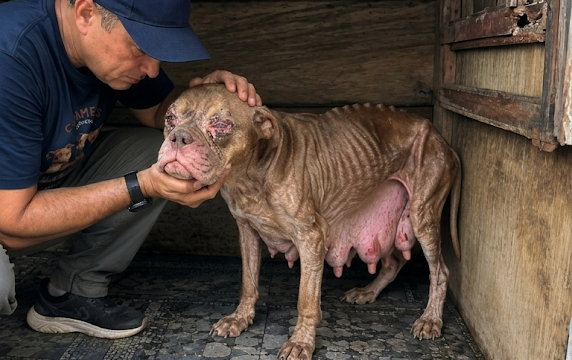
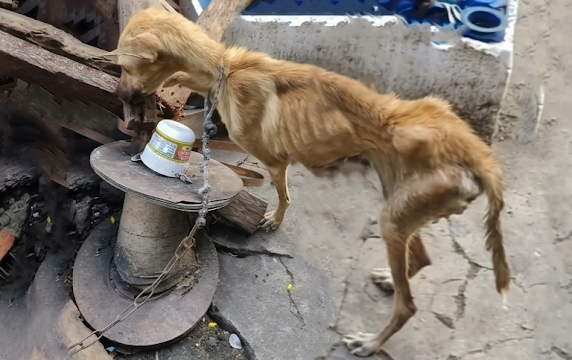
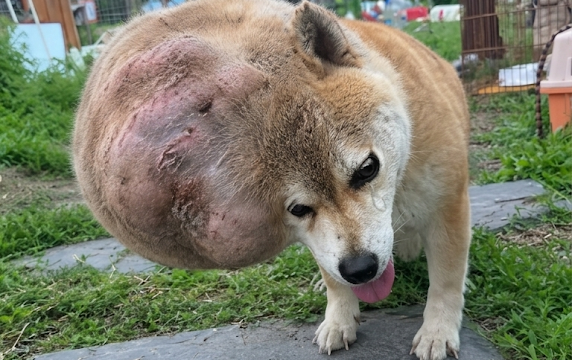
She was a golden-brown dog, or at least she had been once. Now there was very little left of the animal she used to be. Her fur was thin and dull, lying in patches over a body so frail that every rib and every bone of her spine stood out sharply beneath it. Her face and neck were swollen and sore. Her legs, so thin they hardly seemed able to carry her, buckled a little with each step.
She moved the way a living thing moves when it has nothing left to spend. Her head hung low, far below her shoulders, too heavy to lift. Her eyes were half closed, as if even the pale daylight hurt. Her thin tail hung limp behind her. Everything about her posture spoke of exhaustion, the kind that goes deeper than a single bad night.
It was easy to imagine how long she had been out there. Days, perhaps, wandering the same empty streets in pain, with no food, no water, and no hand reaching out to help. Cars may have passed. People may have looked away. Whatever the reason, no one had stopped, and the street had never offered her anything but more cold pavement.
And it was cold. The sky above the city was pale and overcast, the light flat and gray, draining the color from everything it touched. Dry brown leaves skittered across the ground in the breeze. A worn iron drain grate sat in the pavement beside a dark concrete pillar and a low concrete wall. Far off, leafless trees and distant buildings faded into the haze, as if the whole city had pulled back from her.
She was shivering. Not a small shiver, but a deep, uncontrollable trembling that ran through her entire body, from her narrow shoulders down to her shaking paws. It was the shaking of a body weakened by cold, by pain, and by hunger that had gone on far too long. Her breathing was ragged and wet, and with every labored breath her hollow ribcage rose and fell, so visibly that it was hard to watch.
Then came the sounds. A soft, steady whimpering, so faint it might have been mistaken for the wind. Every so often, something more broken escaped her, a thin, trembling cry that rose for a moment and faded into weak little sobs. It was not the sound of a dog asking for much. It was the sound of a dog who had almost stopped asking at all.
She walked on, one painful step after another, until something made her pause.
Slowly, with enormous effort, she stopped. She lifted her heavy head, and for the first time she turned toward us and looked straight into the camera.
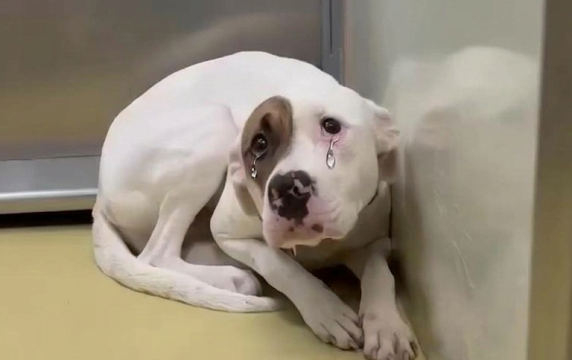
Her dark eyes were glazed and glistening, filled with tears. She blinked slowly, the way someone blinks when they are tired of fighting. A single tear rolled down her swollen muzzle. It is hard to put into words what that look carried. It seemed to say what no voice could say for her: please, someone, stop. Please, save me.
For a long moment she held that gaze. Then her head sank lower again, trembling, as if the effort had cost her more than she had to give. And yet, after a breath, she lifted it once more, turning back toward us with something fragile and desperate in her face. It was not a strong hope. It was a thin, shaking thread of one, but it was there.
Her legs buckled slightly on the cold stone. She did not fall. Somehow, she stayed standing.
There was no one else in sight. No crowd, no passing cars, no voice calling out to her. Only the empty street, the heavy silence, the dry rattle of leaves, and a small, broken dog holding herself upright through sheer will.
Moments like this have a way of staying with us. Not because they are loud, but because they are so quiet. A dog like her does not demand anything. She does not bark at passersby or chase after anyone for help. She simply walks, and suffers, and hopes that somewhere along the road a person will see her.
Many of us have been that tired. Many of us have felt, at some point, that the world was too cold and too busy to notice us. Perhaps that is why her story reaches so deep. Looking at her, we do not just see a stray dog on a gray pavement. We see how much a living creature can endure, and how much a single act of kindness could mean to someone at the very end of her strength.
She is thin, but she is still here. She is trembling, but she is still standing. She is in pain, but she turned her face toward the lens and looked at us as if to ask whether anyone was left who would care.
If you were standing on that street, what would you do? Most of us like to believe we would be the one to kneel down, speak softly, and offer a little water, a little warmth, a little time. That belief is what makes stories like hers so important. They remind us that compassion is not complicated. It begins with noticing, and with stopping.
She deserved to be noticed. She deserved warmth, food, and a gentle hand. Every animal that wanders alone through the cold deserves that much, and so much more.
Her journey on that grey street is a reminder to keep our eyes open and our hearts softer than the pavement beneath us. Because somewhere out there, another dog is walking slowly through the cold, waiting for someone to stop.