The sound reached the corner before the cars did.
Not loud. Not aggressive. Just wrong for that neighborhood.
One engine purred softly through the crowded street. Then another followed. Then a third.
People looked up from plastic tables and paper bowls because vehicles like that did not belong there. Not beside broken sidewalks, faded apartment walls, and the smell of grilled meat drifting from old food carts. Children stopped chasing each other between puddles. Vendors lowered their voices. Even the traffic seemed to hesitate.
Three Rolls-Royces moved slowly down the narrow street in perfect silence.
White.
Black.
White.
They stopped directly in front of Shiomara’s food cart.
For a moment, nobody moved.
Steam rose from the large pot of rice in front of her, brushing against her tired face. Her hand froze in midair, still holding the metal ladle. The heat from the cart warmed her fingers, but suddenly the rest of her body felt cold.
The engines shut off one after another.
Click.
Click.
Click.
Every eye on the street turned toward the luxury cars.
Shiomara swallowed hard.
She had spent years trying not to attract attention. Her small cart stood on the same corner every morning before sunrise. She served rice, beans, soup, and whatever inexpensive food she could afford that week. Some days she earned enough to survive. Some days she barely covered the cost of ingredients.
But she kept showing up.
Because life did not pause for exhaustion.
The doors of the first car opened slowly.
A man stepped out wearing a dark blue suit tailored so perfectly it looked untouched by dust, rain, or hardship. Another man emerged from the second vehicle, calm and serious, his polished shoes reflecting the morning light. Then a woman stepped out from the third car, elegant and composed, though something fragile hid behind her expression.
None of them looked at the crowd.
They looked only at Shiomara.
Her chest tightened.
Time slowed in a strange, unbearable way. The street noises faded until all she could hear was her own heartbeat pounding in her ears.
A familiar fear crept quietly into her mind, the same question she buried every day just to survive.
What did I do wrong?
The three strangers walked toward her.
Too slowly.
Too carefully.
As if every step mattered.
The man in the blue suit tried to smile, but his lips trembled before the expression fully formed. The second man swallowed hard, unable to hide his emotions. The woman pressed one hand against her chest as though she was trying to hold herself together.
Shiomara opened her mouth.
“Good morning,” she tried to say.
But the words never fully came out.
The woman stopped directly in front of her cart. Her eyes searched Shiomara’s face with heartbreaking intensity, as if she had spent years trying to remember every detail.
Then, in a trembling voice weakened by emotion and time, she spoke.
“You fed us.”
Shiomara blinked.
Confused.
The sentence made no sense at first.
The man in the blue suit stepped closer.
“We were the kids,” he said quietly, “under the bridge.”
Everything inside her stopped.
Rain-soaked nights.
Cold wind cutting through torn blankets.
Three tiny children huddled together beneath concrete.
Hungry eyes trying to look brave.
Triplets.
The memories rushed back so suddenly that Shiomara gripped the edge of the cart to steady herself.
Years ago, before the neighborhood changed, there had been an abandoned underpass nearby. Homeless families slept there during the rainy season. Most people hurried past without looking.
But Shiomara remembered the children.
Three little bodies sitting together in the dark.
Too thin.
Too quiet.
Too hungry.
At the time, Shiomara barely had enough food for herself. She worked long days cleaning houses and sold small plates of food at night just to survive. Yet whenever she saw those children, she always found a way to save something for them.
Sometimes rice.
Sometimes soup.
Sometimes only bread and warm tea.
But she never let them go hungry if she could help it.
The third man finally spoke, his voice breaking with emotion.
“You used to tell us something every night,” he whispered. “‘Eat first. The world can wait.’”
Shiomara’s hands began shaking.
“No,” she whispered weakly, unable to believe what she was hearing.
The woman stepped closer, tears finally sliding down her cheeks.
“You saved us.”
Silence fell over the street with crushing weight.
Even strangers nearby looked emotional now. Some lowered their phones. Others stared in stunned disbelief.
The man standing in the middle reached into his coat and carefully removed a thick sealed envelope.
Without saying another word, he placed it gently on top of Shiomara’s cart.
Steam curled around it like ghosts from another lifetime rising into the morning air.
“We searched for you for years,” he said softly.
His voice cracked halfway through the sentence.
“We promised ourselves that if we ever made it in life…”
The woman finished the thought for him.
“…we would come back.”
Shiomara could not breathe.
Her vision blurred with confusion and disbelief. She looked from one face to another, trying to connect the successful adults standing before her with the frightened children she remembered from years ago.
The second man nodded slowly.
After social workers finally removed them from the streets, life had not magically become easy. They had moved through shelters, foster homes, and difficult schools. They had faced rejection, loneliness, and years of struggle.
But they never forgot the woman who treated them like human beings when almost everyone else ignored them.
“She gave us dignity,” the woman said quietly to the growing crowd around them. “When people walked past us like we didn’t exist, she looked us in the eyes.”
The man beside her smiled through tears.
“She fed us before she fed herself.”
Shiomara lowered her gaze, overwhelmed.
To her, those meals had seemed small.
A few spoonfuls of rice.
A bowl of soup.
Simple kindness.
She never imagined those moments had stayed with them all these years.
The man gently pushed the envelope closer.
“Open it,” he whispered.
Her fingers trembled violently as she broke the seal.
Inside was not money.
At least not at first.
It was a photograph.
Old.
Faded.
The corners bent with age.
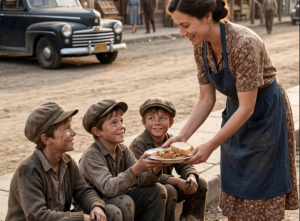
Three tiny children sat on the ground holding plates of food in their laps. Behind them stood Shiomara herself, younger then, exhausted from work but smiling anyway.
A real smile.
The kind people wear when kindness still feels natural.
Tears filled her eyes instantly.
She touched the photograph carefully, almost afraid it would disappear.
Then she noticed another document underneath it.
Official papers.
Her name printed clearly across the top.
Her breathing became uneven.
“What… is this?” she whispered.
The man in the blue suit looked directly at her, his own eyes filled with gratitude deeper than words.
“It belongs to you,” he said.
Shiomara looked down again, struggling to understand the legal language through her tears.
Then realization slowly spread across her face.
The papers transferred ownership of a fully paid home.
Not a temporary apartment.
Not a rental.
A real house.
In her name.
Along with enough financial support to ensure she would never have to work on the streets again.
Her knees nearly gave out.
The woman reached forward quickly, gently holding her arm.
“You gave us hope when we had none,” she whispered.
The third man swallowed hard before speaking again.
“You fed us when we were starving,” he said, his voice shaking. “And now…”
He paused, unable to continue for a moment.
Then he finally finished the sentence that shattered every heart on that street.
“Now you will never be hungry again.”
Shiomara broke down crying.
Not graceful tears.
Not quiet tears.
Years of exhaustion, loneliness, sacrifice, and survival poured out of her all at once.
The three siblings embraced her carefully beside the food cart where she had spent so much of her life serving strangers.
Around them, people wiped away tears of their own.
Because in a world that often rewards cruelty and forgets kindness, something extraordinary had finally happened.
A small act of compassion had come back home.
And for the first time in many years, Shiomara no longer looked like a woman merely surviving.
She looked like someone finally seen.