For one long, breathless second, the entire sidewalk seemed to vanish around him.
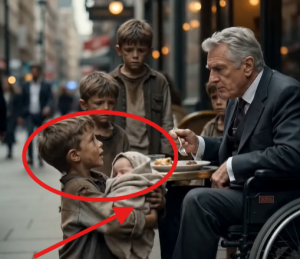
The traffic still rolled past the busy downtown café. Coffee cups still clinked against saucers. Conversations still floated through the warm afternoon air while strangers stared from behind glass windows. But to the old man sitting in the wheelchair, none of it existed anymore.
There was only the baby.
And the tiny silver half-moon charm resting gently against her throat.
His eyes locked onto it instantly, and the color drained from his face. The world around him blurred into silence as his heart stumbled somewhere between one beat and the next.
Because that charm was impossible.
It had never been sold in any store. No jeweler had ever displayed one like it in a case. Decades earlier, he had commissioned the piece himself from a private craftsman the week his daughter was born. Two matching silver half-moons had been made — one for him and one for her. He still remembered the pride he felt when he first held the tiny necklace in his hands.
His daughter wore hers every single day of her short life.
Then fever took her before her first birthday.
At least, that was the story he had been forced to live with for years.
He had been told the charm was buried with her in the small white coffin. He never questioned it. Never demanded proof. Grief mixed with pride had closed every door inside him long ago.
And now that same silver moon was hanging around the neck of a baby held by a starving boy on a crowded city sidewalk.
His breathing turned uneven.
“Where did you get that?” he asked quietly, his voice cracked with disbelief.
The boy kneeling beside the wheelchair looked exhausted, thin, and dirty from too many nights outside. His clothes were worn, and his hands trembled slightly as he adjusted the baby in his arms. But his eyes stayed steady.
“Our mom tied it on her,” he answered softly.
Then came the pause that changed everything.
“Before she died.”
The old man felt those words hit harder than the strange movement he had felt moments earlier in his leg.
Because now this wasn’t some unexplained miracle.
This was blood.
Family.
His eyes returned to the baby, and this time he truly looked at her. Not just at the necklace. Not just at the mystery. He studied the tiny shape of her mouth, the soft curve of her forehead, the stubborn calmness in her expression.
And suddenly he saw it.
The resemblance.
It was faint, unfinished, still growing into itself, but it was there all the same. The same features his daughter had carried as an infant. The same quiet strength. The same eyes.
His chest tightened painfully.
Slowly, almost fearfully, his trembling hand moved toward his own shirt collar. Hidden beneath the fabric, untouched for years, was the second half of the moon necklace. He had worn it every day since losing his daughter, though he rarely admitted why.
The boy swallowed hard before speaking again.
“She said if the baby made your foot move,” he whispered, “then you were the man she wrote about.”
The old man froze completely.
His breath caught in his throat.
“What did she write?” he asked.
The boy reached carefully into his torn jacket pocket and removed a folded piece of paper. The edges were soft and worn, as though it had been opened and reread countless times. He placed it gently on the café table beside the untouched plate of expensive food.
The old man stared at it before finally unfolding the paper with shaking fingers.
The handwriting hit him first.
It was unmistakable.
His daughter’s handwriting.
Older now. Less polished. A little uneven in places. But alive.
Alive far longer than he had ever been allowed to believe.
Years ago, she had run away with a man he deeply disapproved of. In his anger, he cut her out of his life completely. He had convinced himself it was necessary. That discipline mattered more than emotion. That control mattered more than forgiveness.
Months later, someone informed him she and her child had died in a roadside fire.
He never saw a body.
Never attended a funeral.
Never searched for answers.
Pride had buried the questions before grief ever could.
Now, sitting in front of a crowded café while the city moved around him, he finally learned the truth.
His daughter had survived.
The man she loved had abandoned her shortly after the baby was born. Left alone and struggling, she had tried to survive while raising her children in poverty. She stayed away because she believed her father would never forgive her. She thought his pride mattered more to him than family.
The words on the page felt heavier with every line.
She wrote about hunger.
About sickness.
About trying to protect her children while her health slowly failed.
And in the final paragraph, the handwriting became shakier.
If she touches you and your body remembers us, don’t let my children go hungry the way your anger left me hungry.
The old man closed his eyes.
Something inside him finally broke.
Not dramatically.
Not loudly.
There were no screams, no public collapse, no desperate scene meant for attention.
But it broke enough.
Enough for the silence around the table to change.
Enough for the children standing nearby to sense that something important had shifted forever.
Enough for the entire hard, indifferent city to suddenly feel softer for one brief moment.
The old man looked down at the expensive meal sitting untouched in front of him. A meal that cost more than these children probably spent in a week. Then he looked back at the boy and the baby trying so hard not to hope for too much.
And that realization hurt most of all.
They hadn’t searched for him because they wanted money.
They hadn’t come expecting miracles.
They had come because they were hungry.
Alone.
And carrying the final proof that they belonged to someone who should have protected them long ago.
The old man slowly pushed the plate toward the boy first.
The child hesitated, almost as if he feared the offer might disappear if he moved too quickly.
Then the old man reached out carefully with both hands toward the baby.
For years he had believed the greatest tragedy of his life was losing movement in his legs. He had spent endless days focused on doctors, treatments, pain, and bitterness. He thought the small twitch he felt earlier when the baby touched him was the miracle he needed.
But now he understood the truth.
The movement in his leg was never the real miracle.
The real miracle was that love had somehow found its way back to him before pride buried him completely too.