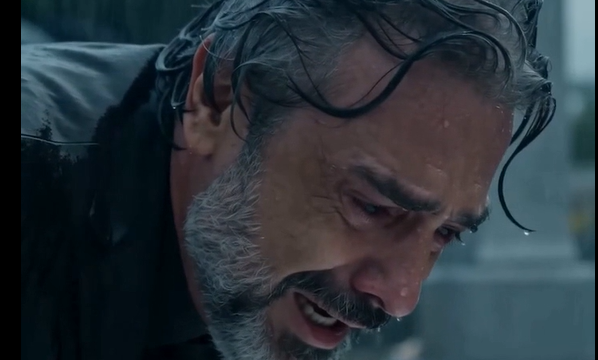
The biker charged down the narrow hallway with heavy boots pounding against the worn wooden floor, his broad frame filling the space like a storm moving through the house. Behind him, another rider held up a phone flashlight while the faint sound of a crying child drifted in from the front yard. The tension inside the small home felt suffocating, thick with fear that had clearly lived there for far too long.
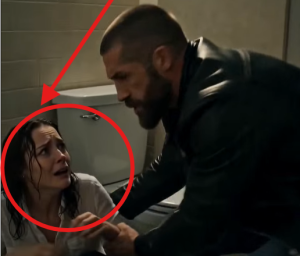
Then he saw her.
The bathroom door stood half open, hanging crooked on its hinges. Inside, a young mother sat curled on the freezing tile floor beside the bathtub. Her wet hair clung to her face, and her shoulders trembled as though she had no strength left in her body. There were no screams anymore. No fight left in her eyes. Just exhaustion. The kind that comes from surviving the same nightmare over and over again.
For a moment, the biker froze.
People in town knew him as a rough man. Tattoos covered his arms. His leather vest carried the patch of a motorcycle club that most strangers avoided. He looked like the kind of man people crossed the street to avoid at night.
But the second he looked at that woman, every hard edge disappeared.
He dropped to one knee beside her carefully, lowering his voice until it barely sounded above a whisper.
“Easy,” he said gently. “I got you.”
The woman looked up slowly, almost as if she didn’t believe anyone had truly come to help her. Her eyes were swollen from crying, and her hands shook violently when she tried to push herself upright.
The biker reached for her with surprising patience. He didn’t grab or pull. He simply offered support, steady and calm, waiting until she was ready to stand on her own feet. When she finally rose, weak and unsteady, he positioned himself between her and the hallway as if shielding her from the entire world.
Outside, the late evening sun cast long golden shadows across the quiet neighborhood. Several motorcycles lined the curb, their chrome reflecting the fading light. A small crowd of neighbors had gathered at a distance, watching nervously from porches and windows.
Near the front steps stood a little boy no older than seven.
Tears streaked down his cheeks as he stared at the doorway, clutching a stuffed dinosaur tightly against his chest. The poor child looked terrified, like someone who had seen too much for someone his age.
Then the front door opened.
The second he saw his mother step outside safely, the boy let out a broken cry and sprinted across the yard. He threw himself into her arms so hard they nearly both lost balance. The woman collapsed to her knees and held him tightly, burying her face in his shoulder while sobs shook her entire body.
Everyone watching felt the emotion of that moment.
It wasn’t dramatic in the way movies are dramatic. It was real. Raw. A child finally knowing his mother was safe for the first time in a long time.
But the nightmare wasn’t over yet.
A loud crash echoed from inside the house.
The abusive man stumbled onto the porch, his face burning red with rage. His movements were sloppy, fueled by anger and humiliation. He pointed toward the woman and child, opening his mouth to scream.
“You think you can just—”
Then he stopped.
His words died instantly.
Because for the first time, he looked past the lead biker.
Ten more riders stood behind him in complete silence.
They formed a solid wall of black leather, denim, steel chains, and chrome motorcycles. Not one of them moved. Not one said a word. Their expressions remained cold and unreadable as they stared directly at the man standing on the porch.
The street suddenly felt different.
The fear had changed direction.
The abusive man looked around nervously, realizing nobody was coming to stand beside him. Not the neighbors. Not his drinking buddies. Not even the people who used to pretend they didn’t hear the shouting from inside the house.
He was alone now.
One by one, motorcycle engines began to rumble to life.
The sound rolled through the neighborhood like distant thunder. Deep. Heavy. Powerful.
The lead biker slowly turned his head toward the porch. His eyes locked onto the man with absolute calm, which somehow felt more frightening than yelling ever could.
“Try it again,” he said quietly.
That was all.
No threats. No screaming. No violence.
Just four words spoken with complete certainty.
The abusive man’s face drained of color almost immediately. He stepped backward without realizing he was doing it. His confidence disappeared so fast it was almost painful to watch.
Within seconds, he retreated into the darkness of the house and slammed the door behind him.
Nobody followed him.
Nobody needed to.
The message had already been delivered.
The street no longer belonged to fear.
It belonged to the mother and her son.
The little boy continued clinging to his mother while she cried softly into his hair. One of the bikers quietly brought over a blanket from his motorcycle saddlebag and wrapped it around her shoulders. Another rider crouched beside the child and handed him a small juice bottle from a cooler.
The contrast was almost unbelievable.
These men looked intimidating enough to scare an entire town, yet every movement they made around the woman and her son carried gentleness and respect.
An older neighbor standing nearby wiped tears from her eyes.
“For years,” she whispered softly, “we heard the yelling.”
Nobody answered her because everyone already understood what she meant.
Sometimes people stay silent because they’re afraid.
Sometimes they convince themselves it’s none of their business.
And sometimes it takes strangers—people society judges by appearance alone—to become the ones willing to stand between danger and the innocent.
As the sky darkened into shades of orange and blue, the bikers remained there quietly, making sure the woman felt safe before anyone left. One rider helped load a few bags into a pickup truck while another spoke with local authorities who had finally arrived.
The lead biker stood near the curb with his arms crossed, watching carefully as the mother buckled her son into the passenger seat of a neighbor’s car.
Before getting in herself, she turned toward him.
Her lips trembled like she wanted to say a hundred things at once.
“Thank you,” she whispered.
The biker gave a small nod but said nothing.
He didn’t need praise.
For him and the others, this wasn’t about looking heroic. It was about making sure one terrified mother understood something she had probably forgotten long ago:
She was not alone anymore.
As the motorcycles finally pulled away from the curb, their engines echoing into the night, the neighborhood remained silent behind them.
But it was no longer the silence of fear.
It was the silence that comes after someone finally stands up to darkness—and wins.