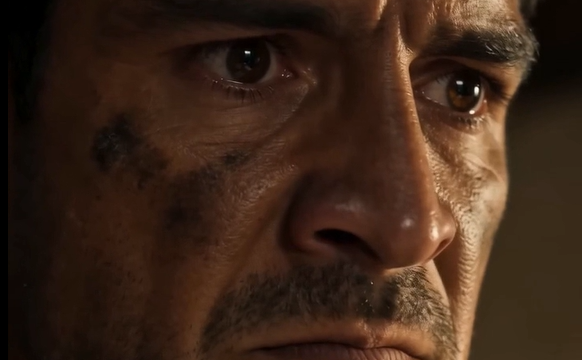
Everyone in the ballroom saw a boy in a wheelchair. Only one little girl saw the courage he still carried inside.
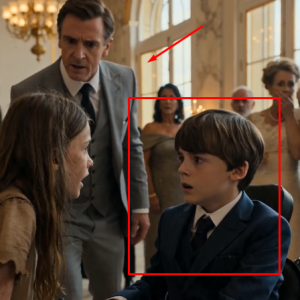
The ballroom glowed as if warm gold had been poured over every wall, column, and polished inch of marble. A string quartet played near the staircase. Wealthy guests laughed in bright circles. Women in silk gowns turned beneath chandeliers.
Everything looked perfect from a distance.
At the far edge of the ballroom, beside white lilies, sat a young boy in a wheelchair.
His name was Ethan Whitmore. He was eleven, dressed in a dark blue suit chosen by his father’s staff. The suit fit, but it did not make him comfortable. His hands rested in his lap. His eyes carried a sadness too heavy for any child.
Ethan watched everyone dance.
Couples glided across the floor while children laughed near their parents. No one asked Ethan to join. No one asked whether he was enjoying the party.
Some guests glanced at him, then looked away. A few wore practiced pity, then returned to their conversations.
Ethan knew all of it. He had learned that silence could hurt more than cruel words. In rooms full of important people, a child who could not stand was sometimes treated like furniture.
Across the ballroom, his father, Richard Whitmore, stood beside donors. He loved his son, but grief had made him cautious. Since the accident three years earlier, doctors had said Ethan might never walk again. Richard heard might and treated it like never. He hired specialists and built ramps, but he also built a quiet wall around Ethan, made of protection and fear.
Ethan looked down at his polished shoes. They had not touched a dance floor in years.
Then the ballroom doors opened.
Almost no one noticed at first. But the girl who stepped inside looked nothing like the others. She wore a simple white dress below her knees. No diamonds. No makeup. Rain had left dark strands against her cheeks. She carried no invitation, no purse, no sign that she belonged among people who measured worth by price.
A guard frowned, but the girl was already walking forward.
She moved through the crowd with quiet purpose. Heads turned. Whispers followed her.
“Who is she?”
“Whose child is that?”
“What is she doing here?”
The girl did not answer. She stopped directly in front of Ethan.
He looked up nervously.
For a moment, neither child spoke. Ethan expected her to ask what had happened. Children often did. He prepared for the familiar question, the careful answer, and the awkward silence that usually followed.
Instead, the girl smiled and stretched out her hand.
“Dance with me,” she said.
A few laughed softly, not because it was funny, but because cruelty sometimes hides behind surprise. Ethan’s cheeks flushed. He lowered his eyes.
“I can’t,” he whispered.
The girl leaned closer. Her voice stayed calm, certain, almost gentle.
“You can do anything.”
Something in the way she said it made the laughter fade. She sounded certain.
Ethan swallowed. “You don’t understand.”
“I understand more than you think,” she said.
The room slowly grew quiet. Guests turned toward them. Phones rose, The musicians faltered, then stopped. The last note disappeared under the chandeliers.
The girl placed her hand gently on the wheelchair armrest.
“You will walk,” she said.
Ethan’s breath caught. His fingers trembled against the metal. He looked toward his father, hoping Richard might rescue him from the attention and the possibility of failing before everyone.
Richard had gone pale.
He stepped away from the donors. “Ethan,” he called, his voice tight. “Don’t.”
The girl did not turn around. She only stepped back and held out both hands.
“Stand up,” she said.
A woman near the champagne table covered her mouth. Someone muttered that this was cruel. But Ethan barely heard them. He was staring at the girl’s hands, small and steady, waiting as if the world had not already decided what he could not do.
His heart pounded.
He remembered hospital lights and adults whispering above him. He remembered the first time a doctor asked him to move his legs and the silence that followed. He remembered his father crying when he thought Ethan was asleep. He remembered learning to smile so other people would stop looking broken for him.
But he also remembered one therapy room. An older doctor had said, “The body listens, son, but sometimes hope has to speak first.”
Ethan had not thought of those words in a long time.
Slowly, he gripped the sides of the chair.
Gasps moved through the ballroom.
His arms shook as he pushed. His legs trembled. Pain crossed his face, but it did not stop him. The girl stayed where she was, hands open, eyes steady.
“That’s it,” she whispered. “I’ve got you.”
Ethan rose an inch. Then another.
The ballroom held its breath. Tears filled his eyes as Ethan fought for balance, fought years of fear, fought a room that had already placed him in a corner.
For the first time in years, Ethan stood. Not fully. Not firmly. But enough.
His knees shook. His hand reached out and found the girl’s hand. The moment their fingers touched, a sob escaped from somewhere in the crowd. Phones lowered. Pity vanished, replaced by awe and shame.
Ethan took one tiny step.
The ballroom erupted in whispers and stunned disbelief.
At that exact moment, the doors behind them slammed open.
A man in a soaked black coat stood at the entrance, He was older, with silver hair and a leather medical bag in one hand. Richard turned and froze.
“Dr. Bell?” he breathed.
The man’s eyes moved from Richard to Ethan, still standing with the girl’s help.
“I came because she asked me to,” Dr. Bell said, nodding toward the girl. “Your son was never hopeless, Mr. Whitmore. He was afraid. And so were you.”
Richard looked at the girl. “Who are you?”
She held Ethan’s hand tighter.
“My name is Lily,” she said softly. “My brother learned to walk again after everyone gave up on him. I thought Ethan deserved someone who believed before the room did.”
No one laughed now.
Richard knelt before his son. “I’m sorry,” he whispered. “I thought protecting you meant keeping you from pain.”
Ethan’s lips trembled. “I wanted to try, Dad.”
Richard nodded, tears falling freely. “Then we try. Every day. Together.”
The quartet began playing again. Richard stood carefully, supporting his son with both arms. Ethan took another small step, then another, not into an easy miracle, but into something stronger.
A beginning.
It was small, fragile, and unfinished, yet everyone in that glittering room understood its meaning. Courage had not arrived loudly. It had come through a quiet girl in a plain white dress, a trembling boy, and a father brave enough to finally admit that love, when ruled by silent fear, can become another invisible cage.
The guests stepped back and opened a path.
For the first time that night, Ethan was not hidden at the edge of the room. He was at the center of it, surrounded not by pity, but by respect. And when his father helped him sway gently to the music, the boy who had been ignored finally smiled like someone invited back into his own life.