There is a stretch of mountain road where the pavement curves away into the mist, and on a cold, gray day it carries almost no traffic at all. Beside that road, on a steep slope of loose gravel and broken rock, lies a dog who has run out of everything she had to give.
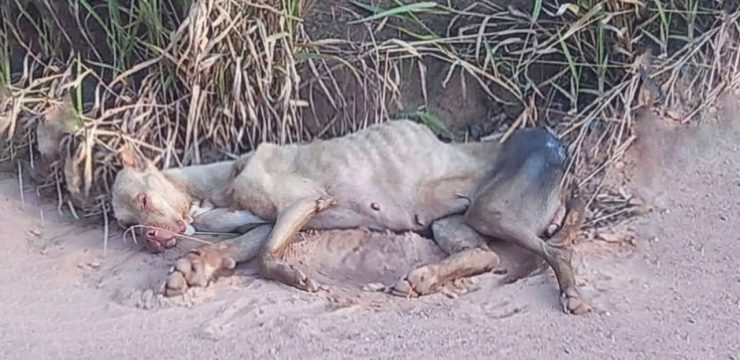
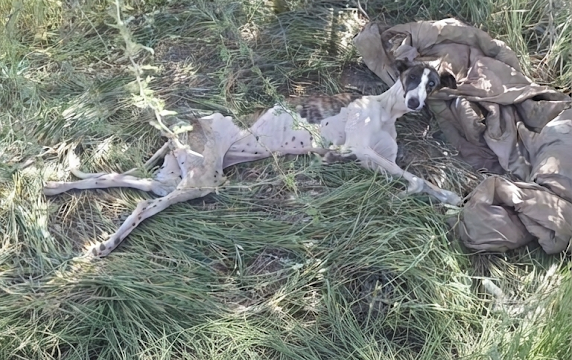
She is a golden-tan dog, thin and badly hurt, her fur dull and dusty from the roadside. She lies collapsed on her side, her long, slender legs stretched out limply and her paws drooping toward the stones. Her thin tail rests slack behind her. Her heavy head is pressed low against the gravel, as though even holding it up has become more than her body can manage.
It is a posture of total exhaustion. Anyone who has ever loved an animal knows this kind of stillness. It is not the peaceful rest of a dog dozing in a sunny window. It is the stillness of a body that has been pushed far past its limits. She looks as though she dragged herself off the road in pain and has been lying here for hours, with no water, no help, and no one willing to stop.
And she is shivering. Not a little, but violently and uncontrollably, her whole frail body quaking from her trembling ribs all the way down to her shaking legs and paws. The cold, the pain, and the shock seem to have taken hold of her all at once. Her breathing is ragged and wet, and with every labored breath her thin ribcage heaves. You can see just how thin she has become.
A soft, steady whimpering comes from her without pause. Every few moments, a thin, broken cry escapes her and fades into weak, trembling sobs. It is the kind of sound that finds its way straight into your chest and stays there long after you have stopped listening.
Then, slowly and with great effort, she lifts her heavy head from the gravel and turns toward the camera. Her dark eyes are glistening and glazed, filled with tears. She blinks slowly, and a single tear rolls down her thin muzzle. Her gaze reaches straight into the lens, as if she is silently asking someone, anyone, to stop and save her.
It costs her dearly. Her head sinks back down, trembling, and then rises again toward the camera, her front paw shifting weakly on the loose stones with the effort. Every small movement seems to take everything she has left.
Around her, the world could not look colder or lonelier. A steep bank of crumbling dirt rises behind her, scattered with rocks and dry, broken roots. A gray asphalt road curves away into the distance, marked by a few bright orange traffic cones. Beyond it, dense green forest and misty slopes climb beneath a pale, overcast sky. The road stretches out nearly empty, and no one is coming.
The light is soft and dim, flat and muted, the kind of natural daylight that makes everything feel a little colder than it already is. Gentle shadows gather beneath her thin body. There is no music, no voice, and no comfort in the scene, only the sounds of the mountain itself.
Those sounds say a great deal. There is the shaky, wet rhythm of her breathing. There is the soft scrape of her claws against the loose gravel, and the faint trickle of small stones sliding down the bank. A low, cold wind moves through the trees. And somewhere far off, a passing car hushes by and fades away into the distance, carrying on down the road.
That last sound is the one that lingers. So many of us have driven along a quiet road and glimpsed something at the edge of our vision, only to wonder later whether we should have slowed down. Life moves quickly. We are tired, we are late, we assume someone else will stop. Most of us are not unkind people. We are simply busy people, and sometimes the moments that matter most arrive when we are least prepared for them.
But a dog like this one reminds us what a single moment of attention can mean. She does not need anything complicated. She needs a little water, a warm blanket, a gentle hand, and a veterinarian who can look at her injuries and tell her family what comes next. She needs someone to see her, really see her, and decide that she is worth stopping for.
Think about what she has endured. The cold. The pain. The long stretch of time on those hard, sharp stones. The sight of the road curving away, empty again and again. Yet even now, in the middle of all that weakness, she finds the strength to lift her head and look toward the one thing that might help her, the lens that is watching.
There is something deeply humbling about that. Animals do not hold on to grudges, and they do not keep score of who passed by and who did not. They simply keep trying for as long as their bodies will let them. That quiet persistence is one of the things so many of us have come to admire in dogs, especially those who have been through the hardest days.
If you have ever knelt beside a hurting animal, you know that feeling. Your heart races, your hands shake, and you only want to do the right thing. You find a towel or a coat, you speak softly, and you make the phone calls. Those small acts of kindness have saved countless lives, and they often begin with a single person who simply refuses to look away.
This golden-tan dog is lying on a cold roadside in the mist, thin, injured, and trembling, waiting for that person to arrive. Her story is a reminder that compassion is not a grand gesture. It is the choice to stop, to kneel down, and to say, “You are not alone.”
So the next time you notice something stirring at the edge of a lonely road, consider slowing down. Roll down the window. Take a closer look. You may be the only one who ever does, and your kindness may be the difference between a long, cold night and a second chance at life.