Nobody tells you how quiet a street can feel when you are the only one on it who is hurting.
On a cold, gray morning, on a worn brick sidewalk beside a faded white road line, a tiny white dog sat hunched and swaying. She looked like a poodle, or something very close to it. Her curly coat, which should have been soft and fluffy, hung thin, dirty, and matted. Her eyes were swollen and sore, half-closed against the dim daylight. She was so small that the front wheel of a parked motorbike seemed to tower over her.
There was no one around. No footsteps, no voices, only the faint hush of a distant scooter passing by and fading away.
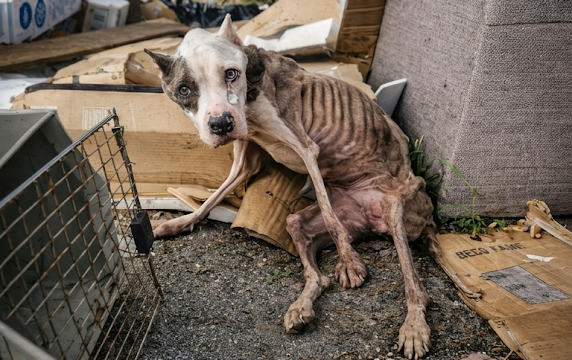
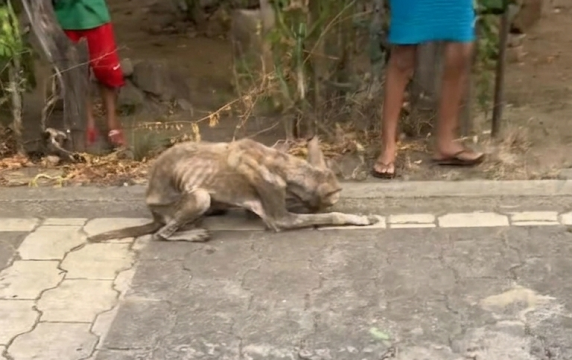
Look closely at the way she was sitting, because her body tells the whole story. Her thin front legs were braced stiffly against the rough bricks, as if they were the only thing holding her up. Her hind legs were folded and trembling beneath her. Her tail drooped low, and her head hung down and turned to one side, as though it had become too heavy to carry. It was the posture of an animal who had used up everything she had.
It is hard to say how long she had been out there. But everything about her suggested days, not hours. Days of wandering empty streets. Days without a bowl of food or a sip of clean water. Days of passing by closed doors and busy people who never slowed down.
She was shivering, and not in a gentle way. Her whole tiny body quaked, from her trembling shoulders all the way down to her shaking paws. The cold, the hunger, and the exhaustion had settled into her bones. Her breathing came ragged and wet, and her narrow ribcage heaved with every shallow, labored breath. You could count the effort in each one.
And then there was the sound.
A soft, continuous whimper came from her, steady as a heartbeat. Every few moments, a thin, broken cry escaped her and faded into weak, trembling sobs. If you have ever heard a frightened child cry themselves out, you know the kind of sound we mean. It is the sound of someone who has been calling for help for a very long time and has nearly run out of voice.
Slowly, with great effort, she lifted her heavy head.
She turned toward us, and her dark eyes, glistening and glazed, looked straight into the lens. They were full of tears. A single tear rolled down her small muzzle. She blinked slowly, the way someone does when they are tired of hoping, and yet she kept looking, as if she were silently asking whether anyone, anyone at all, would stop and take her in.
Then her head sank lower, trembling, and lifted once more. Her legs buckled slightly on the rough bricks with the effort of it. Even the smallest movement cost her something.
Around her, the street went on being a street. Gray and rust-colored bricks. A chipped white road marking. Dark, rough asphalt. A stone wall and green hedges blurring away at the far end of the sidewalk. Everything was muted, flat, and cold under the overcast sky. It was the kind of place where a small dog could disappear without anyone noticing.
If you are a certain age, you may have known a dog like her. Maybe you had one who waited by the door every evening. Maybe one curled up at your feet through the hardest year of your life and never asked for anything except to be near you. Dogs like that have a way of reaching into our hearts and staying there. They give love without keeping score.
That is what makes a scene like this so difficult to watch. This little one had done nothing wrong. She did not choose the cold, the hunger, or the long, lonely walk down that sidewalk. She was simply left to face it, small and unprotected, with nothing but her own shaky breath to keep her company.
And still, she looked up.
There is a lesson in that, and it is one many of us have learned the hard way. Hope does not always look brave. Sometimes it looks like a trembling head lifting one more time. Sometimes it looks like a tired little body refusing to lie down completely, even when every part of it wants to.
We often think of rescue as something dramatic, with sirens and rushing and big gestures. But more often it begins with something very simple. Someone slows down. Someone notices. Someone kneels on the cold pavement, speaks softly, and says, “It’s okay, sweet girl. I’ve got you.”
That small act of noticing can change an entire life. It can turn a frightened, shivering stray into a warm, fed, safe companion who learns what it feels like to sleep without fear. It can bring back the shine to dull eyes and the softness to matted fur. It can teach a heart that has forgotten how that the world still holds kind people.
The next time you see a dog on the roadside, thin and alone, remember this little white poodle on a quiet brick sidewalk. Remember how much courage it took just to lift her head. And remember that you do not have to do everything. Sometimes you only have to do the first thing, which is to stop, look, and care.
Because for a creature who has been walking alone for days, the moment someone finally stops is the moment everything can begin to change.
She is small. She is tired. She is shaking in the cold. But she is still here, still breathing, still looking toward anyone who might see her. And that, more than anything, is why her story deserves to be told.