Inside Maison d’Or, every surface seemed designed to reflect wealth. Glass cases held diamond rings, gold cabinets lined the walls, and the marble floor gleamed beneath elegant lighting. Everything suggested wealth and perfection. That was why the little girl who stepped through the glass doors looked so painfully out of place.
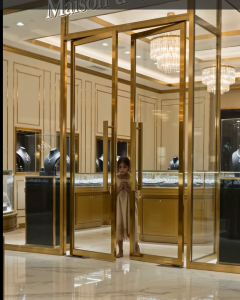
She was barefoot.
Her oversized beige tunic was torn and worn thin, and dirt covered her arms, knees, and tear-streaked face. She looked exhausted and frightened, yet moved forward, holding a small gold locket tightly in both hands as though it were the only valuable thing she had left in the world.
The soft music inside the boutique could not hide the sound of her crying.
Behind one of the counters stood the owner, a well-groomed middle-aged man with dark hair and a prominent mustache. His dark three-piece suit was perfectly tailored. A white shirt, deep red tie, and gold pocket-watch chain completed his immaculate appearance.
The girl stopped before him and slowly opened her trembling hands.
“Buy this locket from me,” she pleaded. “It’s my mother’s, but I need the money.”
Her voice shook so badly that the words almost disappeared beneath her sobs.
The owner looked down at the dirty child, then at the locket. His expression remained cold. Whatever he assumed about her or the jewelry, there was no warmth in his response.
“Get out of the store,” he said sharply. “Your locket is worthless.”
The rejection devastated her.
She pulled the locket against her chest as if protecting it from another insult. Tears ran through the dirt on her cheeks, leaving wet lines behind. Her breathing became uneven, and desperation overcame whatever fear had kept her voice quiet.
“My mother is dying in the hospital!” she cried.
The words changed the atmosphere.
For a moment, the boutique felt silent. The diamonds still sparkled, but the girl’s grief suddenly felt more powerful than anything expensive around her.
The owner looked at her again.
Something in her desperation made him hesitate.
Instead of ordering her out a second time, he reached for the locket.
The girl reluctantly placed it in his hand.
Up close, the piece was old but unmistakably real. The gold had the softened surface of something carried and touched for many years. It looked deeply personal.
The owner’s fingers slowed.
He found the small clasp and opened it.
Inside was a vintage photograph of a beautiful young woman.
He could not move.
His face changed immediately. The coldness disappeared first. Then his eyes widened, and his mouth opened slightly as though he had forgotten how to speak. He stared at the photograph, then looked at the girl, then back at the image again.
A decades-old memory had suddenly appeared in his hands.
“Where did you get this locket?” he asked urgently.
The girl stared at him through tears.
His voice was no longer dismissive. It was trembling now.
“She is my daughter,” he said, pointing toward the photograph. “She has been missing for over twenty years.”
The girl froze.
Until that moment, she had entered Maison d’Or for only one reason. She needed money. Her mother was in the hospital, and the locket was apparently the last possession she believed she could sacrifice to help her. She had expected rejection or perhaps sympathy.
She had never expected this.
The owner stepped around the counter, still clutching the open locket.
His eyes searched the child’s face more carefully than before. Beneath the dirt and tears, he began noticing features he had missed when he first saw only a poor girl in ragged clothing.
The shape of her eyes.
The curve of her face.
Small traces of someone he remembered.
“Who is the woman in this picture to you?” he asked, although fear and hope were already battling in his expression.
The girl swallowed hard.
“She is my mother.”
The answer seemed to take the strength from his legs.
He quickly lowered himself until he was at her eye level. The polished marble, perfect suit, and watching customers no longer mattered. He gently held the girl’s arms, careful not to frighten her, and stared into her face with overwhelming disbelief.
“My granddaughter,” he whispered. “I can’t believe it.”
The girl continued crying, but now confusion mixed with her fear.
Only moments earlier, this man had told her to leave. Now his eyes were filling with tears.
For more than twenty years, he had lived without knowing what had happened to his daughter. The photograph inside the locket had reopened that loss instantly, but it had also brought something he could hardly have imagined: the child standing before him was family.
The discovery, however, did not erase the emergency that had brought her there.
Her mother was still in the hospital.
That truth hung over their reunion.
The owner looked again at the locket, and the meaning of the girl’s desperate attempt to sell it became painfully clear. His missing daughter had apparently kept this piece through years of separation, and now her own child had been willing to part with it because she believed money might help save her mother.
The man tightened his gentle hold on the girl’s arms.
His expression carried regret for how quickly he had judged her.
She had walked into one of the most luxurious rooms imaginable looking poor, dirty, and unwanted. He had seen her appearance before he saw her pain. He had measured the locket before understanding its history. In seconds, everything he thought he knew had been overturned.
Now the gold locket was no longer merchandise.
It was a bridge between generations.
The vintage photograph was no longer merely an old picture.
It was proof that a family separated for more than two decades had somehow found its way back together.
The grandfather drew the girl closer, holding her carefully as emotion overwhelmed them both. Around them, the pristine glass cases, diamonds, golden cabinets, and marble floors became little more than a glowing background to a reunion neither could have expected.
But the ending was not completely peaceful.
The girl’s tears still carried urgency.
Her mother needed help, and time mattered.
The grandfather now understood that finding his granddaughter was only the beginning. Somewhere beyond the boutique walls was the daughter he had spent more than twenty years believing he had lost, and she was fighting for her life in a hospital.
He held his granddaughter as though afraid she might disappear too.
For the first time since she entered Maison d’Or, the little girl was no longer standing alone.
And for the first time in more than twenty years, the store owner had a path back to his missing daughter.
In that instant, the lesson was impossible to miss: appearances had hidden both suffering and family. The child he nearly dismissed had carried the answer to a twenty-year mystery in her hands. Compassion arrived late, but recognition transformed everything, replacing judgment with responsibility and giving both of them a reason to move quickly toward hope together.
What began as a desperate attempt to sell one old locket had become something no diamond in his boutique could equal: a second chance to bring a broken family home.