The ballroom glowed with the kind of elegance that made every movement seem important. At the center of the room stood a black grand piano, its lacquered surface catching the light like a mirror. Then a young man in a black mandarin-collar jacket with a crisp white pocket square stepped toward it.
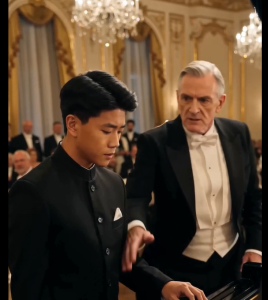
He did not make a show of his interest. He simply paused beside the keyboard, looking down at the polished keys with the attention of someone who knew them well. One hand lifted slightly, hovering above the piano. There was uncertainty in his posture, but also something deeper, almost instinctive, as though the instrument had called him across the room.
Before his fingers could touch a single key, an older man in a black tuxedo and white bow tie moved sharply into his path.
“Don’t touch the piano.”
The command cut through the ballroom faster than any music could have.
The older guest swatted the young man’s hand away in one brief, dismissive motion and stepped between him and the instrument. It was not a violent attack, but it was deliberate enough to make the insult unmistakable.
The young man lowered his hand.
For one painful second, his face appeared in the piano’s dark reflection. His eyes dropped toward the keys he had been forbidden to touch, and his shoulders tightened. He did not argue. He did not demand an explanation. Instead, he absorbed the embarrassment in silence while the older man stood beside the piano with the satisfied look of someone certain that he had protected something valuable from someone who did not belong.
That assumption was the real humiliation.
The young man turned away.
His steps were measured as he crossed the ballroom floor, but his posture had changed. His shoulders sat a little lower, and the confidence that had drawn him to the instrument seemed to fade. Behind him, quiet whispers traveled between the tables. The older guest remained near the piano, composed and superior, apparently convinced that the moment was over.
Then the room erupted in applause.
The sound came so suddenly that the young man stopped in the middle of a step.
At first, he looked confused. He glanced toward the seated guests as clapping spread across the ballroom. More people joined in until the applause filled the space beneath the chandeliers.
The older guest straightened, momentarily pleased.
Then he noticed where everyone was looking.
A tall man in a black tailcoat tuxedo and white bow tie was walking through the crowd with an unmistakably proud smile. He was the host of the evening, a man whose authority needed no announcement.
But he was not looking at the older guest.
He was looking directly at the young man.
The young man remained still, caught between confusion and cautious hope. The host reached him as the applause continued, then stood beside him with the calm confidence of someone who understood exactly what had happened.
The older guest’s expression changed.
Only moments earlier, he had carried himself as though the piano belonged to a world the young man had no right to enter. Now he watched the host place a gentle hand near the young man’s shoulder and guide him back toward the center of the room.
Then the host spoke.
“He’s my son.”
The applause grew louder.
The words were simple, but their meaning landed with enormous force.
The young man was not an intruder. He was not an uninvited stranger reaching for something beyond his place. He was the host’s son, welcomed, recognized, and clearly loved. The ballroom had not been watching a reckless young man cross a boundary. It had been watching a respected guest publicly misjudge someone because of appearance and assumption.
The older man’s confidence disappeared.
His mouth tightened. His eyes moved from the host to the young man and then toward the applauding crowd. There was nowhere for his earlier certainty to hide. The same people who had witnessed the humiliation were now witnessing the truth.
The host did not lecture him.
He did not need to.
Instead, he turned toward his son and gently guided him back to the grand piano.
That quiet gesture carried more dignity than a confrontation ever could.
The young man walked beside his father with a different posture now. His shoulders lifted. His expression steadied. Each step back toward the instrument seemed to return something that had been taken from him only seconds earlier.
The older guest stayed frozen near the piano.
For the first time that evening, he looked out of place.
As father and son approached, the black lacquer reflected the chandeliers, the moving crowd, and the young man’s calmer face. The room’s energy changed from shock to anticipation. Guests leaned forward. Smiles replaced uneasy whispers.
The son reached the bench and sat down.
He adjusted his posture with practiced calm.
That small movement revealed what arrogance had failed to notice.
He knew exactly where he belonged.
He placed both hands above the keys, not tentatively now, but with the relaxed focus of someone familiar with the instrument. His father remained standing behind him, proud and protective without needing to say another word.
The applause gradually softened.
One clap after another faded until the grand ballroom became almost completely silent.
Everyone waited.
The older guest watched from only a few feet away, his earlier superiority replaced by visible embarrassment. No one mocked him. No one shouted at him. The moment had already judged his behavior more clearly than anger could have.
The son looked down at the keyboard.
Seconds earlier, those same keys had been used as a reason to make him feel unwelcome. Now they were waiting beneath his hands.
The difference was not the piano.
The difference was that the truth had been revealed.
He had not suddenly become worthy because the host identified him as family. His worth had been there from the beginning. What changed was the room’s understanding of who had been unfairly judged and who had made the mistake.
That is what made the moment so powerful.
Public humiliation can make a person feel small, especially when it comes from someone acting with confidence and authority. But confidence is not the same as correctness. A polished tuxedo, a commanding voice, or a sense of entitlement does not give anyone the right to decide another person’s value.
The young man’s response made the reversal even stronger.
He did not retaliate.
He did not insult the man who had embarrassed him.
He simply returned to the piano when invited, sat with quiet dignity, and prepared to do what he had wanted to do all along.
Around him, guests smiled and applauded again.
His father stood behind him with unmistakable pride.
The older guest could only watch.
Then the young man lowered his hands toward the keys.
The first soft note seemed ready to rise through the ballroom as the scene reached its final moment. What began as an attempt to push him away had ended with the entire room waiting to hear him perform.
The piano had not changed.
The young man had not changed.
Only the truth had finally been given the chance to speak.