The dirt path stretched through the countryside, bordered by rolling green hills and a weathered wooden fence that had seen more seasons than anyone could count. Beyond it stood a modest farmhouse and an old barn, both faded by sun, rain, and years of hard rural life. Cows grazed slowly in the pasture while birds called from somewhere beyond the trees. Nothing about the peaceful scene suggested that one simple request would soon turn into a life-changing proposition.
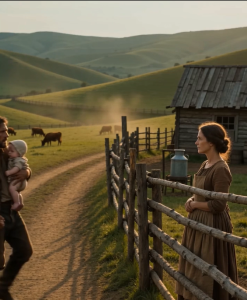
A tired father walked along the path with a baby cradled in one arm. With his other hand, he held to his young son. His clothes were worn from work, his brown vest dusty, and his boots carried the marks of many miles. He did not look like a man searching for charity without effort. He looked like someone who had worked as hard as he could and had reached a moment when pride had to give way to necessity.
The baby rested quietly against his chest beneath a light bonnet. Beside him, the boy walked without complaint, staying close to his father. The child seemed old enough to understand that life had become difficult, but too young to know how to fix any of it.
Behind the wooden fence stood a woman in a plain brown dress and apron. She watched the three travelers approach without waving or calling out. Her face was calm, serious, and practical. There was no mockery in her expression, only the guarded attention of someone accustomed to handling problems alone.
The man stopped on the dirt path, leaving the fence between them. He adjusted the baby gently against his chest and glanced down at his son before speaking.
“Podría darme un poco de leche?”
Could you give me some milk?
His voice was respectful, almost hesitant. He was not demanding anything. He was asking because his children needed help.
For a moment, the woman said nothing.
She looked first at the baby, then at the little boy holding his father’s hand. Finally, she studied the man himself. The countryside remained alive around them. Grass moved softly in the wind. A cow shifted in the pasture. Somewhere near the barn, a faint bell sounded.
The woman seemed to be measuring more than the request.
Then she answered.
“Puedo darle leche, pero tiene que ser mi marido.”
I can give you milk, but you have to be my husband.
The man stared at her.
His eyes widened, and for the first time, the exhaustion on his face gave way to complete surprise. He had come hoping for a little milk for his children. He had not expected the request to become a proposal.
“¿Por qué?” he asked.
Why?
The question was simple, but it carried everything he could not immediately say. Why would a stranger make such an offer? Why would marriage become the price of milk? Why would she connect his children’s need with her own future?
The woman did not laugh.
She did not flirt with him or treat his confusion as entertainment. Instead, she remained behind the fence with the same steady expression. Her response was not romantic in the ordinary sense. It came from a place of survival, loneliness, and practical reality.
She gestured gently toward the baby in his arms and then toward the boy beside him. After that, she motioned toward herself and the quiet farmhouse standing behind her.
The message became clear even before she spoke.
The father needed something she could provide.
She needed something he might be able to provide in return.
The boy tightened his grip on his father’s hand. He may not have understood every word, but he could feel that the conversation had changed. His father stood frozen on the road, caught between immediate need and a decision far larger than anything he had expected to face that day.
The woman finally explained.
“Usted necesita leche para sus hijos y yo necesito un marido.”
You need milk for your children, and I need a husband.
Her words settled over the quiet path.
There was no cruelty in them. There was also no attempt to pretend that this was a fairy-tale romance. She was looking at life as it stood before her. A man had arrived with two children who needed care. She lived alone on a rural property that demanded constant work. He needed food for his family. She needed a partner.
The fence between them suddenly seemed more important.
It was not only wood separating a farmhouse from a road. It represented the distance between two different hardships. On one side stood a woman who apparently had resources but lacked companionship and help. On the other stood a father who had his children and his responsibilities but lacked something as basic as milk.
The father looked down at the baby. She remained calm in his arms, unaware that her hunger had led to a conversation that might change the entire family’s future. Then he looked at his son, whose small hand remained wrapped around his own.
Finally, he looked back at the woman.
She waited.
She did not pressure him further. She had stated her condition plainly and explained the reasoning behind it. The decision now belonged to him.
The stillness of the countryside made the moment feel even heavier. The cows continued grazing. Wind moved through the tall grass. Dust shifted lightly across the road. The farmhouse remained where it had always been, silent behind the woman, while the father stood on the other side of the fence trying to understand an offer that was both startling and strangely logical.
That does not make the decision simple.
The man is responsible not only for himself but for two children. Accepting such an arrangement would affect all three of their lives. The woman, meanwhile, would be inviting a near stranger and his children into her home and future. Her practical words may sound firm, but her offer carries risk for her as well.
That is what gives the exchange its emotional weight.
Neither character is presented as foolish.
The father is not mocked for needing help, and the woman is not portrayed as desperate for making an unusual proposal. Instead, both are shown as adults confronting difficult circumstances with limited options.
He needs milk.
She needs a husband.
Between those two needs lies an enormous question about what people are willing to consider when life leaves them with few easy choices.
As the moment ends, the father remains on the path with the baby in his arms and his son at his side. The woman remains behind the fence, waiting calmly. No answer comes before the scene cuts away.
That unfinished decision is exactly what makes the story linger.
The surprising proposal is not really about milk alone, and it is not simply about marriage. It is about two people recognizing that each possesses something the other lacks. Whether that recognition could become a healthy family, a practical partnership, or a mistake is left unanswered.
What remains certain is that the father walked down a rural road hoping to feed his children and found himself facing a choice that could reshape their lives forever.