The bright modern home looked peaceful enough to belong in a magazine. Warm daylight poured through the large windows beside the dining area, spreading across a wooden table where several children were eating lunch. Beyond the glass, a green garden moved gently in the afternoon breeze. Inside, forks tapped against plates, cups shifted across the table, and the children talked over one another with the careless energy of an ordinary family meal. A few feet away, the spotless kitchen gleamed with white cabinets, polished counters, and stainless steel appliances. Everything about the room suggested comfort, routine, and security. No one at the table realized that within moments, one simple question would expose a painful division inside the family and turn lunch into a confrontation none of them would forget.
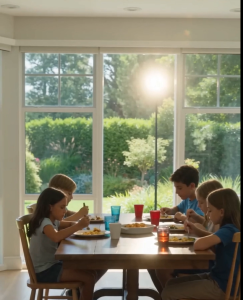
A young boy with short brown hair sat apart from the others for a moment, watching them eat. He wore a blue and white striped shirt, and his attention kept drifting toward the plates in front of the other children. He was hungry, but he did not complain. Instead, he rose quietly from his chair and walked toward the kitchen, where Mrs. Lorena was working at the counter in a light blue polo shirt and white apron.
He stopped a respectful distance away.
“Mrs. Lorena, is there food for me too?” he asked.
His voice was polite and soft. There was no demand in it, only the hopeful question of a child who had watched everyone else receive lunch and wanted to know whether a plate had been prepared for him.
Mrs. Lorena turned sharply.
The movement was so abrupt that the atmosphere changed before she even spoke. Her face hardened, and whatever patience she had shown moments earlier disappeared. Behind her, the white cabinets reflected the bright kitchen light, making her angry expression seem even more severe.
“Don’t call me just to ask for food,” she snapped. “I cook for my children, not for strangers.”
The dining room chatter began to fade.
Several children at the table looked up from their plates. A fork stopped halfway to a mouth. A cup was lowered carefully onto the wood. Nobody seemed sure whether to keep eating or pretend they had not heard what Mrs. Lorena had said.
The boy remained still.
His eyes dropped toward the floor. The hunger that had brought him into the kitchen was suddenly overshadowed by embarrassment. He had asked for lunch, but her answer made it clear that the problem was not whether there was enough food. She wanted him to understand that she did not consider him part of the family she was willing to care for.
Mrs. Lorena was not finished.
“If you’re hungry, wait until your father gets home,” she said. “You are not my responsibility.”
The words landed harder than the first rejection.
The boy’s face tightened as he tried not to react. He did not argue. He did not raise his voice. He simply stood there, visibly hurt, while the children behind him grew increasingly silent.
For them, the meal had become uncomfortable. They still had food on their plates, but the ordinary sounds of lunch were disappearing. Chairs shifted faintly. Someone put down a fork. Another child stared at Mrs. Lorena, then at the boy, as if trying to understand why he had been singled out so harshly.
Then a heavier step came from the dining area.
A middle-aged man with dark hair and a beard moved forward. He wore a black suit jacket over a white dress shirt, and his expression was controlled but unmistakably serious. He had heard enough.
Mrs. Lorena turned toward him.
The children froze.
The man did not shout. He did not rush toward her or make a dramatic gesture. His calmness made the silence feel even heavier. He looked first at the boy, then at the children seated around the table, and finally at Mrs. Lorena.
Her earlier confidence began to falter.
There was something in his face that suggested this conversation was no longer about a plate of food.
He stepped closer and spoke with deliberate authority.
“Then your children shouldn’t be eating either,” he said, “because I just found out that none of them are mine.”
For a second, the room seemed to stop.
Mrs. Lorena’s anger vanished.
Her eyes widened, her mouth opened, and she stared at him as if she had not understood the sentence. Behind her, the polished kitchen remained bright and orderly, but the family standing inside it no longer felt stable at all.
She gasped.
The children looked from one adult to the other. Their plates remained untouched. No one seemed to know what to say.
The boy stayed quiet.
He had not caused the confrontation. He had not asked for anyone’s secrets to be revealed. He had only asked whether there was food for him.
That small detail made the scene especially painful.
Children often remember far more than adults realize. They remember who welcomed them to the table, who made them feel like a burden, and who treated kindness as something they had to earn. A meal can look insignificant to an adult, but to a hungry child, being offered a plate can communicate safety, acceptance, and dignity. Being rejected in front of others can communicate the opposite.
Mrs. Lorena had chosen to make the distinction public. The other children heard her call the boy a stranger. They watched his eyes fall after she told him he was not her responsibility. And they were still watching when the father answered her with a truth that left her speechless.
Nothing about the room physically changed. The garden was still green outside the windows. Sunlight still touched the table. The stainless steel appliances still reflected the figures standing in the kitchen. Yet the home no longer felt ordinary.
The final shock was not simply about biology. It was about the danger of using family status as an excuse to deny basic compassion.
The father’s revelation turned Mrs. Lorena’s own logic back toward her, forcing her to confront how quickly the categories she trusted could collapse. The children at the table had done nothing wrong, just as the hungry boy had done nothing wrong. They were all children caught in decisions made by adults.
That was the uncomfortable truth hanging over the silent lunch.
The boy deserved kindness before the revelation, not because of who his father was, but because he was a child asking for food in a home where others were eating. The other children deserved kindness after the revelation for exactly the same reason.
As Mrs. Lorena stood frozen in disbelief, the room offered a lesson much larger than the family secret that had just surfaced. Compassion should not depend on bloodlines, labels, or