The bakery glowed warmly against the street, its windows filled with rows of golden croissants, fresh loaves, and delicate pastries arranged behind polished glass. Wooden shelves lined the walls, carrying bread that had just come from the ovens. The air smelled of butter, flour, and warmth, the kind of comforting scent that could make anyone hungry. But for one little girl standing outside the door, hunger was not a passing feeling. It had become a painful part of her day.
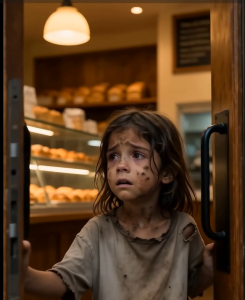
She was small, thin, and visibly exhausted. Her clothes were worn and torn, her hair was unkempt, and dirt marked her cheeks. She stared through the bakery window for several seconds before gathering enough courage to step inside.
A faint bell chimed above the door.
The girl froze for a moment, suddenly aware of how different she looked from the customers around her. She did not reach for anything. She did not cause trouble. She simply looked toward the display case, where fresh croissants sat beneath the warm lights.
Her eyes filled with tears.
Slowly, she approached the counter.
“Sir, could I please have a small piece of bread?” she asked, her voice trembling. “I haven’t eaten since yesterday.”
The baker stood behind the counter in a gray shirt and white apron. He looked at the girl, then at the customers nearby. His expression remained cold.
“We don’t give away food here,” he said.
The little girl lowered her eyes. She had not asked for money, a full meal, or anything expensive. She had asked for a small piece of bread because she was hungry.
“Leave before you scare away my customers.”
Her face crumpled. Tears began slipping down her dirt-smudged cheeks as she turned toward the door. She looked embarrassed, frightened, and defeated, as though being hungry had somehow become something she should be ashamed of.
Then another voice stopped her.
“Wait, wait, princess.”
The girl turned.
An elderly man with white hair, glasses, and a brown jacket had been watching from nearby. His voice was gentle, and when he stepped closer, he moved carefully so he would not frighten her. He placed a reassuring hand on her shoulder.
He looked toward the baker, reached into his pocket, and pulled out a crisp one-hundred-dollar bill.
He placed it on the counter.
“I’ll take the biggest loaf of bread you have.”
“Give her the biggest loaf of bread you have,” he said. “She deserves it.”
A paper bag filled with bread was handed down to her.
Moments earlier, she had been made to feel unwanted. Now a stranger was treating her with tenderness and dignity. He did not know her story. He did not ask whether she could repay him. He simply saw a hungry child and decided that her suffering mattered.
That single act of kindness stayed with her long after the bread was gone.
Twenty years passed.
The bakery remained on the same street, though time had changed the neighborhood around it. Cars moved along the road, people hurried down the sidewalk, and the storefront carried the quiet familiarity of a place that had watched thousands of lives pass by.
Then a sleek black luxury car pulled up at the curb.
The door opened, and an elegant woman stepped out.
Her hair was carefully styled, and she wore a polished beige pantsuit. Everything about her appearance suggested that she had built a successful life. Yet the moment she looked at the bakery, her composure began to break.
“Twenty years ago, someone saved my life here,” she said softly.
She was the little girl who had once entered that bakery starving.
The clothes were different now. The frightened child had grown into a confident, successful woman. But she had never forgotten the day when hunger, humiliation, and kindness became tied forever to one place.
Then she noticed someone sitting on the sidewalk.
An elderly homeless man rested near the storefront. He looked extremely frail. His white hair was thin, his clothing was dirty and worn, and his body seemed tired from years of hardship. In one hand, he held a small paper cup toward passersby.
“God bless you,” he said. “Any help is welcome.”
Something about his face pulled at her memory.
The street seemed to disappear around her. The bakery, the passing cars, and the noise of the city faded beneath the force of recognition.
“It can’t be,” she whispered. “It’s you.”
The elderly man looked up, confused.
For him, she was an elegant stranger stepping out of an expensive car. He could not immediately see the starving little girl he had once comforted. Two decades had changed them both in ways neither could have imagined.
She remembered his white hair, his glasses, his gentle voice, and the way he had called her “princess” when she felt invisible. She remembered the one-hundred-dollar bill landing on the bakery counter. She remembered the large bag of bread being placed into her hands.
Most of all, she remembered how he had made her feel human when someone else had treated her like a problem.
Now their circumstances had reversed.
The man who once had enough to help her was sitting on the sidewalk asking strangers for assistance. The child who once had nothing had returned as a successful woman.
Her tears were not only about the past. They were about the strange way life had brought them back to the same place. Twenty years earlier, he had seen her at her lowest moment and chosen compassion. He had no way of knowing whether his kindness would matter beyond that afternoon.
To her, it mattered for a lifetime.
A loaf of bread could not solve every problem she faced as a child. A one-hundred-dollar bill could not erase poverty or guarantee her future. But his gesture gave her something powerful at the exact moment she needed it: proof that cruelty was not the only response the world could offer.
Someone cared.
Someone saw her.
Someone believed she deserved kindness.
Standing before him twenty years later, the woman understood that small acts can travel much farther than the person giving them ever realizes. Kindness does not always return quickly, and it does not always return in the same form. Sometimes it waits quietly in another person’s memory for years.
The elderly man had once helped a hungry child without asking what he would receive in return.
Now that child had found him again.
The final moment was not about wealth, status, or the luxury car parked at the curb. It was about recognition.
The woman looked at the man who had changed one terrible day in her childhood. He looked back at her without yet understanding the full meaning of her tears.
She stepped closer.
Twenty years had passed since he placed that money on the counter and insisted that a hungry little girl receive the biggest loaf in the bakery.
She had never forgotten.
And now, when life had placed him in need, she finally had the chance to stand before him not as the frightened child he once rescued, but as the woman she had become.
Some kindness lasts only a moment.
Other kindness waits twenty years to come home.