The ballroom looked as though it had been designed for a moment that would enter royal history. Crystal chandeliers hung from towering ceilings, scattering warm light across polished marble floors and gold-framed mirrors. At the far end of the room, grand double doors stood closed beneath carved arches, while members of the court waited in formal silence. Four princesses, dressed in elegant gowns of pink, silver, yellow, and blue, stood with smiles. Each wore a tiara, and each seemed certain she understood why the young prince had been brought before them.
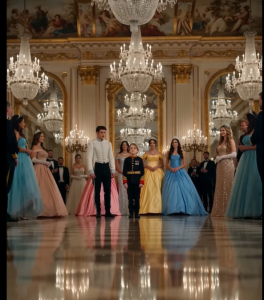
Prince Smith stood near the center of the ballroom in a black military-style royal uniform trimmed with gold. He was a child, yet every eye in the room followed him. Behind him stood his father, the royal leader, handsome and composed in a white military-style jacket with silver buttons. The gathering appeared ceremonial, like a test of affection arranged for an audience. The father placed a gentle hand near his son’s shoulder and spoke softly enough to sound kind, but enough for everyone to hear.
“Go to the woman you love the most, Smith.”
The four princesses brightened. They extended their hands toward the boy, smiling as if one of them expected to be chosen.
“Come here, sweetheart,” they called in gentle voices.
For a heartbeat, Smith remained still. He moved.
But he did not run toward the princesses.
He rushed straight past them.
Their smiles disappeared at once. The sound of his shoes striking the marble echoed through the ballroom as surprised murmurs followed him. The princesses turned in confusion, their outstretched hands falling to their sides. Courtiers leaned forward, trying to understand where the boy was going. Even his father seemed to hold his breath.
At that moment, the grand double doors opened.
A young servant entered carrying a silver tray. She wore a light blue and white maid uniform, the kind of clothing that made her nearly invisible in a room filled with jewels, crowns, and formal gowns. She had taken a few steps when she saw Prince Smith racing toward her.
Her face changed instantly.
“No, no, Prince Smith!” she cried.
The tray slipped from her hands and crashed against the marble floor. The sharp clatter cut through the room, but Smith never slowed. He ran into her arms and clung to her as though he had finally reached the only person he had been searching for.
“Mom!” he cried.
The servant froze.
Then her arms closed around him.
Gasps spread across the ballroom. The four princesses stared in disbelief. Members of the court exchanged shocked looks. The servant held the boy tightly, tears filling her eyes, while Smith buried his face against her shoulder. The formal ceremony had vanished in an instant. Whatever everyone thought they had been invited to witness had become something far more personal.
The princess in the yellow gown stepped forward first. Confusion sharpened her voice.
“Wait, why is he calling her mom?”
The servant looked across the room toward Smith’s father. Her expression carried fear, heartbreak, and the weight of a secret that had been kept for years. Still holding the boy, she spoke through tears.
“You promised he’d never find out.”
Every face turned toward the father.
His composure broke.
Tears appeared in his eyes, and for the first time he looked less like a royal leader and more like a man confronting the consequences of a painful decision.
“I lied,” he said, his voice trembling, “because I wanted to protect him.”
The confession left the ballroom silent except for the sound of Smith crying against his mother. The princesses no longer looked certain of anything. The woman in yellow, however, reacted with anger rather than sympathy.
“She was only a servant!” she shouted.
The words struck the room with almost as much force as the fallen tray.
Smith lifted his head.
His face was wet with tears, but his response came without hesitation. He wrapped his arms more tightly around the woman who had been called a servant and looked toward the princess.
“She isn’t my servant,” he said. “She’s my mom.”
There was something powerful in the simplicity of his answer. The adults around him had built titles, secrets, expectations, and social rules around the truth, but Smith reduced everything to the one fact that mattered most to him. He did not care about uniforms, status, or what the court believed was appropriate. He knew who had deeply loved him, and he was not willing to let anyone diminish her.
His father walked toward them.
The servant watched him approach with uncertainty. Smith remained close to her, protective even though he was only a child. When the father reached them, he did not order her away or attempt to restore the ceremony. Instead, he gently took her hand.
The room remained completely still.
Tears were visible on his face, but his voice became firm.
“From this day forward, no one will ever call you a servant again.”
The young woman looked stunned. Her eyes moved from his face to their joined hands, then down to Smith. For years, she had apparently lived with the knowledge that her own child could not publicly know who she was. Now the secret had been exposed in front of the entire royal court, and the man who had helped keep it hidden was finally standing beside her.
Before anyone else could respond, another figure stepped forward.
The Queen entered the center of the room with the natural authority of someone who did not need to raise her voice to command attention. She wore a sparkling gold gown, a sweeping cape, and a tiara that caught the chandelier light as she moved. The princesses turned toward her. The court straightened. Even the father waited for her judgment.
The Queen looked at the servant, at Smith, and then at the father.
“Of course not,” she said. “A servant is going to be part of my family.”
Her words transformed the atmosphere.
The woman who had entered carrying a tray now stood beside the royal leader with her son holding close to her. The same room that had expected Smith to choose among four princesses was now witnessing the public recognition of his true mother and her acceptance into the royal family.
The four princesses could only watch.
Their earlier confidence had disappeared. The princess in yellow, who had dismissed the woman as “only a servant,” now faced the full meaning of what had happened. Status had not decided where Smith’s heart belonged. Titles had not erased motherhood. A uniform had not made love less real.
As the triumphant music swelled, the princesses lowered themselves to their knees in submission.
Smith remained beside his mother.
His father stayed at her side, still holding her hand.
And the Queen stood before them all, making the new reality unmistakable.
The final image was not about luxury, crowns, or royal tradition. It was about a child who ignored every expectation in the room and ran toward the person he loved most. One word—“Mom”—had shattered a secret, humbled a room full of royalty, and forced a family to face the truth they could no longer hide.