The glass doors of an impressive corporate tower revolved steadily as people moved through the polished entrance. The building rose above the sidewalk in sleek lines of steel and glass, reflecting passing cars, traffic lights, and the gray-blue sky. Everything about the place suggested money, influence, and control. Several security guards stood near the entrance.
Then the Wealthy Man stepped outside.
He wore a perfectly tailored light pink suit, a crisp shirt, and a matching tie. His shoes gleamed, and his expression carried the confidence of someone accustomed to being protected from inconvenience. Two guards followed closely behind him while another remained near the entrance. Pedestrians moved around them as traffic rolled past with the usual noise of engines and distant horns.
For him, it seemed like an ordinary day.
For the elderly woman waiting near the sidewalk, it was anything but ordinary.
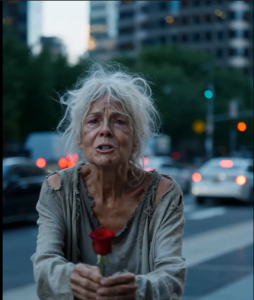
Mrs. Diana stood several yards away, watching him with tired eyes. Her white hair was messy from the wind, and her clothes were worn, dirty, and far too thin for the cool air. She looked extremely frail. Yet in one trembling hand, she held a single red rose.
It was bright, delicate, and strangely beautiful against everything she had lost.
She swallowed her fear. She gathered her courage and stepped toward him.
“Sir, please buy a flower.”
Her voice was soft and fragile, almost swallowed by the city noise.
The Wealthy Man stopped. His eyes moved from the rose to her face, but there was no warmth in them. Instead, irritation crossed his expression. He seemed less concerned with who she was than with the fact that she had interrupted him in front of his building.
He turned slightly toward the guards.
“Get her out of here.”
The words were cold and immediate.
One of the guards shifted forward, ready to obey. Mrs. Diana did not argue. She did not raise her voice or beg. She simply stared at the man more carefully.
Something about his eyes held her attention.
The city around her seemed to fade. The building, guards, passing cars, and even the rose became distant as an old memory returned.
Her lips parted.
“You still have the eyes of the little boy from the fire.”
The Wealthy Man froze.
For an instant, the sidewalk disappeared from his mind.
He remembered orange light.
He remembered smoke filling a house and the terrible roar of flames somewhere behind him. He remembered being small, frightened, and unable to understand what was happening. Then came another memory: a woman rushing through the danger, reaching him, lifting him into her arms, and carrying him away from the burning home.
The memory was brief, blurred by childhood and time, but the feeling had never left him.
Someone had saved his life.
Back on the sidewalk, his face changed completely.
He looked at the elderly woman again, no longer seeing a stranger in torn clothing. He searched her face as though the years between them were suddenly falling away. His breath caught, and the certainty he usually carried vanished.
Then, in front of his guards, employees, and anyone passing the building, he dropped to his knees.
“Oh my God,” he whispered. “Was it you?”
Mrs. Diana’s eyes filled with tears.
The red rose shook in her hand.
For years, she had carried memories of that fire, the child she rescued, and everything that came afterward. She had not approached him expecting gratitude. She had not even known whether he would remember. She had only recognized something in his face that time had failed to erase.
His eyes.
Those same eyes had once belonged to a terrified little boy looking up at her through smoke and fear.
Now they belonged to a wealthy man kneeling on a city sidewalk.
Mrs. Diana began to cry.
The tears came slowly at first, then harder. Her shoulders trembled as grief she had kept locked away returned all at once. The Wealthy Man remained on his knees, staring up at her, stunned by the realization that the woman he had just ordered removed from his presence might be the person who had given him the chance to grow up at all.
The guards stood silent.
None of them moved toward her now.
The distance between wealth and poverty, authority and vulnerability, seemed suddenly meaningless.
Mrs. Diana looked down at the rose and struggled to steady her voice.
“After my husband died, I spent everything trying to save him.”
Her words broke under the weight of the memory.
The Wealthy Man’s expression tightened with sorrow. He had spent years building a life surrounded by success, expensive clothes, polished offices, and people ready to follow his instructions. Yet standing before him was a woman whose life had taken a very different path after the day she had saved his.
She had once carried him away from danger.
Later, she had faced tragedy of her own.
After losing her husband, she had exhausted what she had trying to help him before he died. The years afterward had left visible marks: the worn clothes, the exhaustion in her face, the fragile hands holding a flower she hoped someone might buy.
The man slowly reached for those hands.
This time, he did not gesture for security.
He did not look away.
He held her gently, as though afraid that any careless movement might deepen the hurt he had already caused.
“I’m sorry,” he said, his voice unsteady.
The apology could not erase what she had endured, but it changed the moment between them. Only seconds earlier, he had treated her as a problem to be removed. Now he understood that appearances had hidden a history he should never have dismissed.
Mrs. Diana looked at him through tears.
For a moment, neither spoke.
The noise of traffic returned around them, but it seemed quieter than before. Reflections moved across the glass doors behind the guards. People entering the building slowed when they saw the powerful man still kneeling beside the elderly woman. The red rose remained between them, no longer merely something for sale. It had become a small symbol of memory, recognition, and a debt that money alone could never repay.
The Wealthy Man rose carefully and kept hold of her hand.
Then he stepped closer.
Mrs. Diana’s face crumpled with emotion as he opened his arms, and she accepted the embrace.
There was no grand speech.
There was no need for one.
The man who had first seen only a homeless stranger now held the woman who had once carried him out of a burning house. She had recognized him by his eyes when status, clothing, and years might have convinced anyone else that the little boy was gone forever.
But he was still there.
And so was the woman who had saved him.
On that busy sidewalk, in front of the glass tower and silent guards, a single red rose brought two lives back together. What began with rejection ended with remembrance, remorse, and gratitude. And the Wealthy Man learned, in the most personal way possible, that the people we overlook may carry stories, sacrifices, and acts of courage we cannot see until we finally stop and look.