The living room had always felt comforting. Soft daylight poured through the windows, warming the neutral walls of the modern home. The kitchen beyond it was spotless, with clean counters, a wide island, and everything arranged neatly. But that afternoon, the familiar space felt different. The air was tight with tension, and the only sound at first was the faint rustle of legal papers in the wife’s hands.
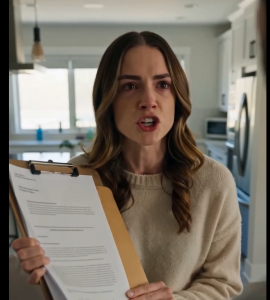
She stood across from her husband holding a clipboard against her chest. Her wavy brown hair framed a tearful face, but sadness was not her only emotion. Anger, confusion, and betrayal were there too. She had been looking through documents she apparently believed represented their shared future. Instead, she had discovered something that made her question how her husband viewed their marriage.
Her fingers tightened around the clipboard.
“Why are all your properties registered under your mother’s name instead of mine?” she asked.
The question came out loudly, sharpened by hurt. Her voice trembled as though she had rehearsed it before confronting him. To her, the documents were not simply paperwork. They seemed to reveal a decision made without her, a boundary she had never known existed.
Her husband stood a few feet away in a gray T-shirt, his posture controlled. His expression was far calmer than hers. His jaw tightened slightly, but he did not raise his voice. Instead, he remained still, as if he had thought through this issue long before the confrontation began.
For a moment, he said nothing.
That silence made her more anxious.
Then he answered steadily.
“Because my mother will always be my mother. A marriage can end, but that relationship never will.”
The words landed heavily between them.
From his perspective, the explanation was practical. He saw the property as something he had built before the marriage, connected to years of work and sacrifice. Registering those assets under his mother’s name was, in his mind, protection.
But his wife did not hear only a financial explanation.
She heard a warning.
Her eyes filled again as she stared at him, trying to understand what his answer meant about the place she held in his life. Marriage, to her, was supposed to represent commitment, partnership, and trust. Yet he had described it as something that could end while emphasizing that his relationship with his mother was permanent.
The contrast hurt.
He could see the tears on her face, but he continued calmly.
“It’s not that I don’t love you,” he said. “I’m simply protecting what I worked hard to build long before I met you.”
His tone remained measured, almost businesslike, while she struggled to keep herself together. He was not saying that he expected the marriage to fail. He was explaining a personal financial boundary that, to him, existed independently of his feelings for her.
Yet that distinction did little to comfort her.
She pulled the clipboard closer, pressing it against her sweater like a shield. The legal documents suddenly seemed heavier than paper. Every page appeared to reinforce the same painful thought: somewhere in his planning, he had imagined a future in which the marriage might end, and he had taken steps to make sure certain things remained beyond her reach.
For him, that was caution.
For her, it felt like distrust.
The difference between those interpretations filled the room.
Neither seemed willing to pretend it was a small disagreement.
She moved toward the couch and sat down, completely exhausted by the confrontation. One legal document rested on her lap. She looked down at it, but the words no longer seemed important. What mattered was what she believed the paperwork represented.
The living room, bright and welcoming minutes earlier, now felt strangely cold. The open floor plan made the distance between them seem larger. Her husband remained standing near the kitchen, while she sat alone on the couch, quietly crying.
There was no shouting now.
Only the soft sound of her breathing, the occasional rustle of paper, and the emotional distance neither knew how to close.
She looked back at the documents, then toward the kitchen counter. A brown envelope sat nearby, another ordinary object now connected to a conversation much bigger than money. Property titles, names, signatures, and ownership arrangements could be explained legally. What was harder to explain was what those choices meant inside a marriage.
Financial boundaries can exist even in loving relationships. People bring different histories, fears, and expectations into a marriage. One person may see separate assets as sensible protection. Another may see the same decision as evidence of distrust.
That was the conflict unfolding in this quiet room.
The husband believed love did not require surrendering everything he had created before the relationship. He believed protecting earlier assets did not cancel his commitment to his wife. In his mind, both ideas could be true at once: he could love her and still maintain a boundary around property he had earned before meeting her.
His wife saw the matter differently.
She was not focused only on ownership. She was asking whether he trusted her enough to build a life without protecting himself from her. The fact that the properties were registered under his mother’s name made that fear stronger. To her, it suggested that another relationship had been given permanent security while hers had been treated as conditional.
She lifted her face slowly.
Her eyes were red, and tears continued to gather along her lashes. The anger that had driven her first question had faded. What remained was something more vulnerable.
She wanted reassurance.
She wanted him to tell her she had misunderstood.
Instead, she looked at him as if she already feared the answer.
“So…” she began, her voice breaking. “You’ve never really trusted me?”
The question changed the atmosphere again.
It was no longer about houses, ownership records, or legal protection. It was about what those choices meant emotionally.
Her husband closed his eyes for a moment. He took a slow breath, visibly frustrated but controlled. When he opened them, his expression remained firm. He did not explode, and he did not retreat from the boundary he had explained.
But he also did not immediately give her the reassurance she was seeking.
That silence left the final question hanging between them.
The wife remained on the couch with the document across her lap, watching him with heartbreak and uncertainty. He stood several feet away, calm but resolute, caught between defending the decisions he had made and responding to the emotional damage those decisions had created.
Neither person had clearly won the argument.
The scene revealed why conflicts over money can become conflicts over trust so quickly. One partner may see financial protection as responsible planning, while the other experiences it as emotional rejection. Without an honest conversation, paperwork can become a symbol of deeper fears.
The room stayed quiet.
No final answer came.
No one walked away, apologized, or changed the documents.
There was only a wife asking whether her husband had ever truly trusted her, and a husband facing the painful reality that a boundary he considered practical had become, in her eyes, proof of distance.
The question remained unresolved as the moment faded to black.