The sun hung high over the outdoor military training grounds, throwing bright light across the blue padded mat where soldiers practiced controlled hand-to-hand combat. Low military buildings stood beyond the training area, and groups of uniformed personnel moved through drills in the distance. Boots scraped against pavement, instructors called out commands, and the air carried the familiar rhythm of disciplined training.
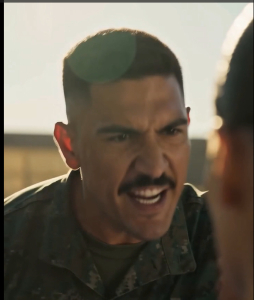
At the edge of the mat stood Sergeant Morales, a mustached instructor with short dark hair and a green camouflage uniform. The name MORALES was stitched clearly across his chest. He leaned forward toward Soldier Ruiz with an aggressive confidence that made his opinion obvious before he even finished speaking.
Ruiz stood across from him in the same camouflage uniform. Her dark hair was pulled into a neat bun, and the name RUIZ rested over her chest pocket. She did not shift her weight nervously or look away. Her shoulders remained square, her posture straight, and her expression calm.
Morales raised his voice so nearby soldiers could hear him.
“Hand-to-hand combat is not for you. You’re going to get hurt.”
His tone was not protective. It was dismissive. He spoke as if the outcome had already been decided and as if Ruiz had no business proving otherwise.
For a brief moment, the training area seemed quieter. Ruiz looked directly at him. She did not answer with anger, and she did not try to match his volume. Instead, she let the silence settle before responding with the kind of control expected from someone who trusted her training.
“My sergeant, stop underestimating me.”
The words were simple, but her delivery changed the mood immediately. Ruiz was not asking for special treatment. She was asking to be judged by the same standard as everyone else.
Morales smirked.
A short, mocking laugh escaped him as he glanced toward the mat. Her confidence appeared to amuse him rather than impress him.
“Let’s see then,” he said. “Try it, little soldier.”
That challenge brought both of them onto the blue mat.
They moved toward the center while several soldiers in the background slowed their own drills to watch. No one needed an announcement. The tension had already drawn attention. Morales lifted his hands into a fighting stance. Ruiz did the same.
For a few seconds, they circled.
Their boots shifted carefully across the padded surface. Morales watched her with the confidence of someone expecting an easy lesson. Ruiz watched him differently. Her face remained focused, and every movement looked measured. She was not trying to perform for the spectators. She was waiting, reading his balance and timing.
Then Morales attacked.
He lunged forward with a wide, forceful punch, trying to overwhelm her quickly. Ruiz reacted without panic. She dipped under the strike, allowing his arm to pass above her as she moved into position.
The exchange lasted only a moment, but it revealed the difference between aggression and control.
Morales had committed his weight forward. Ruiz recognized it.
Instead of meeting strength with strength, she redirected his momentum. Her feet planted securely on the mat, her body turned with practiced precision, and she guided him over her back in a clean training throw.
Morales hit the padded surface with a heavy thud.
The sound drew startled murmurs from the soldiers watching nearby, but Ruiz did not celebrate or lose focus. She followed the movement exactly as a disciplined trainee should, maintaining control rather than escalating the exchange.
Before Morales could recover, Ruiz secured his arm behind his back and established a firm submission position.
There was nothing reckless about it. The hold was controlled, professional, and clearly part of supervised combat training. Morales grimaced from the pressure and frustration, breathing heavily as he realized he could not simply overpower his way free.
“Ruiz, let me go!” he shouted.
Only seconds earlier, he had warned her that she would be the one getting hurt. Now he was pinned on the same mat where he had expected to embarrass her.
The irony was impossible to miss.
Ruiz kept the hold steady without adding unnecessary force. Her breathing was controlled, and her expression remained composed. Around them, the other soldiers watched with a mixture of surprise and growing respect.
What had begun as a condescending challenge had become a lesson in discipline.
Morales had entered the sparring match relying on confidence, size, and aggression. Ruiz had relied on timing, technique, and attention. She had not needed to prove that she was stronger in every possible way. She only needed to demonstrate that training and composure could defeat careless assumptions.
After making her point, Ruiz looked down at Morales.
Her voice was steady.
“See? I don’t need you to take care of me. I need you to respect me.”
The message reached far beyond the takedown itself.
Ruiz was not rejecting teamwork, guidance, or safety. In a military environment, all three matter. What she rejected was the idea that concern could be used as an excuse to dismiss her ability before she had even been given the chance to demonstrate it.
Respect, in that moment, meant being evaluated on performance.
The soldiers watching had seen the entire exchange. They had heard Morales tell Ruiz that hand-to-hand combat was not for her. They had watched her refuse to become emotional. They had seen him mock her confidence and invite her onto the mat. Then they had watched her respond with exactly what the situation demanded: controlled skill.
She did not taunt him. She did not brag. She did not turn toward the spectators looking for applause. Her final statement carried more weight because she remained disciplined even after winning the exchange.
For Morales, the lesson was immediate.
The blue mat had become a simple testing ground.
Morales had expected Ruiz to confirm his belief that she needed protection from the challenge. Instead, she showed that she was prepared for it.
That difference decided the exchange.
As the tension eased, the sounds of the training facility returned. Commands carried across the grounds. Boots moved over mats and pavement. Soldiers resumed their drills. The bright afternoon sun still reflected from the uniforms and equipment.
But something had changed.
Ruiz had answered disrespect with discipline.
She had answered mockery with preparation.
And when she finally had the advantage, she used it not to humiliate Morales, but to make one clear demand: respect her ability.
That was the real victory on the mat.
Strength mattered. Technique mattered. Training mattered. But so did the willingness to see a fellow soldier for what she could actually do instead of what someone assumed she could not do.
In the end, Ruiz did not need a speech to change the atmosphere. One controlled exchange was enough. Morales challenged her because he believed she did not belong in the fight.
She proved that she belonged there by doing exactly what trained soldiers are taught to do: stay calm, read the situation, act with precision, and maintain control.
The final image said everything.
Morales was on the mat, his earlier confidence replaced by reluctant recognition. Ruiz stood above him, steady and composed, not asking to be protected from the challenge.
She was asking to be respected for meeting it.