Margaret Ellis had worked at Whitmore Home Goods for nearly twenty-three years, long enough to know every delivery truck, every squeaky drawer, and every nervous new hire. She was sixty-two, gentle, and trusted by customers who asked for her by name. She remembered birthdays, favorite curtains, and which older shoppers needed help with bags.
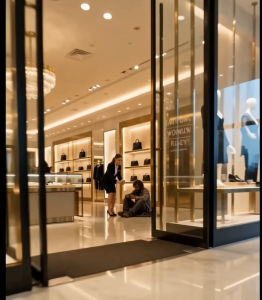
But kindness had become inconvenient since Vanessa Clarke became general manager.
Vanessa was thirty-four, polished, ambitious, and certain every human moment should fit inside a sales report. She wanted quiet aisles, spotless floors, and unquestioning employees. She often said the store needed “a more upscale image,” though everyone knew what she meant: no hardship near the front door.
That cold Tuesday afternoon, rain streaked the windows while shoppers rushed inside. Under the awning stood an older homeless man in a soaked coat. He was not begging. He was shivering, one hand pressed to his chest.
Margaret noticed him first.
She looked toward Vanessa’s office, saw the blinds closed, and made a decision. She stepped outside with hot coffee, a clearance blanket, and a careful smile.
“Sir, please come in for a few minutes,” she said. “You can warm up by the front bench.”
The man hesitated, embarrassed. “I don’t want to cause trouble.”
“You’re not causing trouble,” Margaret replied. “You’re cold.”
For fifteen minutes, he sat near the entrance, wrapped in the blanket, sipping coffee with both hands. A few customers glanced over, but no one complained. One woman bought wool socks for him. Another whispered, “That was decent of you.”
Then Vanessa came out.
Her heels stopped sharply, and the front counter went quiet. She stared at the man as if he had ruined everything.
“What is this?” she demanded.
Margaret turned. “He was outside in the rain. I only let him warm up.”
“This is a business, Margaret. Not a shelter.”
The old man lowered his eyes. Margaret moved slightly between them, protectively.
“He wasn’t bothering anyone,” she said. “He looked unwell.”
Vanessa raised her voice. “Do you understand how this looks? People come here to shop, not sit beside some drifter at the front door.”
A mother frowned. A cashier stared at the scanner. The homeless man stood, humiliated, clutching the blanket.
“I’ll go,” he said.
Margaret shook her head. “Please wait.”
Vanessa pointed outside. “No. He leaves now. And you come to my office.”
Margaret’s hands trembled, but her voice held. “May I at least let him keep the blanket?”
Vanessa gave a cold laugh. “You may pay for it out of your final check.”
Inside the office, Vanessa did not ask for an explanation. She opened Margaret’s file and read from a policy manual.
“You brought an unauthorized person into the store, damaged our image, distracted staff, and risked customer discomfort. I’m terminating your employment effective immediately.”
Margaret stared at her. “After twenty-three years?”
“Years do not excuse bad decisions.”
“I helped a man who was cold.”
“You made the store look cheap,” Vanessa snapped. “Kindness is bad for business when it scares away paying customers.”
Margaret stood, looking less hurt than disappointed. “Then maybe business has forgotten what people are.”
Vanessa slid a cardboard box across the desk. “Pack your things.”
By closing time, Margaret had cleaned out her locker. Employees hugged her. The homeless man was gone, but the blanket sat folded on the front bench with a note beneath it.
Thank you for seeing me.
Margaret slipped the note into her coat pocket and walked into the rain.
The next morning, Vanessa arrived early, expecting a normal day and praise from regional leadership for protecting the store’s image. Instead, two black sedans sat outside, and a locksmith changed the code on the employee entrance.
Inside, the store felt different. Staff stood in uneasy silence. A woman in a navy suit spoke with the assistant manager. Boxes were stacked outside Vanessa’s office.
Vanessa marched forward. “What is going on?”
The woman turned. “Ms. Clarke?”
“Yes.”
“I’m Helen Morris, corporate counsel for Whitmore Holdings. Your access has been suspended pending review.”
Vanessa laughed once. “Suspended? For what?”
Helen handed her a folder. “Wrongful termination, reputational misconduct, and violation of company values. Please do not enter your office.”
“My office?” Vanessa pushed past her, stopped in the doorway.
Her nameplate was gone.
So were her framed awards, designer chair, personal photographs, and her favorite glass paperweight. Her computer had been removed. A sealed envelope remained.
Vanessa’s voice cracked. “Who authorized this?”
A calm voice answered behind her.
“I did.”
She turned.
The homeless man from the day before stood near the registers. Now clean-shaven in a charcoal suit, with combed silver hair and an impossibly expensive watch. He no longer looked invisible. He looked powerful.
Staff gasped.
Helen stepped beside him. “Ms. Clarke, this is Arthur Whitmore.”
Vanessa’s face drained of color.
Arthur Whitmore was not just a visitor. He was the retired founder of Whitmore Home Goods, whose family still controlled it. His portrait hung in training centers. His name was on every shopping bag.
Vanessa opened her mouth, but nothing came out.
Arthur looked at her with quiet sadness. “Yesterday, I came here dressed as a man most people choose not to see. I wanted to understand what culture had taken root here.”
Vanessa swallowed. “Mr. Whitmore, I had no idea it was you.”
“That is exactly the problem,” he said. “You believed your behavior was acceptable because you thought I had no power.”
No one moved.
“Margaret Ellis showed this company’s founding values: dignity, patience, and basic decency. You called those values bad for business.”
Vanessa tried to recover. “I was protecting the brand.”
“The brand is not marble floors and perfect displays,” Arthur said. “The brand is how people feel when they walk through our doors.”
He nodded to Helen, opening the folder. “Margaret Ellis’s termination has been reversed. She has been offered reinstatement, full back pay, a formal apology, and promotion to customer experience lead. As for you, Ms. Clarke, your employment is ended effective today.”
Vanessa gripped the doorframe. “You can’t do this over one mistake.”
Arthur’s expression remained steady. “It was not one mistake. It was a revelation.”
Then the front doors opened. Margaret stepped inside, wearing the same blue coat, unsure why she was back. The employees began clapping softly, then louder, until the store seemed to breathe again.
Arthur walked to her and extended his hand. “Mrs. Ellis, I owe you thanks.”
Margaret blinked. “Sir?”
“You reminded this company of its soul.”
Vanessa stood beside her boxed-up office, watching the woman she had fired receive the respect she had spent years demanding.
Margaret did not smile with triumph. She looked at Vanessa and said, “I hope someday you understand that helping someone never makes a place smaller. It makes it worthy of being entered.”
Vanessa lowered her eyes.
By noon, the story had spread through every Whitmore location. Employees repeated Arthur’s words. Customers returned, asking to meet Margaret. The front bench, once treated like an embarrassment, was moved closer to the entrance and given a small brass plaque that read: Warmth is never bad for business.
And from that day forward, whenever rain darkened the windows, someone at Whitmore always looked outside first.