My mother did not come to the hospital because she was afraid of losing me. She came because she was afraid of losing access to my money.
I was in a private room on the eleventh floor of Lakefront Medical Center in downtown Chicago, so weak that lifting a cup of water made my hands tremble. Dialysis tubes were taped to my arm, a transplant coordinator’s card sat beside my Bible, and every machine around me seemed to understand the truth my family kept avoiding. Both of my kidneys were failing. The doctors had explained it, but there was no soft way to say it. My body was filling with toxins faster than treatment could remove them.
In that room, I had imagined every frightening possibility. I imagined not making it to thirty-three. I imagined my name being printed on a hospital bracelet for the final time. I imagined my father standing beside my bed, trying to hide his tears. I even imagined my mother, Evelyn Whitaker, brushing my hair from my forehead the way she had when I was a sick little girl, whispering, “Maya, baby, we’re here. You’re not alone.”
But when the door opened that Thursday afternoon, there was no tenderness in her face.
She walked in wearing a camel-colored coat, pearl earrings, and the hard, practical expression she always wore when somebody else’s paycheck was needed to solve a family problem. My father, Richard, followed behind her with his jaw tight and his hands buried in the pockets of his old navy jacket. Behind them came my younger brother, Connor, the twenty-six-year-old golden boy of the Whitaker family, still carrying himself as if the world owed him applause for simply showing up.
No flowers. No gentle questions. No concern about whether I was scared or in pain.
My mother dropped a folder onto my blanket.
“Sign,” she said.
The folder slid across the thin hospital sheet and stopped beside my hip. At first, I stared at it in confusion. The medication made the room feel distant, like everything was happening underwater. My head ached, my mouth was dry, and the monitor beside me kept beeping in a steady rhythm, as if it were the only one still committed to keeping me alive.
“What is that?” I asked.
Connor rolled his eyes. “Don’t start, Maya.”
I turned my head slowly toward him. He wore a designer hoodie I was almost certain I had paid for. His hair was styled, his expression sharp with irritation. Not worry. Not sadness. Irritation, as though my kidney failure had inconvenienced his schedule.
My mother opened the folder herself and pulled out notarized transfer documents.
“You have two hundred and fifty thousand dollars sitting in an account,” she said. “Connor needs it.”
The words hit me with more force than any diagnosis.
For five years, I had protected that money like a quiet prayer. Two hundred and fifty thousand dollars. Every bonus I refused to waste. Every dinner out I skipped. Every weekend trip I turned down. Every cab ride I avoided by walking home through Chicago wind that cut through my coat. That money was my escape plan. My down payment. My evidence that one day I would stop being the daughter my family emptied whenever they needed something.
My mother looked at my failing body and saw a bank account.
“Connor needs capital for his luxury streetwear brand,” she continued. “He has a real opportunity. A serious investor is waiting, but he has to prove he has money behind him.”
I laughed once, but it came out cracked and painful.
“Connor has never kept a job longer than a month.”
His cheeks turned red. “That’s because ordinary jobs are beneath me.”
I looked at my father, hoping illness might bring out even a small measure of decency.
“Dad,” I whispered. “Both of my kidneys are failing.”
Richard did not step closer. He did not look at the tubes in my arm or the exhaustion in my face. He looked at the folder.
“You have insurance,” he said. “Your company will cover the hospital. Connor doesn’t have that kind of safety net.”
“Because Connor has never built anything that required one,” I said.
My mother’s eyes narrowed.
“Maya,” she said slowly, “do not be selfish.”
Selfish.
The word filled the room like smoke.
I had paid the mortgage on their Oak Brook house for five years. I had covered gas, electricity, groceries, property taxes, car insurance, prescriptions, Connor’s phone, Connor’s credit cards, Connor’s failed online business, Connor’s unpaid parking tickets, and Connor’s so-called networking trips to Miami and Las Vegas. I had missed birthdays, holidays, dates, meals, sleep, and the warning signs from my own body.
And now, while I was lying in a hospital bed fighting to stay alive, I was selfish.
“No,” I said.
Silence fell so completely that even the machines sounded louder.
My mother blinked. “What did you say?”
I took a breath. It hurt all the way down.
“I said no. That money is mine. It is for my future. It is for my life. None of you are getting it.”
Connor gave a cruel little scoff. “What future? You’re stuck in a hospital bed.”
My father stepped forward. “Watch your tone.”
I looked at him, and something inside me broke cleanly, not into weakness, but into truth.
“No, Dad. You watch yours. I am not signing anything. Get out.”
My mother’s face changed. At first, it was not rage. It was disbelief, as if a chair had spoken, as if a refrigerator had refused to make ice, as if the family ATM had suddenly grown a soul.
“You ungrateful little witch,” she hissed.
Then everything happened too fast for my mind to hold in order.
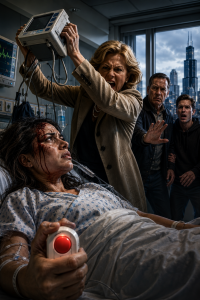
Her hand shot toward the wall. The nurse-call cord swung. Connor stepped back. My father turned toward the door. My mother grabbed the blood pressure monitor from its wall mount with both hands and yanked. Wires snapped loose. Plastic cracked. The machine was heavier than it looked, a hard white-and-gray block of hospital equipment with the cuff dangling from it like a lifeless snake.
For one impossible second, she lifted it over her head.
“Maya!” someone shouted.
Maybe it was me. Maybe it was Connor.
Then my mother brought it down.
Pain burst through my skull in a flash of white heat. I screamed as the room tilted, and warm blood ran down the side of my face. The monitor beside me began beeping faster. I reached for my head, but my arm caught in the IV line.
“Mom!” Connor cried, suddenly frightened.
My father moved, but not toward me.
He moved toward the door and stood in front of the narrow window, blocking the hallway view.
That was when I understood everything. My mother had hit me. My father was covering for her. My brother had watched it happen.
Evelyn lifted the monitor again, breathing hard, pearls shaking at her throat.
“You will sign,” she said.
But none of them knew my right hand had been under my pillow since the moment she started shouting. My fingers were already wrapped around the emergency panic button.
I pressed it.