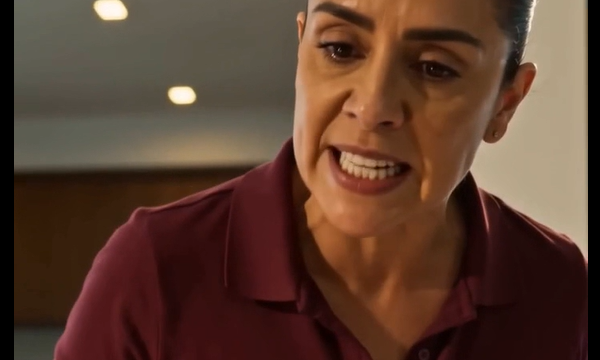
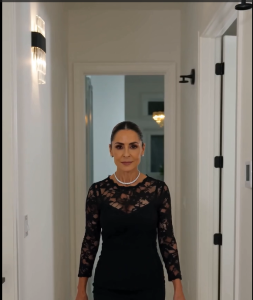
For eight years, the people on Maple Ridge believed Clara Whitman had rescued a little girl from heartbreak. They saw framed family photos in her bright hallway, school ribbons on the refrigerator, and sweet birthday posts online every spring. They saw a polished woman in a black lace dress who smiled at charity luncheons. What they never saw was the truth hidden inside the white wardrobe at the end of the upstairs hall.
The girl’s name was Lily. She had long dark hair that Clara made her wear in two neat braids. Lily was old enough to remember her real parents in pieces: her mother’s perfume, her father’s laugh. After the accident that took them both, Clara appeared like a rescue boat in a storm. She signed forms, and promised to raise Lily as her own.
Clara knew how to perform kindness when people were watching. She packed lunches with handwritten notes, attended school meetings, and told neighbors adoption was the most meaningful choice of her life. But inside the house, behind clean walls, her voice changed. Love became a schedule. Gratitude became a rule. Lily learned early that every gift came with a reminder: You have no one else.
By the time Lily turned fifteen, she had stopped asking why Clara never liked talking about her real parents. She stopped asking why drawers stayed locked, why Clara handled all mail first, and why conversation happened behind closed doors. Still, some part of her kept listening.
The first clue came from a phone call Clara took in the hallway. Lily was in her bedroom, pretending to study, when she heard Clara say, “The papers are signed.” Her tone was not worried. It was pleased.
That night, after Clara left for dinner, Lily searched the house. She moved quietly across the polished floor. In the white wardrobe near Clara’s room, behind old scarves, she found a folder marked with her parents’ last name. Inside were insurance documents, trust papers, and notes written in Clara’s sharp handwriting.
The words made Lily’s hands go cold.
The adoption had not been about love. It had been about money. Clara had moved close after the funeral, secured legal guardianship, and waited until Lily became old enough to sign paperwork she did not fully understand. The life insurance from Lily’s real parents, the trust they had left for their daughter, the property tied to her future, all of it had been Clara’s target from the beginning.
Tomorrow. No delay. After papers clear, no witness.
For a moment, the house seemed to tilt. Lily pressed one hand against the wardrobe door. But fear can become focus when there is no other choice. Clara watched her phone, checked her messages, and controlled everything she could reach. So Lily did the one thing Clara would never expect.
She set up a livestream.
Lily placed her smartphone on the neatly made bed, angled toward the bedroom and the white closet area. She connected it to a private page shared with a trusted teacher, a neighbor. Then she sent one message with photos of the documents: Please watch. If I disappear, this is why.
Minutes later, Clara returned.
Heels crossed the floor downstairs. Lily stood inside the closet space, folder open in her trembling hands. When Clara appeared in the hallway, her face changed instantly. The sweet motherly mask slipped away.
“What are you doing with that?” Clara asked.
Lily lifted the paper, her expression no longer frightened but burning with accusation. In Spanish, she said, “You didn’t adopt her for love! You brought her here to collect the life insurance of her real parents!”
Clara stared at her for one long second. Then she smiled.
It was thin, cold, and amused. “So you finally learned how to read more than schoolbooks,” she said. Her hand moved behind her back, and when it came forward, Lily saw the syringe.
Clara stepped into the white hallway as if walking onto a stage. Her black lace dress moved softly with each step. Clara’s voice became gentle in the cruelest way.
“You were very sweet, daughter,” she said, mocking the word as if it were a joke. “But your friend already signed the trust papers. Tomorrow she won’t be necessary in this world anymore.”
Lily’s knees nearly gave way. Clara believed she was speaking only to a terrified child. She believed the folder, the house, and the future were already hers. She did not know the phone on the bed was streaming every word. She did not know trusted adults were watching her mask fall.
From downstairs came a heavy crash.
Clara froze.
Another crash followed, louder, “Police! Open the door!”
For the first time, Clara looked afraid.
Lily stepped backward into the bedroom and picked up the smartphone. The screen showed the live broadcast still running, comments racing too quickly to read. Her hands shook, but her voice did not.
“The insurance company already canceled the policy,” Lily said. “And the police are breaking down your front door right now.”
Clara’s mouth opened, but no convincing lie came out. The woman who had spent years arranging documents, smiles, and sympathy had no performance left. Footsteps rushed inside. A command echoed up the stairs.
“Drop what’s in your hand!”
Clara looked at the syringe, then at Lily, then at the phone. In that small glass screen, she saw not a helpless girl, but witnesses. She saw the world watching the truth she had buried under charity events and family photos.
The officers reached the hallway seconds later. One moved between Clara and Lily while another ordered Clara to turn around. The syringe slipped from her hand and tapped against the floor. Clara shouted that it was medicine, that Lily was confused, that none of it was what it looked like. The threat had been heard.
As they placed Clara in handcuffs, Lily did not cheer. In that instant, she understood something her real parents would have wanted her to know: being young did not make her powerless. The truth had a voice, and she had found a way to let it speak beyond locked doors, pretty lies, and the woman who called herself mother. It was the bravest breath she had ever taken. And everyone finally heard it that night She simply stood there, holding the phone close to her chest, breathing like someone who had finally reached the surface after years underwater.
The neighbors would later say they had no idea. They would remember Clara’s polished smile, her charity speeches, the way she called Lily lucky. But Lily knew luck had little to do with survival. She had survived because she listened to the whisper of truth. She had survived because she trusted her fear enough to act. And in the house where she had once been treated like a payout waiting to happen, Lily finally became something Clara never planned for.
A witness.
A daughter of her real parents.
And a girl who exposed the woman who mistook silence for weakness.