Every private airport has a silence unlike anywhere else. It is not peaceful, exactly. It is polished, expensive, and guarded, the kind of silence that belongs to people used to walking past locked doors without being questioned. Inside the large, brightly lit hangar that morning, the smooth floor reflected the belly of a sleek white private jet. Its boarding stairs were lowered, waiting like an invitation only a certain kind of person believed she deserved.
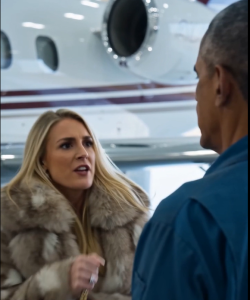
The blonde woman stepped through the hangar doors wearing a huge luxury fur coat over a beige dress, hoop earrings shining beside her styled hair, and a dark designer handbag hooked over one arm. She looked around as if the entire place existed to serve her schedule. The jet, the crew, the lights, even the people moving near the aircraft all seemed, in her mind, part of a service she had already paid for.
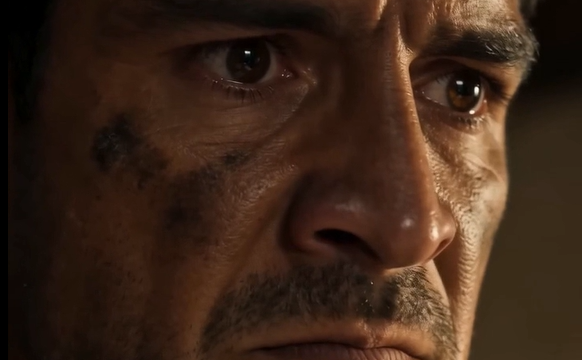
Near the nose of the plane stood a mechanic in a dirty blue jumpsuit over a black polo shirt. Grease marked his sleeves, collar, and one side of his face. His work gloves were heavy and stained from the inspection he had been doing himself. He had short dark hair, calm eyes, and the posture of someone who knew what mattered.
She slowed, saw the grease, and curled her lip as if his presence had offended her. The mechanic was standing between her and the foot of the stairs, checking something near the aircraft. He had not blocked her intentionally. But to the woman, being made to pause was already an insult.
“Get out of my way, you filthy man,” she snapped, her voice bouncing off the high walls of the hangar. “You’re going to dirty my expensive clothes.”
Before he could answer, she shoved him with her designer handbag. It was not a light tap or careless bump. It was sharp, angry, and meant to humiliate. The bag hit his side hard enough to move him back a step. A smear of grease on his glove brushed against his own jumpsuit as he caught his balance, but he did not raise his voice. He only looked at her, steady and silent.
“Do you people not understand where you’re allowed to stand?” she said, glancing at his stained clothes with disgust. “This is a private jet, not some garage. I have a business flight, and I will not have it ruined by someone who looks like he crawled out from under an engine.”
The mechanic studied her. His expression gave away almost nothing. Around them, the hangar had gone quieter. A few workers stopped pretending not to hear. They knew the man in the blue jumpsuit. They knew why he was there. More importantly, they knew what the woman did not.
He simply said, “The aircraft is being checked for safety, ma’am.”
She laughed under her breath, a short sound without kindness. “Safety? I am paying for comfort, privacy, and speed. I am not paying to be delayed by dirty hands.”
Then she lifted her boarding pass as if it were a royal decree and stepped toward the stairs.
The pilot emerged from the cabin, dressed in a crisp white short-sleeve shirt with epaulets, a black tie, and black trousers. He descended briskly, professional and composed. The woman turned toward him, expecting he would support her complaint. She even raised her chin, preparing to point out the mechanic who had dared stand near her path.
He reached the bottom of the stairs, stopped squarely in front of the mechanic, stood at attention, and saluted.
“Mr. President,” the pilot said clearly, “the private jet is ready for your business trip.”
The woman’s face changed so quickly that everyone saw it. Her anger collapsed into confusion, then fear, then disbelief. Her mouth opened, but no sentence came out. She looked from the pilot to the mechanic, then back again, searching for some way to make the moment less real. The man she had shoved, the man she had called filthy, was not a disposable worker in her story. He was the president of the aviation company. He was the owner of the jet. And he had been working on the plane himself.
The mechanic did not smile. He did not enjoy her panic. Humiliation is sometimes easier when the person you wronged becomes cruel in return. But his calm authority left her with nowhere to hide.
Slowly, he pulled off one heavy, grease-stained glove. The leather made a soft rustling sound in the silence. Then he removed the other. Beneath the grime and workwear, a pristine two-tone luxury watch gleamed on his wrist, spotless, elegant, and unmistakably expensive. It had been hidden there the whole time, not because he needed to prove anything, but because real power rarely needs to announce itself before doing the work.
Her hand tightened around the boarding pass.
“Sir, I had no idea,” she said quickly, her voice suddenly smaller. “There has been a misunderstanding.”
The mechanic looked at the ticket in her hand, then at her fur coat, handbag, and eyes. He reached out and plucked the boarding pass from her fingers.
“There was no misunderstanding,” he said. “You understood exactly what you were doing when you thought I was only a mechanic.”
Her cheeks flushed. “I was upset. I have an important meeting. I’m expected.”
“So was this aircraft,” he replied. “It was expected to carry you safely through the sky. That happens because people with dirty hands inspect the engines, tighten the bolts, check the systems, and notice the small problems passengers never see. You saw grease and decided it meant I deserved disrespect. But grease on a uniform can be evidence of responsibility.”
The pilot remained silent beside him. The workers watched, not with delight, but with the quiet satisfaction that comes when arrogance finally meets a boundary.
“Private flight canceled for you,” he said. His voice was calm, formal, and final. “Learn to respect those who keep your plane from falling.”
For the first time since entering the hangar, the woman looked small. She looked small because the truth had reduced her image of herself. The coat, jewelry, handbag, and expensive clothes could not cover the ugliness of how she had treated a person she believed had no power.
The president turned back toward the jet. The camera of life, if there had been one, would have pulled wide then, showing the full scale of the aircraft inside the glowing hangar: the lowered stairs, the silent pilot, the stunned woman, and the mechanic-president standing exactly where he had belonged all along.
The lesson was not that every mechanic might secretly own the plane. The lesson was better than that. A person should not need a title, a watch, or a private jet before receiving basic respect. The people who keep the world running often wear uniforms, gloves, stains, name tags, and tired shoes. They may not look powerful to someone blinded by status, but their work carries lives, families, businesses, and futures.
She left learning, in front of everyone there that morning, that character is revealed most clearly in how we treat people when we think they cannot do anything for us.