He had been only a stray in Blackwood, a thin, limping dog with no collar, no porch, and no one waiting for him. Most nights, he slept behind the Silver Slipper Diner, digging through trash and dodging angry shoes. To the town, he was a mangy nuisance. To himself, he was simply alive.
Then Leo Martinez disappeared.
Leo was eight, the mayor’s grandson, and his smiling face appeared on every lamppost and storefront window before sunrise. Search parties gathered in the square. Parents held their children tighter. Volunteers carried flashlights and fading hope.
Sheriff Miller stood at the center with a clipboard and a calm, official voice, sending teams to the woods, docks, highway, and marsh. “Stay calm,” he kept saying. “Trust the process.”
Nobody watched the stray watching him. But dogs notice fear beneath aftershave and boots carrying places men deny. On the day Leo vanished, Miller’s boots smelled of salt, stone, fresh mortar, and cologne. That scent drifted near Northern Point, where the condemned lighthouse stood. Developers wanted that land. Catherine refused to sell.
By day three, hope was fading.
That afternoon, before the stray could drink outside the diner, Miller’s boot kicked his bowl across the gravel.
“Get moving, you useless stray,” Miller snapped. “We don’t need a mangy mutt tripping up the search.”
The volunteers looked away. Nobody wanted trouble with Miller.
The dog limped off, but not away. Under the sheriff’s coffee breath and nervous sweat, he caught Leo’s fear, fresh mortar, lighthouse stone, and Miller’s cologne. He followed it toward the cliff path.
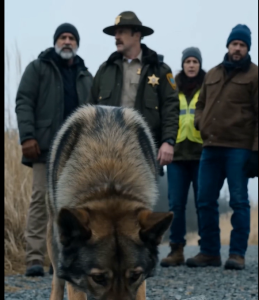
Near the lighthouse parking area, nearly fifty exhausted townspeople stood silent. The dog moved among them, nose close to gravel, weeds, and salt air. The trail sharpened. Leo had been there recently.
“We’re wasting time on a stray,” Miller called. “Get it out of here.”
The dog ignored him. He froze, ears lifted, body aimed at the lighthouse, its peeling door nailed shut beneath a red CONDEMNED sign.
A weathered man named Elias stepped forward. “Wait,” he said. “Look at him. He’s found something.”
For once, every eye turned to the dog. Then he ran.
Behind him, voices erupted. “Follow him!” One quiet voice cursed. Miller had hesitated.
The dog slammed the boarded door until wood cracked. Elias pulled a board loose. Others joined until the door gave.
“Everyone stay back,” Miller ordered, pushing forward. “This is police business.”
Catherine Martinez stepped in front of him. Her face was hollow, but her voice was steel. “If that dog thinks my grandson is in there, we are going in.”
Inside, the spiral stairs climbed into darkness. The dog scraped upward over rusted metal.
“Leo!” Catherine cried. “Baby, are you here?”
Only footsteps and ragged breathing answered.
At the gallery level, the scent overwhelmed him. He pawed at mortar too pale, too new, clawing until blocks shifted.
Elias leaned close, flashlight shaking. “Someone sealed this recently.”
“Stop!” Miller shouted, panic breaking through his authority. “You’ll bring the structure down. Everyone out.”
“No,” Catherine said. “Keep going.”
The dog dug until his paws bled. The wall broke, and a pale, tear-streaked face appeared.
“Grandma?”
Catherine pulled him into her arms. He was filthy, weak, and shaking, but alive.
“He locked me in there,” Leo sobbed. “Sheriff Miller. He said he was showing me the boats. Then he pushed me inside and bricked up the wall. He said nobody would ever find me.”
The lighthouse went silent.
Miller reached toward his holster. “The boy is confused,” he said. “Traumatized.”
Leo lifted his tear-streaked face. “You said the developers would pay you when Grandma sold the lighthouse. You said if I was gone, she would sign anything.”
Elias stepped between Miller and the boy. “Don’t even think about it.”
The sheriff looked toward the stairs, but the crowd blocked them. There was nowhere to go.
“You’re going to believe a hysterical child and a stray dog?” Miller laughed, but it cracked. “I organized this search. I led every team.”
“You led it away from here,” Catherine said. “You made sure nobody searched the lighthouse.”
Elias pointed to the broken wall. “Your cologne is on that mortar. Your boot prints are in the dust.”
Miller backed up, hand closing around his gun.
The dog stepped in front of Leo and growled.
“Move,” Miller warned.
The dog did not move.
The gunshot thundered through the tower. Pain tore across the dog’s shoulder, but he charged anyway, all street instinct and loyal fury. He struck Miller low at the knees. The sheriff stumbled backward into the rusted railing. It gave way.
His scream disappeared below. The dog collapsed, blood darkening the floor.
Leo dropped beside him, pressing small hands to the wound. “Please don’t die,” he cried. “Please.”
Elias wrapped his jacket around the dog. Catherine held Leo and touched the stray’s head as paramedics rushed in.
One medic looked at Miller’s gun, then at the dog. “The child comes first.”
Elias stood, voice quiet and immovable. “That dog saved the child.”
Catherine’s eyes burned. “He took a bullet for my grandson. Treat him like the hero he is.”
They did.
Three days later, the dog opened his eyes in a bright veterinary room that smelled of antiseptic. Elias sat beside him.
“Hey, Cooper,” Elias whispered. “You scared us.”
Cooper. The dog heard the name like warmth.
Elias scratched behind his ears. “Your heart stopped twice, but you came back. Stubborn thing.”
He told him what the town had learned. Miller’s phone held messages from developers in Portland. They had promised him twenty thousand dollars to force the sale. When Catherine refused, Miller decided grief might make her sign what pressure could not.
“Everyone knows now,” Elias said. “Leo keeps asking when he can see you.”
His voice softened. “I lost my wife and daughter two years ago. Since then, I’ve only been pretending to live. Then I saw you, a dog with every reason to hate people, choose to save a boy anyway. You reminded me that pain doesn’t free us from doing what is right.”
He touched his forehead to Cooper’s. “I bought the cottage on South Ridge. Three acres. Big porch. Needs work. It could be home for both of us.”
Cooper’s tail thumped once.
A month later, Blackwood’s square looked different. The missing posters were gone. In their place stood a carved sign honoring Cooper, the Watchman of Northern Point, with a promise that no stray in Blackwood would go hungry again. Beside it, a low stone fountain ran with fresh water.
Cooper sat there in a new leather collar, his limp still with him, but his ribs covered and his place secure.
“Cooper!” Leo shouted, running up with blue sea glass in his palm. “Grandma says the lighthouse is a museum now. Your picture is going in the lobby.”
Cooper licked his ear, and the boy laughed. Elias arrived with two ice cream cones, handed one to Leo, and offered the other to Cooper. “Don’t tell the vet,” he said.
As dusk settled, the lighthouse beam crossed the gray sky. It was no longer a tomb. It was a promise for the lost and the found.
Cooper rested his head on Elias’s boot. The wind was but he did not shiver. He was not invisible anymore. He was Cooper: friend, survivor, hero, and home.