Daniel Carter had learned that a person could vanish in the middle of a crowded street. For six years, his wheelchair had been parked outside the closed deli on West Madison, a cardboard sign leaning against one wheel, his life depending on coins, leftovers, and hurried strangers. Before the accident, he had been a construction foreman. Then a steel beam fell, crushed his spine, and doctors called the damage permanent and irreversible. He sat beneath the sun, ignored by traffic and people alike. He had once measured days by blueprints and paychecks; now he measured them by shade, soreness, and whether anyone would meet his eyes. Pride had not left all at once. It had worn down slowly, meal by meal, until survival felt like the only schedule he could keep. Some mornings he dreamed he was climbing ladders, shouting instructions over machinery, and walking home tired but useful. Waking up was the cruel part, because the room always returned first, then the chair, then the silence. That sandwich was not lunch; it was tomorrow’s courage, folded in paper. And he was tired. Still, something inside him kept watching the street. On his lap rested half of a turkey sandwich, wrapped. It was his only meal.
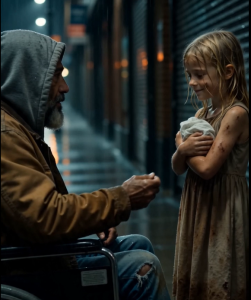
Then a girl stopped in front of him. She looked about thirteen, barefoot on the scorching sidewalk, wearing a torn brown dress, her cheeks streaked with dirt. But her eyes were calm, steady, and strangely wise.
“You’re hungry,” she said.
Daniel swallowed. “We both are, kid.”
She looked at the sandwich. “Give me that, and I’ll help you.”
He laughed bitterly. “Help me how? You carrying a miracle around?”
“Something like that.”
She sounded certain. Daniel studied her face, then handed her the sandwich. She accepted it gently.
“Thank you,” she whispered.
Then she looked down at his legs. “They’ll heal,” she said. “Sooner than you think.”
She smiled and turned away.
“Wait,” Daniel called. “What’s your name?”
But she disappeared into the lunch crowd like smoke.
Daniel sat frozen. A faint warmth moved through his calves. He gripped his knees and felt it again. “I felt something,” he whispered. Maybe hunger had finally broken his mind.
The next evening, rain hammered Daniel’s studio while he heated soup. Nobody ever knocked, but someone did. He wheeled over, looked through the peephole, and nearly stopped breathing. The girl stood there in the same torn dress, her bare feet clean and dry despite the storm.
Daniel opened the door. “You came.”
“You gave me food when you had nothing,” she said. “That matters.”
She walked inside, noticing the mattress, bare walls, and single lamp.
“You live alone.”
“Six years. Since the accident.”
“What happened?”
“Construction site. A beam fell. Crushed my spine. Doctors said I’d never walk again.”
She looked at him with quiet certainty. “They were wrong.”
Daniel laughed sharply. “I appreciate the hope, but—”
“Stand up.”
The room went silent except for the rain.
“I can’t.”
“Yes, you can.” “You’re afraid of what it means if you try and fail again.”
“I tried everything,” he whispered. “Therapy. Treatments. Everything.”
“You haven’t tried believing. Close your eyes.”
Daniel obeyed. Heat shot through his legs, fierce and electric. He gasped as sleeping nerves woke all at once.
“What are you doing?”
“Reminding your body what it forgot. Breathe.”
His toes curled inside his worn sneakers. “My toes moved!”
“I know,” she said. “Now stand.”
Daniel pressed his palms down. His legs shook, but held. Inch by inch, he rose from the wheelchair. For five seconds, Daniel Carter stood. Then his knees buckled. The girl caught him and lowered him to the floor.
Daniel sobbed and laughed. “I stood. I actually stood.”
She moved toward the door.
“Wait. Who are you?”
She paused. “My name doesn’t matter. What you do with this matters.”
“With what? I stood for five seconds.”
“Tomorrow it will be ten. Next week, you’ll reach the corner. Next month, you’ll run. The question is what you will do when you can.”
Before he could answer, she disappeared.
The next morning, Daniel stood for twenty seconds. By afternoon, he took three steps. His landlord found him and called an ambulance. At County General, doctors tested him. Dr. Chen stared at the scans.
“This does not make sense,” she said. “Your last MRI showed severe spinal damage. Irreversible trauma.”
“And now?” Daniel asked.
“Now you have full nerve function and complete motor control, as if the injury never happened.”
“So I can walk?”
“With physical therapy, yes.”
News vans arrived. Reporters called it a miracle recovery. Doctors called it unexplained. Daniel smiled through interviews, but one question consumed him: Where was she?
After three weeks of therapy, he walked into sunlight and searched. He showed her sketch along West Madison, then at shelters, kitchens, stations, and underpasses. No one had seen her.
One exhausted night, he entered the library and flipped through old newspapers. On page seven of a two-year-old edition, a headline froze his breath: Girl, 13, Dies Saving Child in Hit-and-Run.
The photo was her. Same face, eyes, and brown dress.
Her name was Maya Rodriguez. She had pushed a six-year-old out of a speeding car’s path, and the driver never stopped. Daniel read it three times. Maya had died two years before his accident. The last line said witnesses saw her whisper something before she passed, though no one heard them.
Daniel closed his eyes and remembered what he had mistaken for traffic noise on the sidewalk: You’re not done yet.
He left the library walking on legs that worked, and he understood. Maya had healed his body and handed him a purpose.
The next morning, Daniel volunteered at the West Madison shelter. He brought sandwiches to people under bridges. He learned names and listened to stories. Soon he organized clothing drives, weekly meals, and help from churches.
People began calling him the Walking Man, who beat paralysis and used his second chance to serve. Daniel never corrected the nickname. He simply kept walking.
Three months later, he organized a 5K for spinal injury research. Two hundred people registered; a donor gave fifteen thousand dollars. At the starting line, Daniel stretched. When the race began, he ran slowly but steadily. His calves cramped, yet he kept going.
Near the finish line, he saw her barefoot in the torn brown dress, smiling. He blinked, and she was gone. But he had seen her nod.
Daniel crossed the finish line in tears. Later, he framed Maya’s photo and whispered, “Thank you.” The room stayed quiet, but he felt sure she had heard him.
Six months later, the Walking Man Foundation opened a West Madison community center with free meals, job resources, and medical support. At the ribbon cutting, someone asked what inspired it.
Daniel smiled. “A girl once told me I wasn’t done yet,” he said. “It took me a while to understand.”
That night, he found a small wrapped sandwich on the front step, still warm. Daniel looked down the empty street, saw only lights and shadows. Maya was still walking beside him. He unwrapped it, took a bite, smiled through tears, and kept walking, because he was not done yet. Not even close.