The fire took them on a Tuesday, the kind of ordinary Tuesday that gives no warning before life splits in two. My wife, Tessa, had been reading bedtime stories to our three-year-old son, Michael. He had his favorite blue truck tucked against his pajama shirt. I was working late at the warehouse, wearing the same heavy parka I used for night deliveries, thinking about invoices, a broken loading dock light, and whether I would get home before Tessa fell asleep.
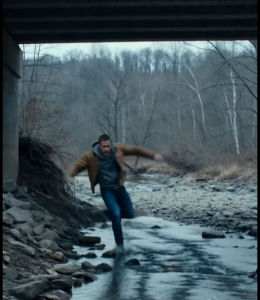
Then my phone rang.
I remember the call in pieces. A neighbor’s shaking voice. Sirens in the background. My street name. The word fire. I drove too fast, praying at every red light, bargaining with a God I had barely spoken to in years. When I turned the corner, orange light was pouring through every window of our house, raging through the rooms where my family had just been living.
I ran toward it.
The firefighters stopped me before I reached the front walk.
“Sir, you need to step back.”
“My family is in there!”
Two of them held me. I fought like a man who had already lost his mind. I screamed their names until my throat felt torn open. Tessa. Michael. I kept thinking that if I shouted loudly enough, they would answer. If I pushed hard enough, someone would let me go. If I begged in the right words, the world would rewind one hour.
It did not.
By morning, there was no house left, not in any way that mattered. Only black beams and wet ash remained. A firefighter handed me a blanket. I let it hang around my shoulders because I had forgotten how to move. People came and went. Someone asked questions. Someone said they were sorry. Every voice sounded far away, like it was coming from the bottom of a well.
The funeral was four days later.
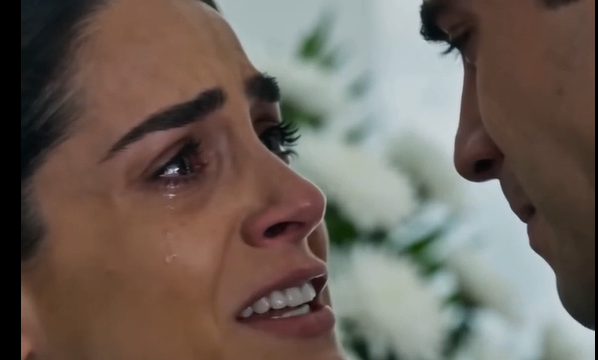
I stood at the front of the church in a dark suit that felt borrowed from another man’s closet. Two closed caskets rested beneath soft flowers, one heartbreakingly small. I could not look at that one for more than a second. Friends, neighbors, and warehouse workers filled the pews. They cried quietly and waited for me to speak. I thought grief would give me words. Instead, it hollowed me out.
When Pastor Pierce nodded, I stepped forward. My mouth opened. Nothing came out except a broken sound. I gripped the pulpit until my knuckles hurt, but I still could not say my wife’s name. I could not tell them how Tessa sang while washing dishes, or how Michael called pancakes “morning cakes.” Those memories were too alive. Saying them out loud would have made the caskets real.
So I stepped back.
After the service, people hugged me at the church door. They said the things people say when language is too small. You are in our prayers. She was a wonderful woman. He was such a bright little boy. I nodded because they meant well, but every sentence landed like a stone.
Pastor Pierce caught me as I reached the steps. He was an older man with gray hair and calm eyes, steady when everyone else was falling apart.
“Don’t turn right or left,” he said gently. “Just walk straight.”
I stared at him, waiting for something more. Maybe an explanation. Maybe a reason. Maybe one sentence that could make a father understand why a bedtime story had ended in smoke and sirens. He gave me only that.
Don’t turn right or left. Just walk straight.
For one terrible second, I wanted to hit him. I wanted to grab his collar and ask what kind of God lets a three-year-old die in a house where his mother is reading to him. I wanted to demand why Tessa, who remembered birthdays and always helped stranded drivers, had been taken while men like me kept breathing.
But I did not hit him. I did not ask.
I walked straight to my truck, climbed inside, and drove.
There was no going home, so I went to the apartment the insurance company arranged. It had beige walls, a narrow kitchen, and windows that faced a parking lot. Nothing in it belonged to me except the duffel bag and the smell of smoke trapped in my hair and clothes. That first night, I sat on the bed and listened to the refrigerator hum. I waited for Tessa’s footsteps, for Michael’s voice asking for water, for life to continue out of habit.
It did not.
Maren came three days later.
She was Tessa’s younger sister, and grief had made her face look older than it should have. She did not knock. She simply left a pan of lasagna on the porch and sat on the steps like she planned to stay until I acknowledged her. I saw her through the blinds for twenty minutes. Part of me wanted her to leave. Part of me wanted someone to prove I had not disappeared with the house.
When I finally opened the door, she looked up.
“You don’t have to talk,” she said. “But you do have to eat.”
I almost told her I was not hungry. Hunger had become meaningless. Food tasted like cardboard. Coffee went cold beside me. Days passed in a blur of forms and people whispering around my pain. But the look in Maren’s eyes stopped me. She had lost her sister. She had lost the little boy who used to run into her arms yelling, “Aunt Mare!” I did not have the right to make her carry my emptiness too.
So I took the lasagna inside.
We ate at the tiny table without turning on the television. For a while, only forks and passing cars made noise. Maren did not ask how I was doing. She knew better. Instead, she told me Tessa once called her at midnight because she was convinced Michael had swallowed a penny, only to find it stuck inside his sock. I almost smiled. Then the almost-smile hurt so badly I put my fork down.
“I keep hearing them,” I said.
Maren nodded, tears gathering but not falling.
“I know.”
That was all. No sermon. No advice. No promise that time would heal everything. Just I know.
The nights remained the worst. In that apartment, silence had weight. The refrigerator hummed like a machine in a hospital room. The water heater clicked behind the wall. Pipes knocked. Cars rolled over gravel. Every noise reminded me that no one was breathing beside me, no child was turning in his sleep, no wife was whispering that tomorrow would be better.
Sometimes I woke reaching for Tessa. Sometimes I thought I heard Michael laugh. Sometimes I stood in the kitchen before sunrise, repeating Pastor Pierce’s words under my breath because they were the only instructions I had.
Don’t turn right or left. Just walk straight.
I did not know where straight led. I did not know whether faith was still possible, or whether joy could ever enter a room without feeling like betrayal. All I knew was that on Tuesday, the fire had taken my family, and morning kept coming anyway.
So I walked into it alone.