A bus full of passengers feared the wolves had come to attack, but the truth waiting in the snow changed everything they believed about danger, fear, and mercy.
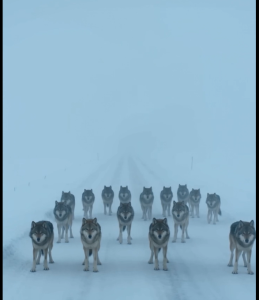
A pack of wolves surrounded the bus in the middle of a brutal winter storm, but the predators did not attack. The passengers stared through frozen windows, terrified and confused. What happened next would haunt them for years.
The bus rolled along the mountain highway slowly, as if the old vehicle knew that one mistake could turn deadly. Its tires slipped on ice, then caught again. Snow struck the windshield, and wind howled across the road.
Inside, it was warmer, but no one took off a coat. Scarves covered faces, and the windows were cloudy with breath. Frost crept along the glass. Some passengers searched for the next village. Others waited silently.
The driver was Martin Hale, a man in his fifties with tired eyes and hands that knew every curve. For twenty years, he had driven these roads. He understood winter. It did not forgive pride, impatience, or panic.
That afternoon, Martin drove with steady caution. The headlights cut a short tunnel through the blowing snow. Then his eyes narrowed.
Something was moving ahead.
At first, he thought wind was pushing snowdrifts over the pavement. Then the shapes grew darker, longer, and deliberate. One gray figure stepped onto the road. Then another. Then several more.
“No,” Martin whispered. “That can’t be.”
Within seconds, the white curtain filled with bodies. They moved like shadows, heads low, gray coats blending with snow.
Wolves.
Not one or two. Dozens.
Martin hit the brakes. The bus slid sideways for one terrifying second, tires crying against the ice, before it stopped a few yards from the pack. A woman gasped. Then silence filled the bus.
“What happened?” someone asked from the back.
Nobody answered. Passengers stood, leaned forward, and wiped circles into the fogged windows. When they saw what waited outside, fear moved through them.
“Wolves,” a man breathed.
The pack stood in front of the bus, blocking the road. Then more appeared along both sides. A few moved behind them. They padded through the snow without hurry. Their eyes caught the headlights like sparks.
“They’re surrounding us,” someone said.
“They’re going to attack,” a younger man whispered.
“Lock the doors!” a woman cried.
“They can break the windows, can’t they?” another passenger asked.
Martin kept both hands on the wheel. He left the engine running but did not move. He had seen wolves before from a distance. He respected them and feared them. But this was not normal.
The wolves were not snarling. They were not leaping at the bus. They simply stood there, still and focused.
Then the largest wolf stepped forward. It was broad and gray, with a dark stripe along its back. It stopped in front of the bus, looked at Martin, then turned toward a narrow ditch beneath snow.
“What is it doing?” a woman asked.
The wolf looked back at the bus, then toward the ditch again.
Martin felt a strange chill. The animal was not threatening them. It was trying to show them something.
“Everybody stay seated,” he said. “No one opens a window. No one screams.”
“Are you crazy?” the younger man snapped. “Drive through them!”
“If I hit one, they may attack,” Martin said. “Stay still.”
The large wolf moved toward the ditch. Two others followed, looked down, then turned back to the bus.
That was when Martin heard it.
Not a growl. Not the wind. A thin, broken sound came from beyond the snowbank.
A child crying.
Martin froze. “Did you hear that?”
The bus went silent again. Beneath the roar of the storm, the sound came again, weak and distant, but human.
“Oh my God,” someone whispered.
Martin grabbed the radio and called for help. Static answered. He tried again, but the storm swallowed the signal.
He looked at the wolves. The big gray one stood by the ditch, watching him.
Martin opened the emergency panel and pulled out a flashlight, a flare, and the first-aid kit. The passengers reacted.
“You can’t go out there!”
“They’ll kill you!”
“Please, don’t open the door!”
Martin looked back at them. “Someone is out there in this storm. If that is a child, we may be the only chance they have.”
His words quieted the bus.
Slowly, he opened the door. Wind rushed across the steps. The wolves did not move closer. They only watched.
Martin stepped into the storm. The cold stole his breath. The big wolf backed away, then turned toward the ditch. Martin followed carefully.
At the edge, he aimed the flashlight down.
A small car lay almost buried in the ditch, nose first in the snow. Its windshield was cracked. Beside it, wrapped in a red coat, was a little girl no older than six. She was shaking and clutching a toy rabbit. Behind her, an older woman sat slumped against the car, alive but barely conscious.
Martin slid down the snowy bank.
“It’s okay,” he called. “I’m here to help.”
The little girl looked up. “Grandma won’t wake up,” she sobbed.
Martin checked the woman. She was breathing, but freezing and dazed. He wrapped his coat around the child first, then shouted toward the bus.
“Two people! I need blankets!”
For one second, no one moved. Then fear became purpose. A retired nurse pushed to the front. Two men grabbed blankets. Another passenger found warm tea. The young man who wanted to drive through was first outside after Martin.
Together, they carried the child up to the bus. The wolves opened a path without a sound.
Then they helped the grandmother while the nurse checked her breathing. Once both were inside, passengers wrapped them in coats and blankets. The little girl kept staring at the wolves.
“They found us,” she whispered.
Martin looked at her. “What do you mean?”
“Our car went off the road,” the girl said, shivering. “Grandma told me not to sleep. I cried for help, but nobody came. Then the wolves came. I thought they were bad, but they stayed near us. One kept looking toward the road.”
No one spoke.
Outside, the big gray wolf stood in the headlights. Snow gathered on its back. It no longer looked fierce. It looked watchful.
Minutes later, the radio crackled. Martin reached emergency services and gave their location. Until help arrived, the bus waited. The wolves remained around it, simply standing guard in the storm.
When distant sirens rose through the wind, the big wolf lifted its head. One by one, the pack turned and slipped back into the forest. Within moments, they were gone, swallowed by snow.
The rescue team arrived soon after. The grandmother and child survived because they had been found in time. Later, everyone on that bus told the same story: the wolves had not come to hunt. They had come to save lives.
That truth humbled everyone aboard, because the creatures they had feared had shown more patience, discipline, and mercy than any person on that frozen highway had expected on that unforgettable winter afternoon in the lonely white mountains.
And Martin Hale, learned something he never forgot. Sometimes help does not arrive with lights or voices. Sometimes it comes on silent paws, through a storm, from creatures people are taught to fear.