When her husband abandoned her during her darkest moment, he thought fear would silence her. But some women rise from pain stronger than anyone imagined.
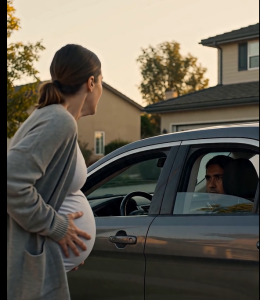
The road seemed endless that afternoon, a gray strip of asphalt cutting through empty fields and scattered houses. I sat in the passenger seat with both hands on my pregnant belly, trying to stay quiet. For most of the drive, nothing seemed wrong. The radio played softly. The sky hung low and pale. Then a sharp pain tore through me so suddenly that I bent forward and cried out.
At first, I thought it might pass. I tried to breathe through it, but the pain only tightened, deep and frightening. My fingers trembled against my stomach. One thought filled my mind: something was wrong with the baby.
“Please,” I said, turning toward him. “Take me to the hospital. It really hurts.”
He kept his eyes on the road. His hands gripped the steering wheel harder, and he let out an irritated sigh.
“I’m serious,” I whispered. “Please. I’m scared.”
He still said nothing. The car moved faster. Another wave of pain came, and I could not stop myself from crying out again.
That finally made him turn his head.
“Stop yelling,” he snapped through clenched teeth. “You’re getting on my nerves.”
I stared at him, shocked. “I’m not trying to bother you. I can’t calm down. Something is wrong.”
“You always make everything dramatic,” he muttered.
The words hurt, but the pain in my body was worse. I clutched my belly and begged again. “Please, just take me to the hospital. I need help.”
Instead of answering, he tapped his fingers against the wheel and pressed harder on the gas. The empty road blurred outside my window. I saw no stores, no clinic, no people, only fields and fences. Fear rose in my chest until I could barely breathe.
Then, without warning, he slammed on the brakes.
The car lurched onto the shoulder, gravel popping under the tires. For one hopeful second, I thought he finally understood. Maybe he was going to call an ambulance. Maybe he was going to wait beside me.
But when he looked at me, his face was cold.
“Get out,” he said.
I blinked, not understanding. “What?”
“You heard me. Get out.”
“I’m pregnant,” I said, my voice shaking. “I can barely stand.”
He leaned across me and pushed the passenger door open. Cold air rushed in.
“I don’t care about you or that child,” he said. “Get out.”
Those words cut deeper than the pain. Until then, I had made excuses for him. I told myself stress made him cruel, marriage had hard seasons, and he might change when the baby arrived. But hearing him say he did not care while I held my stomach in terror made something inside me go silent.
I slid one foot onto the gravel, then the other. My legs shook so badly that I had to hold the door to stay upright. Everything dimmed at the edges.
“Please,” I whispered. “Don’t leave me here.”
He looked annoyed, not ashamed.
“Think about your behavior,” he said.
Then he slammed the door.
A moment later, the car pulled away. I watched it shrink away, leaving dust, silence, and my uneven breathing. I stood there because my mind refused to accept that my husband had abandoned me. Then another wave of pain bent me in half, and I dropped to my knees on the roadside.
The asphalt was cold beneath my palms. There were no passing cars, no voices, no footsteps. A mailbox leaned near a dirt driveway, but I could not tell how far the house was. I pressed one hand to my belly and whispered, “Hold on, baby. Please hold on.”
I tried to crawl toward the mailbox, but the pain came in waves. Each time it hit, I had to stop and breathe. My throat burned from calling for help. The road felt like the loneliest place in the world.
Minutes stretched until they felt like hours. I remember thinking that strangers might have shown more mercy than the man who had promised to protect me.
At last, an old pickup appeared in the distance. I lifted one hand, but I was too weak to wave properly. The truck almost passed, then slowed. A woman in her sixties jumped out and ran toward me.
“Oh, honey,” she said, kneeling beside me. “What happened?”
“My baby,” I whispered. “Please help my baby.”
Her name was Martha. She wrapped her coat around my shoulders, called emergency services, and stayed with me while we waited. She held my hand. “You’re not alone now,” she kept saying. “Stay with me.”
At the hospital, everything moved quickly. I remember staring at the ceiling and praying that my child would live, even if I had to face everything else alone and never return to that fear. There were bright lights, hurried voices, machines, and nurses telling me to breathe. I heard someone say I had arrived just in time. I heard another voice say the baby’s heartbeat was still there. I held that sentence like a lifeline.
Hours later, exhausted and shaking, I heard the sound that changed everything: my baby crying.
A daughter.
Tiny, strong, alive.
When they placed her against my chest, tears rolled down my face. In that moment, revenge did not mean shouting, chasing, or begging my husband to regret what he had done. Revenge meant surviving. It meant holding my child after he had tried to leave us both behind.
But cruelty rarely disappears without leaving evidence.
Martha gave a statement. The emergency call recorded where I had been found. A traffic camera had captured our car and the time we passed. Hospital workers documented my condition when I arrived. While my husband went home pretending nothing had happened, the truth was already moving faster than his lies.
He called late that night.
“Where are you?” he demanded.
I looked at my sleeping daughter and felt something I had not felt in years: peace.
“Safe,” I said.
“You’re making a mistake,” he warned.
“No,” I answered softly. “I finally stopped making one.”
In the weeks that followed, his confidence fell apart piece by piece. There were reports, questions, and consequences he never expected. Friends who once believed his stories stepped back. Family members heard what he had said and where he had left me. The man who thought abandonment was power learned that the truth can be stronger than fear.
I rebuilt my life slowly. I learned to sleep without listening for anger in the hallway. I learned to buy baby clothes without asking permission. I learned that peace can feel strange when you have lived too long in fear. Martha visited often, bringing soup, blankets, and kindness.
Years later, people sometimes asked whether I got revenge.
I always told them yes.
My revenge was not becoming cruel. It was refusing to disappear. It was raising my daughter in a home where love was never used as a weapon, where no one had to beg for basic compassion, and where fear did not sit at the dinner table.
He left me on an empty road believing I was helpless.
He never understood that the moment he drove away, he lost every bit of power he had over me.