Everyone thought she was just there to clean the floor. But when a proud black belt tried to humiliate her, her quiet response taught the whole room a lesson they would never forget.
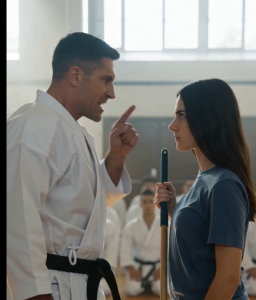
The karate gym was filled with its usual noise. Fists cracked against pads. Bare feet slid across the mats. Sharp commands echoed from wall to wall, followed by short breaths and the heavy sounds of athletes pushing past their limits. Every student trained hard, afraid to lose rhythm, afraid to show exhaustion, and afraid to look weak.
In the middle of the hall stood the coach. He was tall, powerful, and confident, with a black belt tied tightly around his waist. His movements were precise, but his stare was harsh. He did not simply teach. He controlled. When someone made a mistake, he shouted. When someone slowed down, he made the whole group repeat the drill. He believed pressure created champions, and he had no patience for fear, hesitation, or weakness.
The students respected him, but many feared him. He liked that. He often said that inside his gym, his word was law. He decided who sparred, who advanced, and who left feeling proud or ashamed.
That afternoon, training was intense. Sweat darkened uniforms, and the air smelled of rubber. During a short break, one student reached for a water bottle and accidentally knocked it over. The bottle rolled across the floor, spilling water across the main training area.
Everyone froze for a moment.
A wet mat was dangerous. One careless step could send someone falling hard, especially during kicks or fast movement. Someone quickly called for the cleaner.
A minute later, the side door opened. A young woman entered in simple work clothes, holding a mop and bucket. She looked calm under every stare. Without saying anything, she walked to the puddle and began wiping the water from the mat.
At first, most students ignored her. But the coach noticed immediately. He stopped, turned toward her, and frowned as if her presence offended him.
“What do you think you’re doing?” he snapped.
The girl kept the mop moving. “Cleaning the water,” she answered. “Someone called me.”
“You’re interrupting training,” he said. “Get out.”
She looked at the wet floor, then at him. “I’ll finish quickly and leave. The mat isn’t safe.”
A few students exchanged glances.
The coach gave a cold laugh. “I decide what is safe in this room. I said get out.”
The girl did not raise her voice. “You called me here because the floor needed cleaning. I’m doing my job.”
His expression hardened. He was not used to being answered, especially by a cleaner.
“Your job is to obey,” he said. “Or I’ll have you fired before the end of the day.”
She stood straighter, still holding the mop. “You’re not my boss. You don’t have that power.”
The hall grew quiet. Even the students at the back stopped whispering. Some looked down, uncomfortable. Others watched closely, sensing his pride had been challenged.
He stepped toward her.
“Be careful,” he said, lowering his voice. “I may not be your boss, but I can still make you regret disrespecting me.”
The girl did not move back.
“Is that a threat?” she asked.
He pulled at his black belt and smiled. “Do you see this? Do you know what it means? Of course you don’t. People like you clean floors. People like me command rooms. Karate is not your world.”
A few students chuckled nervously, then stopped when the girl turned and looked at them. Her face showed only calm disappointment.
She slowly set the mop across the bucket.
“I won’t tolerate disrespect,” she said.
The coach’s eyes narrowed. “You won’t tolerate it?”
“No,” she replied. “Not from anyone.”
The words hit harder than a shout. The coach had built his image on control, and now a quiet cleaner had refused to shrink in front of him. To him, that could not go unanswered.
He stepped onto the cleared part of the mat. “Then let me teach you something.”
Several students straightened. One whispered that this was going too far, but no one stepped in. They all knew his temper. They also believed the girl would back down.
She didn’t.
Instead, she calmly moved the mop aside so no one would trip. Then she faced him with her feet even and her hands relaxed. She did not look ready to fight. She looked ready to wait.
The coach mistook her calm for ignorance.
He dropped into a fighting stance. The students recognized it immediately. It was his favorite opening attack: a fast step forward, a hard strike, and a sweep meant to break balance. He had used it many times against strong athletes, and most fell before understanding it.
“Last chance,” he said.
The girl stayed silent.
He attacked.
His movement was fast and sharp. His foot drove forward. His shoulder turned. His arm came in with practiced force, meant to overwhelm her.
But she was no longer where he expected her to be.
She shifted half a step to the side, smooth and silent, as if she had read his body before it moved. His strike cut through empty air.
Before he could recover, she caught his wrist and guided his momentum downward. With her other hand, she pressed lightly against his shoulder. It was not flashy. It was not brutal. It was simple, controlled, and exact.
The entire hall froze.
The coach lost his balance. His knee dropped to the mat, his arm held in a position that made resistance useless. He was not injured, but he was trapped.
No one laughed now.
The girl did not twist harder. She did not try to hurt him. She only held him steady, proving with one calm action that real power does not need to shout.
The coach’s face turned red. He tried to pull free, but the more he struggled, the more obvious it became that she knew exactly what she was doing.
One older student whispered, “That isn’t beginner movement.”
Another swallowed hard. “She’s trained.”
The girl released him and stepped back.
The coach rose awkwardly. His anger remained, but doubt had entered his eyes. For the first time, he looked at her not as a cleaner, but as someone he had badly underestimated.
She picked up the mop and finished cleaning the water. Then she turned toward the class.
“Skill does not give anyone the right to insult another person,” she said. “A belt shows what you have practiced. It does not prove what kind of person you are.”
The students stood silent. Some looked ashamed. Others looked at the coach, waiting for him to answer.
He said nothing.
The girl lifted the bucket and walked toward the door. Before leaving, she looked back once.
“Respect should be part of every lesson,” she said. “Especially in a place that claims to teach discipline.”
The door closed behind her.
For a long moment, the gym remained still. The coach stood in the center of the room, his black belt still tied around his waist, but somehow it no longer seemed to carry the same weight.
That day, everyone in the hall learned something no drill had ever taught them: true strength is not proven by humiliating someone you think is weaker. It is shown through restraint, dignity, and courage when it matters most.