They judged him by his clothes and tried to throw him out. But when the chief surgeon saw his face, the entire hospital fell silent.
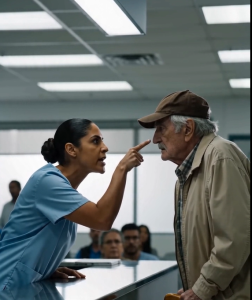
The hospital corridor was busy that morning. People filled the hard plastic chairs, waiting for appointments, test results, and news. A young mother rocked a sleepy child in her arms. An older couple sat shoulder to shoulder without speaking. A man in a business suit stared at his phone. The air carried the sharp smell of disinfectant, coffee, and worry.
Then, that morning, the automatic doors slid open, and a man stepped inside.
He wore a faded brown jacket, an old cap pulled low over his forehead, and shoes that had clearly seen better days. He held a wooden cane and carried a small cloth bag. His back was slightly bent, but his steps were steady. He moved slowly, not because he was lost, but because every movement seemed to cost him effort.
A woman wrinkled her nose. A teenager whispered something to his friend and laughed. Someone shifted away as the old man passed. It was true that he carried the smell of rain, street dust, and old clothes.
But he kept walking until he reached the reception desk.
Behind it sat a young nurse in a neat uniform, her hair pulled back tightly, her eyes fixed on the computer screen. She was typing quickly, barely looking up.
The old man removed his cap.
“Good morning,” he said softly. “I came to see the chief doctor. Could you please tell me where I might find him?”
The nurse did not lift her head.
“Take a number and wait like everyone else,” she said flatly. “The chief doctor doesn’t see people just because they ask.”
“I understand,” the old man replied. “But I was told he would want to know I was here.”
That made her look up.
The moment her eyes landed on his worn jacket and tired face, her expression changed. Her mouth tightened. She leaned back slightly, as though his presence alone offended her.
“Sir,” she said, lowering her voice but not enough to keep others from hearing, “you cannot just walk in here looking like this.”
The old man blinked. “Looking like what?”
She glanced toward the waiting area, then back at him.
“This is a hospital,” she said sharply. “Patients are already under stress. You smell unpleasant, and you are disturbing people.”
A hush moved through the corridor.
Several heads turned. Some people pretended not to listen, but their eyes gave them away. The businessman lowered his phone, and the young mother held her child closer.
The old man’s fingers tightened around his cap.
“I am sorry if I bothered anyone,” he said. “I walked here from the bus stop. It was raining earlier.”
“That is not my problem,” the nurse replied. “We have standards. If you need assistance, try a shelter or charity clinic.”
“I am not asking for charity,” he said quietly.
“Then why are you here?”
“To see the chief doctor.”
Her patience snapped. “You already said that. And I already told you, that is not possible.”
From the back row, someone muttered, “They should not let people like that in.”
Another voice added, “Maybe he wandered in from the street.”
The old man heard them. But he did not answer. He stood there, shoulders heavy, eyes calm.
The nurse reached for the phone.
“I am calling security,” she said. “You need to leave before you upset the patients.”
For the first time, pain crossed the old man’s face. Not anger. Not shame exactly. It was the tired pain of someone judged before he was heard.
He opened his cloth bag and pulled out a folded envelope.
“Please,” he said. “Just give him this. If he still wants me to leave, I will go.”
The nurse looked at the envelope as though it were dirty.
“I am not touching that.”
At that very moment, the doors to the operating area opened.
Everyone turned.
A man in blue surgical scrubs stepped out, pulling off his mask. Deep lines of exhaustion marked his face. The badge on his chest read Dr. Michael Harris, Chief Surgeon.
But he stopped.
His eyes fixed on the old man at the desk.
For one long second, the corridor seemed to freeze.
Then the chief doctor moved quickly toward him.
The nurse straightened. “Dr. Harris, I was just about to call security. This man is refusing to leave, and he—”
“Stop,” the doctor said.
The word was not loud, but it carried through the hallway.
The nurse fell silent.
Dr. Harris stood before the old man, staring as if seeing the past.
“Mr. Whitaker?” he whispered.
The old man gave a small, tired smile. “Hello, Michael.”
A wave of confusion passed through the corridor. The nurse’s face lost color.
Then the chief doctor took the old man’s weathered hand between his own.
“I have been looking for you for years,” Dr. Harris said, his voice breaking.
The old man shook his head gently. “I did not want to trouble you.”
“Trouble me?” the doctor repeated. “You saved my life.”
The hallway went silent.
Dr. Harris turned slightly, and everyone could see tears shining in his eyes.
“When I was twelve,” he said, “my mother died, and my father disappeared. I was hungry, alone, and sleeping behind a bus station. This man found me there. He was a janitor then, working nights. He brought me food. He paid for my school supplies. When I got sick, he took me to a clinic and stayed beside me all night.”
“He never told anyone,” Dr. Harris continued. “He worked two jobs so I could stay in school. When I entered medical school, I learned he had sold his family’s only land to help pay my tuition.”
Gasps moved through the waiting area.
The nurse stared at the floor.
Dr. Harris turned back to him. “Why did you disappear?”
The old man’s voice was soft. “You became a doctor. You had your own life. I was proud enough just knowing you made it.”
The doctor took the envelope from his hand. Inside was an old photograph of a skinny boy standing beside a janitor in a gray uniform. On the back were the words: Keep helping people.
Dr. Harris pressed the photo to his chest.
Then he looked at the nurse, with deep disappointment.
“This hospital treats human beings,” he said. “Not jackets. Not shoes. Not smells. Human beings.”
The nurse’s eyes filled with tears. “I am sorry,” she whispered.
The old man nodded. “Then remember it next time someone walks in looking tired.”
Dr. Harris put an arm around him and led him down the corridor. No one whispered now. People stood aside with respect.
And as the old man passed, the same hallway that had judged him moments earlier became silent for a different reason.
Because dignity is not always dressed in clean clothes, and kindness often returns wearing the face of someone we almost failed to recognize.