Everyone came to see a dangerous bull. But when a grieving little boy stepped into the arena with his father’s old bandana, the crowd learned the real danger had never been the animal.
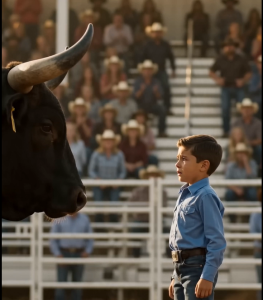
The arena had been built for noise, dust, danger, and entertainment. On that late afternoon, as the sun dropped behind the fairgrounds, no one expected the rodeo to become anything more than another show.
Dust floated like smoke over the packed dirt. Boots stomped on the wooden bleachers. Children pointed. Vendors shouted. Then the announcer’s voice cracked through the speakers, and every face turned toward the chute.
Everyone had come to see Ranger.
He was the bull people talked about before they bought tickets, a massive black animal with sharp eyes and a reputation that grew darker every season. Some called him wild. Others said he was too smart, too watchful, too quick to understand fear. Around the ranch, people spoke his name like a storm rolling in.
“Ladies and gentlemen,” the announcer boomed, “get ready for Ranger!”
The bleachers erupted. Gate crews moved into place. The handlers near the chute tightened their grips and kept their eyes low. Ranger shifted inside the pen, his dark body pressing against the rails.
Then everything changed.
A small figure slipped over the railing.
At first, some people thought it was part of the act. Maybe it was a stunt. Maybe the crowd was supposed to laugh. But then the small body hit the dirt with a sound that did not belong in any performance, and the laughter died.
It was a boy.
He could not have been more than eight years old.
“Get him out of there!”
“Run, kid!”
“Somebody grab him!”
The boy pushed himself up slowly. Dust clung to his shirt, arms, and face. His knees shook. His breathing came rough and uneven, but he did not cry out. He did not turn toward the gate or search for a rescuer.
He looked only at Ranger.
The bull turned.
The arena went silent so fast it felt unnatural, as if someone had cut the sound from the sky. The announcer stopped speaking. Even the men near the fence froze with their hands half-raised.
Ranger lowered his head.
The boy reached into his pocket.
His fingers trembled as he pulled out a faded red bandana, worn thin at the edges and softened by years of sun. He held it up with both hands, not like a flag to provoke an animal, but like something sacred.
“My dad said you’d know this.”
Ranger stopped.
The change in him was not rage. It was not confusion. It was recognition, quiet and sudden, passing through that enormous body like a memory waking after years underground.
“If you remember him,” he whispered, “please remember me too.”
Someone near the chutes swore softly. A woman in the stands covered her mouth. The old ranch hand beside the arena fence went stiff.
Then he charged.
The ground shook beneath him. Dust burst under his hooves. The crowd screamed as one terrified sound. Men lunged toward the fence, too far away to help.
But the boy did not run.
He did not lower the bandana. He did not flinch from the animal thundering toward him. He simply lifted the red cloth higher and stood there as if fear had already taken everything it could take.
Ranger stopped inches from his chest.
Then Ranger lowered his huge head and pressed it gently against the boy’s chest.
The boy broke then. Tears poured down his dusty cheeks as he wrapped both arms around the bull’s head. He held on with the desperate strength of a child who had carried grief too long and had finally found someone who understood its weight.
“I knew you’d remember,” he cried. “I knew you would.”
At the edge of the arena, the old ranch hand took one step backward. His face lost its color. His hands began to shake.
He knew that bandana.
C.H.
Caleb Hayes.
The best rider who had ever worked that ranch. The man who could calm a horse with a touch and ride bulls others refused to go near. Caleb Hayes had been respected by nearly everyone who knew him.
And Caleb Hayes had died on Ranger.
The boy slowly let go of the bull and turned toward the stands. His face was wet, but his eyes were clear. He raised one trembling hand and pointed straight at the old ranch hand.
“You lied to my dad before he died!”
The ranch hand froze in the dust.
The boy’s voice shook, but he did not stop. “You told him Ranger was fine. You told him he could ride.”
The man opened his mouth. “I didn’t—”
“You did!” the boy cried.
A murmur spread through the bleachers. People looked from the boy to the bull, then to the man by the fence. The rodeo no longer felt like a show.
“My dad said Ranger wasn’t right that day,” the boy continued. “He said he was scared. He said he was angry. He said something had changed.”
That was answer enough.
Because Ranger had changed. Not by nature. Not because he had been born a monster. He had been pushed, denied food, teased, crowded, and provoked until fear turned into fury. The people in charge had wanted a harder ride, a louder crowd, and a story that would sell more seats.
Caleb had seen it.
He had known the difference between a dangerous animal and a frightened one. He had said so before he climbed onto Ranger’s back. But the show had been announced. Money had been collected. The crowd had been promised something unforgettable.
So someone told him to ride.
The boy took another step forward, Ranger calm behind him like a shadow made of strength.
“You told him to do it anyway,” the boy said softly. “Even when he was afraid.”
The ranch hand’s knees seemed to weaken. His voice came out thin and broken.
“I was told to keep the show going,” he whispered. “I didn’t think it would happen that way.”
The boy looked at him for a long moment.
“You didn’t care.”
That sentence landed harder than any scream could have.
No one in the arena moved. The people who had come hungry for excitement now sat with shame settling over them. The bull they had feared stood quietly behind a grieving child. Ranger was still, less like a monster than a living witness.
The boy turned back to him and placed his forehead against the bull’s broad face.
“He didn’t blame you,” he whispered. “My dad knew it wasn’t your fault.”
His voice cracked.
“He only wanted them to stop hurting you.”
The wind pushed dust across the arena floor. Somewhere, a gate creaked. The announcer held the microphone at his side, silent for once. The rodeo workers stood frozen, exposed by the truth a child had carried into the dirt.
Nobody cheered.
Nobody clapped.
For the first time that afternoon, the crowd was not watching danger. They were watching the cost of turning pain into entertainment.
And as the sun sank lower, painting the dust around the boy and the bull in fading gold, one question stayed in the air long after the shouting ended.
Was Ranger ever the real danger, or were the dangerous ones the people who made him that way?