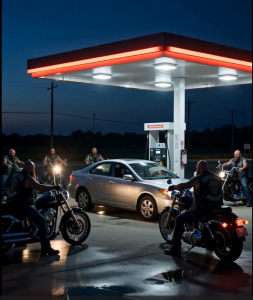
The air around the gas pumps changed in an instant. A moment earlier, the Iron Reapers had owned that lonely station. Now even the lights above the pumps seemed quieter, as if the night itself had stepped back. Their leader stared at the mark on Sarah’s wrist, and every bit of confidence drained from his face. He was not looking at decoration. He was looking at a symbol certain men whispered about but never repeated too loudly.
The trident wrapped in nightshade belonged to Echelon Shadow, a military unit that officially did not exist. People who knew the name understood one thing: its members were trained to survive where others disappeared, to finish missions no report would ever describe, and to leave no room for threats to follow them home.
Sarah lifted her eyes at last. They were no longer uncertain or polite. They were calm, steady, and empty of fear. The soft woman they had mocked was gone, or maybe she had never been there at all. What remained was someone who had spent years staying still while danger wasted its breath.
“I’m going to count to three,” she said.
“On one, you let go of the handle. On two, your men clear the pump area. On three, I leave.”
She stepped out of the car with careful, economical movement. There was nothing dramatic about it. She did not slam the door or raise her voice. She placed one foot on the pavement, then the other, balanced and ready. The young biker holding the wrench shifted backward. A minute before, he had been smiling. Now the tool in his hand looked almost childish.
He glanced at his leader, waiting for a command. The leader gave none. His fingers still clung to the door handle, but his mind seemed frozen between disbelief and panic.
“One,” Sarah said.
The man released the handle as if it had burned him. He stumbled back, nearly tripping over his own boots. The swagger that had filled the station dissolved into nervous movement and scattered breathing. These were men used to frightening strangers on back roads. They understood size, noise, and numbers. They did not understand a woman who needed none of those things.
Sarah stood beside the car, her gloved hand resting loose, her uncovered wrist visible beneath the harsh lights. She made no move toward a weapon. She did not have to. Her shoulders were relaxed, her knees soft, her weight centered. She had already measured every distance, every exit, every weakness.
For most of the bikers, that was enough. They began backing away from the pumps, their leather jackets creaking, their faces pale beneath their beards and bandanas. But the youngest one still had pride left, and pride can make a fool believe one last mistake will save him. With a sharp breath, he lifted the wrench and stepped toward her.
Sarah moved so fast the others barely understood what had happened. She turned just enough to avoid the swing, guided his arm aside, and struck his wrist with a precise motion that made him drop the tool. It hit the concrete with a flat sound.
Before the young man could recover, Sarah had him pinned against the side of the pump, not crushed, not harmed beyond control, but completely unable to move. Her hand rested at his collar, holding him in place with frightening ease. His eyes widened as he realized the fight he had imagined had already ended.
“Two,” she said, close enough for him to hear every syllable.
No one laughed. No one stepped forward. The leader finally found his voice, though it no longer sounded like command. It came out thin and shaky.
“Leave him. We’re going. We’re going now.”
He scrambled toward his motorcycle, fumbling with the keys. His hands shook so badly he missed the ignition twice. The man who had blocked Sarah’s car to prove his power now wanted only distance. Pride, territory, and reputation had become worthless. He had seen the tattoo, and in his mind he could hear old stories: doors opening without force, enemies disappearing without warning.
Sarah released the younger biker. He slid down against the pump, gasping, holding his wrist, and staring at her with the stunned look of someone who had just learned the world was larger and more dangerous than he believed. She did not insult him. She simply turned her attention back to the leader.
His engine finally started. The roar that followed was not a challenge. It sounded like surrender dressed up as noise.
“Three,” Sarah said.
The station erupted into motion. Tires scraped the pavement. Engines coughed, revved, and then tore toward the highway. One by one, the bikers fled into the darkness, no longer a gang but a line of frightened men trying to outrun a mistake. The injured young rider struggled onto his motorcycle and followed last, hunched low, his earlier arrogance gone with the smoke behind him.
Then the night settled.
The gas station returned to silence. A refrigerator hummed inside the store. Sarah stood alone beside her car, the danger gone but not the memory it had awakened.
She looked down at her wrist. The black lines of the trident and nightshade seemed sharper under the fluorescent lights than they ever did in daylight. She had spent years keeping that life buried under plain clothes, quiet routines, and careful manners. She had chosen peace, anonymity, and the simple right to pass through the world unnoticed. But some men only understood restraint after they mistook it for weakness.
Sarah reached into the car, picked up her leather glove, and slid it back over her hand. When the strap snapped closed, the mark vanished. So did the woman the bikers had seen. In her place stood the traveler again: composed, unremarkable, easy to overlook.
Inside the store, the attendant rose from behind the counter. His glasses sat crooked on his face, and his mouth hung open as if he had forgotten how to speak. Sarah walked to the service window and tapped once with her covered knuckle.
“Pump four is clear,” she said gently.
Her voice had returned to the soft, ordinary tone he had heard before the trouble began. She slid a twenty-dollar bill through the slot. The attendant took it with trembling fingers. He wanted to ask who she was. He wanted to thank her. But the look in her eyes told him some questions were better left unasked.
Sarah returned to her car, closed the door, and pulled back onto the highway. Ahead, the taillights of the Iron Reapers had shrunk to red sparks in the distance. She adjusted her mirror and set the cruise control.
To every passing driver, she was just another quiet woman traveling alone at night. But the Iron Reapers would remember her forever. They had learned that power does not always announce itself with noise. Sometimes it waits patiently behind silence, behind kindness, behind a pair of gloves.
And if you carried a secret strength that could change a room in seconds, would you use it to stop a bully, or keep it hidden to protect the life you worked so hard to build?