They laughed at the quiet woman at the end of the table, thinking she didn’t belong. But when the bill arrived, every man in that private dining room learned a lesson about respect they would never forget.
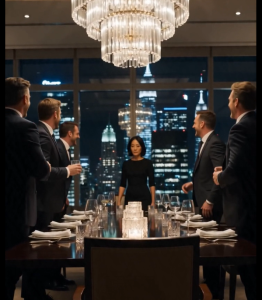
The private dining room sat above the river, wrapped in glass that reflected the lights of the city. Outside, boats moved through the dark water. Inside, everything seemed designed to remind people that money had a language of its own. The white tablecloths looked untouched. The silverware was lined up with the precision of surgical tools. Crystal glasses waited beside plates that cost more than some families spent on groceries in a week. This was the kind of room where powerful men spoke softly because they were used to being heard. Contracts were shaped here. Rivals were weakened here. Fortunes changed hands without witnesses, without raised voices, outside the door.
Marcus Bell loved rooms like that. He had chosen this one himself, because it made people feel small before he opened his mouth. He sat at the head of the table in a dark suit, one hand near his wineglass, the other tapping lazily against the linen. Around him were partners, advisors, and men who laughed too quickly at his jokes. They had come to celebrate what Marcus believed was another victory. By Monday, he expected to control a deal that would secure his company’s place along the riverfront for years.
Then she arrived.
She was the last to enter the room. No announcement followed her. No assistant trailed behind with a briefcase. No jewelry flashed at her throat or wrists. Her dress was simple, dark, and modest, an outfit people noticed only to criticize. She carried herself not nervous, not eager to impress, not apologizing for being late. She took the empty seat at the far end of the table, away from Marcus.
Marcus barely looked at her before smiling.
“Well,” he said, “I didn’t realize tonight included entertainment.”
A few men chuckled. One leaned back, enjoying the cruelty because it was not aimed at him.
Marcus lifted his glass. “I hope you don’t charge by the minute.”
The laughter rolled across the table, polished and practiced, the kind people use to stay close to power. No one corrected him. No one looked uncomfortable enough to speak. They had all made the same assumption the moment she walked in. She did not look wealthy enough to belong. She did not speak quickly enough to defend herself. To them, she must have been invited for someone else’s amusement.
She unfolded her napkin and placed it across her lap. Her hands stayed steady. She gave them nothing to push against.
The waiter poured wine. Steaks were ordered. Side dishes arrived in silver bowls. The men began discussing numbers, property values, zoning approvals, board pressure, and debt that could crush a weaker company. As the wine lowered their caution, their voices grew looser.
“She’s not much of a talker,” one man said, pretending to whisper.
“Good,” another replied. “We don’t need distractions.”
Marcus laughed again and settled deeper into his chair. “Relax,” he said. “She’s here on someone else’s dime.”
For the first time, she looked directly at him. Only for a second. There was no anger in her face, no embarrassment, no wounded pride. Just patience, so calm that Marcus mistook it for surrender.
Dinner continued for nearly two hours. Plates were cleared. Dessert menus came and went. Coffee arrived. The river outside kept moving beneath the lights while inside the room grew warm with wine and self-satisfaction. Marcus spoke about expansion as if the future had already signed itself over to him. His partners nodded. His advisors smiled. Every now and then, one of them glanced toward the quiet woman at the end of the table, as if confirming she was still safely beneath their attention.
At last, Marcus snapped his fingers.
“Let’s get the damage,” he said.
The waiter approached with a leather billfold held in both hands. He moved with the steady calm of someone who knew exactly where he was going. Marcus extended his hand without looking up.
But the waiter walked past him.
He passed the partners. He passed the advisors. He passed every man who had spent the evening assuming the bill belonged to Marcus because the room did. Then he stopped beside the woman at the far end of the table and placed the billfold gently in front of her.
“Whenever you’re ready, Madam Chairwoman,” he said.
Silence fell so quickly it seemed to change the air.
Marcus gave a sharp laugh, but it landed badly. “Very funny,” he said. “Give it here.”
The waiter did not move.
The woman opened the billfold. Inside was more than a receipt: a transfer summary, a signed authorization, and the final page of an acquisition agreement. She read the first line as if confirming the weather, then looked up at the table.
“This restaurant,” she said, “belongs to my holding group. So does the riverfront.”
No one reached for a glass.
“And as of forty-five minutes ago,” she continued, sliding the folder across the table, “so does your company.”
Marcus stared at the papers. The color drained from his face.
“That’s not possible,” he whispered.
She gave a small smile, not warm, not cruel, only certain. “You thought I was here for dinner. I was here for closing.”
The room that had been so loud all evening became painfully still. One man adjusted his cufflinks with trembling fingers. Another cleared his throat, then seemed to forget what he meant to say. The jokes had disappeared. So had their appetite. The steaks, the wine, the polished silver, the view, all of it suddenly looked like decoration around a mistake.
One partner tried to recover. “Surely this is negotiable.”
She closed the billfold and handed it back to the waiter. “Negotiation ended when you mistook my silence for permission.”
Marcus swallowed. “You planned this.”
She stood and smoothed the front of her dress. “I scheduled it.”
Then she looked around the table, meeting each face long enough for them to understand that she remembered every word.
“This dinner was billed to your expense account,” she said. “The acquisition was billed to mine.”
The door opened. Security stood outside, but not restaurant security. Building security. The head guard addressed her directly.
“Madam Chairwoman, your car is ready.”
She paused beside the untouched desserts, the cooling coffee, and the men who had reduced her to a joke before learning her name.
“Enjoy the meal,” she said softly. “You’ve already paid for it.”
As she walked toward the door, Marcus found his voice. It sounded smaller than before.
“What happens to us?”
She did not turn around. “You report to me on Monday.”
The door closed behind her.
For a long moment, no one moved. The river kept flowing beyond the glass, calm and indifferent. Inside, Marcus stared at the folder as if it might disappear if he refused to blink. The men around him sat in the ruins of their own arrogance, finally understanding what they should have known from the beginning.
Power does not always announce itself with noise. Sometimes it sits quietly at the end of the table, listens to every insult, signs one document, and waits for the bill.
And the most expensive mistake in that room was never the dinner. It was disrespect.