Have you ever experienced that sudden, chilling realization that you are no longer the one in control of your own journey? Imagine sitting on a crowded evening commuter train, eager to get back to the quiet comfort of your home, when the doors suddenly lock, your cell phone signal completely dies, and you slowly begin to realize that the unassuming stranger sitting quietly across from you was never just a fellow traveler. She was the reason you might never leave.

The silence inside the train car did not arrive all at once; rather, it settled over the trapped passengers gradually, thickening with every passing second until it stretched into something entirely unbearable. At first, it was merely the abrupt absence of the customary, rhythmic clatter of heavy steel wheels grinding against the steel tracks. It was a sudden, jarring halt that jolted a few nodding heads awake from their evening naps and caused a brief, collective ripple of mild annoyance. Commuter trains traversing the American suburbs experienced unpredictable delays all the time—a sudden signal failure, a minor track obstruction, or a frustrating backlog of transit traffic ahead at the main city terminal. It was an inconvenience, certainly, but a deeply familiar one that most riders were accustomed to handling. However, as the long minutes began to aggressively drag on without a single word of explanation, the atmosphere inside the enclosed metal tube began to fundamentally shift. The ambient, mechanical hum of the overhead air conditioning system sputtered, wheezed, and finally died out completely, leaving behind a suffocating, heavy stillness that seemed to press inward against the reinforced glass windows. You could hear a pin drop on the rubberized flooring. You could hear the shallow, increasingly anxious breathing of the person sitting three rows away. The absolute lack of noise transformed from a temporary, peaceful pause in the commute into a heavy, suffocating blanket of creeping apprehension.
Passengers, initially just irritated by the highly likely prospect of a delayed dinner or missing the beginning of their favorite evening television program, began to instinctively check their watches. Wrists were nervously flicked, crisp shirt cuffs were pulled back, and countless pairs of tired eyes darted from classic analog dials to glowing digital displays in a synchronized, silent dance of growing impatience. Five minutes passed. Then ten minutes. Then fifteen. The passive observation of time was no longer a casual, idle habit; it rapidly became an acute, burning source of anxiety. In the modern, hyper-connected age, the immediate, undeniable reflex to any unexpected pause in routine is to reach out for a digital distraction, to frantically try and connect with the outside world. Hands fumbled blindly into coat pockets, briefcases, and leather purses, desperately retrieving smartphones in the desperate hopes of sending a quick text message to a waiting spouse or aimlessly scrolling through a social media news feed just to comfortably pass the idle time. But as the dozens of screens illuminated the dimming, shadowed interior of the car with their pale, artificial blue light, a brand new wave of genuine unease visibly rippled through the seated crowd. The cellular signal bars located at the top right corners of their digital screens had completely vanished without a trace. “No Service,” the expensive devices declared in cold, unyielding, universal text. It wasn’t just an isolated issue with one specific network carrier, either. People nervously leaned over the narrow center aisles, whispering urgent questions to their adjacent neighbors, only to horrifyingly discover that every single mobile phone, regardless of the brand or the service provider, had been completely and thoroughly severed from the outside world. The invisible digital umbilical cord had been deliberately cut, leaving everyone totally isolated in a manufactured dead zone that felt far too precise and intentional to be dismissed as a mere technical coincidence.
The creeping sense of claustrophobia began to manifest itself physically among the riders. A man seated near the middle of the crowded car—a quintessential, tired American businessman sporting a slightly loosened silk necktie, greying temples, and resting a heavy leather briefcase squarely on his lap—decided he had tolerated more than enough of this entirely unexplained, ridiculous purgatory. He let out a sharp, exasperated sigh, grabbed the thick handle of his briefcase with a white-knuckled grip, and planted his polished dress shoes firmly onto the grooved floor mat. He fully intended to stand up, perhaps planning to march straight down the aisle to the conductor’s locked booth and aggressively demand a sensible, immediate explanation for this entirely unacceptable delay. He heavily shifted his body weight, his knees lifting as he prepared to confidently rise from the plush, patterned upholstery of his window seat. But before his spine could fully straighten, a uniformed officer materialized seemingly out of thin air from the darkened shadows near the vestibule doors. The officer moved with a startling, unnatural lack of sound, his deliberate approach swift and entirely devoid of any hesitation. A large hand, clad in a dark, tactical leather glove, reached out and pressed firmly down against the businessman’s right shoulder. The sudden physical contact was not violently aggressive, yet it possessed an unyielding, immovable, terrifying firmness that immediately communicated the absolute, undeniable futility of any further resistance. The stoic officer did not bother to raise his voice, nor did he offer a fake, reassuring smile to diffuse the tension. He simply looked down directly into the eyes of the startled, trembling man and delivered a command that violently cut through the stifling, hot air like a freshly sharpened blade.
“Remain seated.”
Those two simple words were spoken with a chilling, deeply authoritative calm. They were clearly not a polite request; they were an absolute, non-negotiable directive, heavily carrying the unspoken, implicit threat of severe, immediate consequences should they be foolishly ignored. The businessman, his face rapidly draining of all remaining color, slowly and obediently sank right back down into the deep seat cushions, his brief moment of righteous bravado instantly evaporating into pure fear. The officer’s gloved hand lingered heavily for a fraction of a second longer than was strictly necessary before finally retreating to rest near his heavily equipped utility belt. A collective, involuntary shiver violently ran down the spines of the surrounding, wide-eyed passengers who had silently witnessed the brief, terrifying exchange. The fundamental rules of their everyday reality had fundamentally, irreversibly changed. They were distinctly no longer paying, voluntary customers riding on a public municipal transit system; they were now closely guarded detainees.
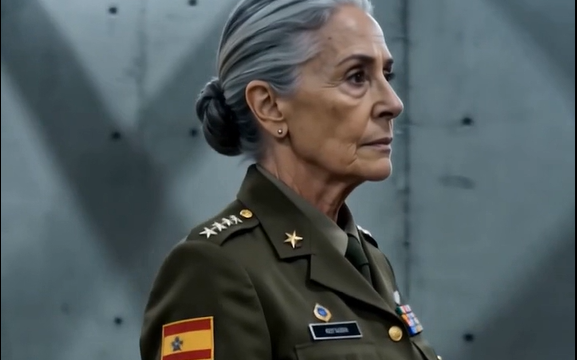
Up at the very front of the train car, entirely detached from the rapidly rising tide of pure panic rippling through the long rows of seats directly behind her, sat a solitary woman. She had been sitting quietly in that exact spot since the very beginning of the long journey, entirely unnoticed, deeply unremarkable, blending absolutely perfectly into the mundane background scenery of the daily commute. But right now, in this frozen moment in time, she was the sole, undivided focus of the stern authorities who had silently boarded the halted train. She did not look like a dangerous, fleeing criminal, nor did she resemble a helpless, frightened victim desperately in need of immediate rescue. She sat there with a perfect, almost statuesque posture, effortlessly exuding a powerful aura of complete, unbothered control over the chaotic situation. She spoke very briefly with the heavily armored, uniformed individuals closely gathered around her front row. There was absolutely no raised voice, no frantic, desperate gesturing, and certainly no desperate pleas for mercy or basic understanding. The quiet exchange was strictly, coldly business, conducted entirely in hushed, muffled murmurs that completely failed to carry past the first few rows of straining ears. She offered absolutely no comforting explanations to the captive, terrified audience of ordinary passengers helplessly staring at the back of her head. There were just subtle, deliberate nods, quiet, whispered confirmations, and a final, highly discerning downward glance at the brightly illuminated screen of an officer’s ruggedized digital tablet. It looked exactly like the detached, deeply clinical review of a critical flight manifest, a final, necessary verification of crucial facts before the flawless execution of a highly coordinated, secret plan.
Then, without any loud fanfare or dramatic, theatrical declarations, the heavy pneumatic metal doors at the front of the quiet car loudly hissed open, violently breaking the agonizing silence with a sharp, explosive burst of compressed air. She calmly stood up from her seat, casually smoothed the non-existent wrinkles from the fabric of her dark, tailored trench coat, and stepped confidently out into the damp, incredibly foggy air of the unknown, abandoned platform. She was gently led off the train, but it was now abundantly, painfully clear to every single person watching her that she was certainly not being taken into any form of punitive custody. She was being highly escorted. She was being closely protected. From the heavily smudged, condensation-streaked windows of the locked train car, the trapped, breathless passengers tightly pressed their pale faces against the cold glass, their rapid, terrified breaths actively fogging the transparent panes as they helplessly watched her officially depart. They quietly watched her solitary figure steadily grow smaller as she deliberately walked away, her even pace entirely unhurried, her long stride speaking massive, undeniable volumes of her absolute, unmitigated personal freedom. She completely disappeared down the long, shadowed length of the desolate concrete platform, quickly swallowed up by the gathering, thick mist and the harsh, unforgiving glare of the yellow sodium vapor lights, until she was nothing more than a fading memory in the dark.
Inside the stifling car, the heavy mechanical doors forcefully slid shut and automatically locked with a definitive, terrifying metallic clank. The brief, refreshing rush of cool outside air that had managed to momentarily seep into the cabin was quickly, aggressively consumed by the returning, stagnant, suffocating body heat. Suddenly, the public address system mounted overhead violently crackled to life with a harsh, ear-piercing burst of audio static. When the automated announcement finally returned to the cabin, it sounded entirely different. The previously polite, pre-recorded, friendly customer service voice was entirely gone, abruptly replaced by a live microphone and a human tone that was infinitely colder, flatter, and deeply devoid of any recognizable human empathy.
“This train will remain stopped until further notice.”
The sharp, sudden click of the live microphone turning off echoed endlessly through the long, narrow cabin. The previous, nervous whispers of mild confusion and commuter annoyance instantly and irrevocably morphed into genuine, unadulterated, blinding panic. The highly muffled, distinct sounds of soft, terrified crying began to slowly emerge from the dark back rows of the trapped car. People tightly gripped the plastic armrests of their assigned seats, their strained knuckles turning stark white under the pressure, as they frantically looked around at the heavily locked doors, the pitch-black exterior windows, and the deeply impassive, unblinking faces of the silent officers now permanently stationed at every single possible exit.
It was only in that profound, deeply terrifying moment of absolute, crushing finality that the awful truth finally began to truly sink into the collective, panicked consciousness of the trapped evening commuters. The scattered, confusing pieces of the psychological puzzle aggressively snapped together in their racing minds, rapidly forming a cohesive picture far too horrifying to easily fully comprehend. The quiet woman in the dark trench coat hadn’t accidentally delayed their routine evening journey by some strange, unfortunate mechanical accident. She certainly hadn’t pulled the red emergency brake lever in a sudden moment of personal distress, nor was she merely a random person of interest in some unrelated, boring investigation that simply happened to cross their unfortunate path tonight. She was the singular, undeniable reason they were currently sitting immobilized on these dead tracks in the absolute middle of nowhere. The entire, massive operation—the sudden, jarring halt, the complete death of the communication signals, the strictly enforced, terrifying captivity—had been meticulously orchestrated specifically for her quiet, seamless extraction from the public eye. They were definitely not just unlucky passengers on a terribly delayed suburban commuter line; they were now trapped collateral damage in a game they did not know they were playing. She was not merely a fellow, tired traveler who had finally reached her intended stop for the night. She had been the destination all along.