After a painful divorce, I thought moving into a quiet old house would give me a fresh start. Then my rescue dog became obsessed with one spot in the basement. What he uncovered beneath the concrete revealed a secret that had been hidden for years.
After my divorce, I felt like a completely different person. The life I had spent years building disappeared almost overnight, and every familiar place carried memories I no longer wanted to face. I needed distance, silence, and a chance to begin again somewhere no one knew me. That decision led me to sell nearly everything I owned and move several states away to a quiet northern suburb.
The house I bought was old, larger than I needed, and filled with the kind of character real estate listings politely call “historic charm.” The wooden floors creaked with every step, the windows rattled during strong winds, and the basement always felt several degrees colder than the rest of the house. Even so, the price was surprisingly low.
The real estate agent explained that the previous owners, an elderly couple, had moved unexpectedly into an assisted living facility. Their family wanted a quick sale and had left behind much of the furniture and household items. At the time, it sounded like a lucky opportunity.
For the first few weeks, I enjoyed the peace. No arguments. No obligations. No constant reminders of my old life. But eventually, the silence became something heavier. The house felt empty in a way that was difficult to describe. Every room echoed. Every evening seemed longer than the one before.
That was when I decided to adopt a dog.
The local animal shelter was full of energetic dogs barking and competing for attention. Most pressed themselves against the kennel doors, eager for anyone to notice them. But at the very end of the row sat a golden retriever who remained perfectly still.
He simply watched me.
There was something unusual about him. He seemed calm, observant, and strangely thoughtful. When I knelt beside his enclosure, he walked over slowly and rested his head against the gate.
A volunteer explained that he had been found wandering near a wooded area without identification. He had no collar, no microchip, and no known owner. Several families had considered adopting him, but many changed their minds after noticing some odd behavior. Occasionally, he would stare at a wall or corner for long periods without moving.
For reasons I couldn’t explain, I felt an immediate connection.
I named him Barnaby.
Bringing him home turned out to be one of the best decisions I had made in years. He adapted quickly, learned routines easily, and seemed remarkably sensitive to my moods. Whenever I felt lonely or discouraged, he would quietly sit beside me until the feeling passed.
For two weeks, everything was perfect.
Then one evening, while we were relaxing in the living room, Barnaby suddenly lifted his head.
His ears became rigid.
His eyes focused on the basement door.
A low growl emerged from his throat.
It wasn’t aggressive. It was cautious, almost concerned.
He stood, walked to the basement entrance, and sat directly in front of it.
I called his name.
Nothing.
I offered him a treat.
Nothing.
I tossed his favorite toy across the room.
He didn’t even look at it.
He remained completely focused on the basement door.
At first, I assumed there were mice or rats below. Old houses often attract unwanted visitors. The explanation seemed reasonable enough, so I ignored it.
That night, however, I woke suddenly.
The house was silent except for one disturbing sound.
Scratching.
Slow. Repetitive. Persistent.
The noise seemed to be coming from the basement.
My heart immediately began racing.
I grabbed a flashlight and headed downstairs.
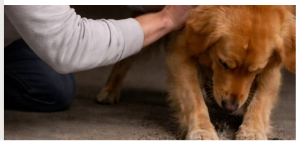
When I reached the basement, I found Barnaby in a far corner. He was furiously scratching at the concrete floor.
The intensity shocked me.
He dug with such determination that it seemed impossible to distract him. I rushed over and pulled him away. Only then did I notice blood on his paws and small red streaks across the concrete surface.
The sight unsettled me.
The following morning, I took him to the veterinarian.
After examining him, she suggested that some rescue dogs develop anxiety-related behaviors after spending time on their own. She recommended a mild calming treatment and advised me to keep him away from whatever location seemed to trigger the behavior.
Following her advice, I locked the basement door.
Unfortunately, that solved nothing.
Every night around the same hour, Barnaby would wake up and walk directly to the basement entrance. He scratched at the door, whined continuously, and pushed against it with his entire body.
Nothing calmed him.
Food didn’t help.
Walks didn’t help.
Comforting words didn’t help.
The behavior became so relentless that I barely slept. Hearing his claws scrape against the wood sent chills through me.
After several exhausting days, curiosity finally overcame frustration.
I needed answers.
Perhaps something had died beneath the floor. Maybe there was a broken pipe, trapped animals, or some other hidden problem causing a scent only he could detect.
On Friday evening, I heard that familiar growl once again.
This time, I unlocked the basement door.
Barnaby immediately rushed downstairs.
I followed close behind and switched on the light.
Within seconds, he reached the same corner and began scratching with renewed determination.
As I crouched beside him, I noticed something I had somehow missed before.
The section of concrete beneath his paws looked different.
The change was subtle, but once I saw it, I couldn’t ignore it.
A faint square outline was visible in the floor.
It appeared as though a portion of the concrete had once been removed and later sealed again.
My stomach tightened.
I stood motionless for several moments, staring at the shape.
Questions flooded my mind.
Why would anyone cut into a basement floor?
Why seal it afterward?
And why was Barnaby so obsessed with that exact spot?
Unable to ignore my growing concern, I went to the garage and retrieved a heavy sledgehammer.
Returning to the basement, I positioned myself over the center of the square.
Barnaby stepped back and watched.
I swung.
The first strike produced only a crack.
The second widened it.
The third caused a section of concrete to collapse inward.
Almost immediately, a foul odor rushed from the opening.
The smell was overwhelming.
It carried the scent of damp earth, rust, age, and something else I couldn’t immediately identify.
I stumbled backward and covered my nose.
Every instinct told me to leave.
Instead, I forced myself closer.
My hands trembled as I aimed the flashlight into the darkness below.
The beam illuminated only a small portion of the hidden space beneath the floor, but it was enough to make my blood run cold.
At that moment, I understood something important.
Barnaby had never been reacting to rodents.
He had never been trying to reach a pipe.
He wasn’t acting out because of anxiety.
From the day I brought him home, he had been trying to tell me something.
Someone had hidden something beneath my house.
Something important enough to bury under concrete.
Something that had remained undiscovered for years.
And somehow, my rescue dog knew exactly where it was.
Standing there in that cold basement, staring into the darkness below, I realized my new beginning was about to become something very different.
The answers hidden beneath that floor were finally waiting to be uncovered.