An elderly father spent years praying to see his missing son one last time. When the man finally walked through the diner door during a violent storm, he did not come home for comfort. He came home carrying a confession, a newspaper clipping, and the painful truth that his goodbye might already be written in handcuffs.
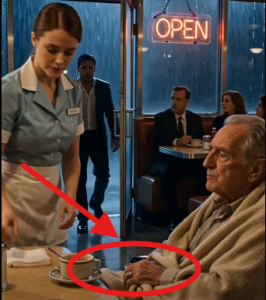
For one long moment, nobody inside the diner moved. The waitress froze beside the counter with a spoon still in her hand. The tired couple sitting in the back booth stopped whispering over their coffee. Even the old man under the faded beige blanket forgot the trembling ache in his body as he stared toward the door.
The storm outside had delivered two impossible things at the same time: a lost son and a reason he should never have returned home.
Rainwater dripped from the stranger’s dark coat and formed small pools on the cracked tile floor. Lightning flashed through the front windows, briefly lighting up his face. The waitress looked down at the newspaper clipping resting near the cash register, then back at the man standing in front of her.
Same eyes. Same sharp jawline. Same exhausted mouth that looked as if it had spent years carrying guilt too heavy to speak aloud.
The article called him wanted.
The son noticed her reaction immediately. Shame crossed his face faster than fear. It was the kind of expression that only appeared when someone had spent too many nights rehearsing regret.
But the old man still did not understand.
All he saw was his child.
Years earlier, he had buried that child deep inside his heart after the letters stopped arriving and the phone calls disappeared without explanation. Neighbors whispered stories about crimes, disappearances, and betrayal, but none of the stories sounded fully true. They sounded polished in the way lies often do when strangers repeat them enough times.
The son slowly stepped forward before dropping to his knees beside the wheelchair. He did not care about the cold water soaking through his pants. He did not care that everyone inside the diner was watching him.
“Dad, I’m sorry,” he whispered, his voice nearly breaking apart beneath the weight of the words. “I should’ve come back sooner.”
That sentence shattered the old man more deeply than recognition itself.
Because he had waited.
He had waited through birthdays spent alone beside silent windows. He had waited through Christmas mornings when he kept an extra cup on the table out of habit. He had waited through countless nights listening for footsteps that never reached the porch. Somewhere deep inside him, he always believed the truth would eventually outrun the rumors.
The waitress quietly placed the spoon on the counter. The couple in the booth remained silent, but neither of them looked away. Something about the scene unfolding before them felt too personal to interrupt and too heartbreaking to ignore.
The old man slowly raised his shaking hand and touched his son’s cheek. His fingers trembled as though memory still felt safer than reality.
“What happened to you?” he asked softly.
The son lowered his eyes toward the floor.
For a brief second, the diner no longer felt like a roadside restaurant. It felt like a confession booth wrapped in chrome and neon light.
Years earlier, he had taken the blame for a robbery he did not commit. He was not innocent in every part of his life. He admitted that to himself long ago. He had made bad choices, trusted dangerous people, and spent too much time believing he could survive by staying close to trouble without becoming part of it.
But the men responsible for the robbery threatened his father. The old man was widowed, drowning in debt, and too stubborn to leave town even when people warned him to disappear. The son believed there was only one way to keep him alive.
So he ran.
He changed names from city to city. He worked under fake identities doing difficult jobs nobody else wanted. Construction sites, warehouses, kitchens, overnight shifts in places where questions were considered dangerous. He stayed hidden because returning home would bring danger directly to the one person he still loved.
For years, he convinced himself distance was another form of protection.
Then one morning, while sitting in a bus station miles away, he saw a small article in a newspaper. It explained that his father was sick and spending most of his days inside a struggling roadside diner owned by a waitress kind enough to serve him soup even when he could not afford to pay.
That story destroyed every excuse he had spent years building.
So he came home during the storm.
Maybe it was too late for explanations. Maybe it was too late for forgiveness. But he could no longer stay away while his father faded into loneliness.
The waitress finally found her voice.
“You’re wanted,” she said carefully.
The son nodded once.
There was no anger in his expression. No panic. No attempt to deny the truth.
“I know,” he answered quietly.
That frightened the old man more than the newspaper clipping ever could.
Not because of the law itself, but because he understood what usually followed words like wanted. Men who returned under those circumstances rarely stayed free for long.
The son reached into his coat and carefully removed a folded envelope that somehow remained dry despite the storm. He placed it gently beside the bowl of soup.
“For you,” he said. “In case they get here first.”
The old man stared at the envelope as though he already feared what waited inside it.
There was money inside. Enough to cover medical bills and keep food on the table for a long time. There was also a bus ticket with his father’s name printed on it and paperwork transferring ownership of the diner into the old man’s hands. Beneath those documents rested a handwritten confession signed with the son’s real name.
The waitress understood the truth before anyone spoke it aloud.
He had not returned home to hide from the police.
He had returned home to surrender after making sure his father would not die abandoned and penniless.
The old man gripped his son’s wrist tightly.
“No,” he whispered.
That single word rose from somewhere far deeper than fear or weakness. It came from years of loneliness, hope, and heartbreak finally colliding at once.
Suddenly every painful detail connected together. The storm outside. The soup growing cold on the table. The newspaper clipping beside the register. The exhausted man kneeling on the floor beside the wheelchair.
All of it pointed toward one unbearable truth.
His son had not come home searching for rescue.
He had come home to say goodbye.
The cruelest part was that the old man had spent years praying for one final chance to see him again. He imagined reunions in hospital rooms, quiet conversations on front porches, and second chances that would heal old wounds.
He never imagined that answered prayer would arrive carrying surrender papers and the shadow of handcuffs before sunrise he still loved.