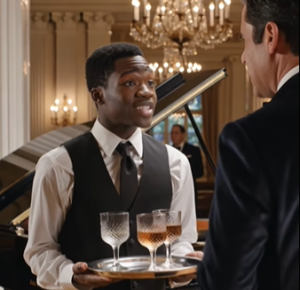
At first, nobody paid close attention to him. He looked like any other member of the serving staff, dressed in a simple black-and-white uniform with tired eyes and calm hands. Guests barely noticed when he quietly replaced the scheduled pianist after the older musician complained of feeling ill. But the moment the young man touched the keys, something inside the room changed.
The melody was unfamiliar to everyone except one person.
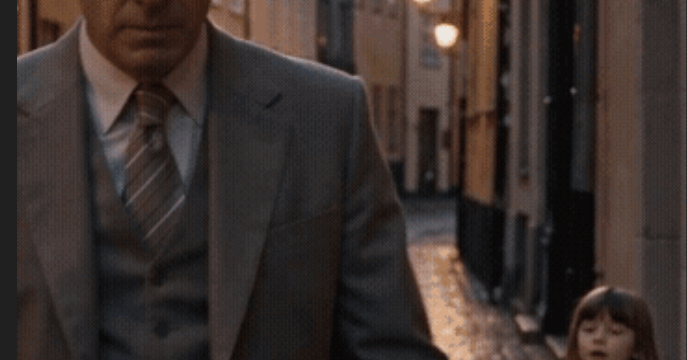
Across the ballroom, a distinguished older man froze beside the fireplace. Only seconds earlier, he had been smiling confidently while discussing investments with several guests. He carried himself like someone who had spent a lifetime being admired and obeyed. But now the color slowly disappeared from his face as he stared at the piano.
The music was not famous. It had never been performed publicly, published in sheet music, or recorded for an audience. The composition belonged to only one woman. Years ago, she had written it alone inside the music room upstairs, a room that had remained locked ever since she disappeared from the family estate.
Yet the melody flowing through the ballroom was perfect.
Perfect enough to sound like memory returning from the dead.
Conversations around the hall slowly faded as more guests noticed the older man’s reaction. He stepped toward the piano, as if afraid the music itself might collapse if he moved too fast. His confident expression vanished, replaced by something far more unsettling.
Fear.
“Who taught you that song?” he finally asked.
The young pianist did not stop playing. His fingers continued moving smoothly across the keys while silence spread through the ballroom. The guests sensed that something deeply personal had just entered the room, something money and influence could no longer hide.
Without lifting his eyes from the piano, the young man answered.
“The woman you told everyone abandoned the family.”
A cold stillness swept through the hall. It was not the polite silence of wealthy guests listening to gossip. It was the kind of silence people fall into when they suddenly realize they may have believed a lie for many years.
Several guests turned toward the older man. Others looked up at the large portrait hanging above the fireplace. The painting showed the missing woman seated beside a piano, her expression calm, as though she were listening to music no one else could hear.
The older man swallowed hard.
“She never finished that piece,” he whispered.
Only then did the pianist look up.
His expression remained calm, but that calmness carried more weight than anger ever could.
“No,” he replied. “She didn’t.”
The room waited.
Then came the sentence that shattered whatever comfort remained in the ballroom.
“She ran out of time after you broke her right hand.”
A woman near the back of the room nearly dropped her champagne glass. Another guest quietly stepped away from the fireplace as though the air itself had become dangerous. Nobody spoke. Nobody even seemed willing to breathe.
The older man stared at the pianist in disbelief.
“That’s a lie,” he said.
But the denial sounded weak and delayed, as if even he no longer trusted the words coming out of his mouth.
Because innocent people usually deny the act immediately.
Guilty people deny the story behind it.
The young pianist slowly rose from the bench. As he stood beneath the chandelier light, several guests noticed something they had overlooked earlier. A tattoo of musical notes curved along his wrist.
The design matched the handwritten opening bars painted into the frame surrounding the missing woman’s portrait.
Suddenly, the tattoo no longer looked decorative.
It looked inherited.
The young man stood facing the ballroom in his waiter’s uniform, yet he no longer resembled staff at all. His posture carried the confidence of someone who had finally stepped into a truth hidden for years.
The older man looked as though time itself had cornered him. The polished image he had spent decades protecting began collapsing in front of everyone who mattered to him.
“She left you a son in secret,” one nervous guest whispered from the crowd.
The pianist’s eyes shifted toward the speaker.
Then he delivered the sentence that sent a chill through the entire mansion.
“She didn’t leave him a son,” he said calmly.
The older man’s breathing stopped.
“She left him a witness.”
The words settled over the ballroom like thunder after lightning. Every guest understood instantly that the evening was no longer about scandal or entertainment. It was about truth finally refusing to stay buried.
The pianist stepped closer to the fireplace, his eyes briefly lifting toward the portrait of the woman. For the first time that night, emotion finally appeared across his face. It was not hatred. It was grief that had waited too long to speak.
“She loved this house once,” he said quietly. “She believed music could make people kinder. She believed family meant protection.”
The older man lowered his eyes.
“But after her injury,” the pianist continued, “she became invisible. Her music stopped. Her friends disappeared. And every story about her was rewritten by the only person powerful enough to control the truth.”
No one interrupted him.
The guests who had admired the older man only minutes earlier now looked at him differently. Wealth could still buy luxury, influence, and silence, but it could not erase the expression forming across his face.
Regret.
The pianist explained that his mother had spent years hiding after the injury destroyed her career and confidence. She had protected her son from the family name because she feared the same cruelty. Before she died, she taught him the unfinished melody and made him promise that one day he would play it inside the mansion again.
Not for revenge.
For truth.
“She wanted someone to remember who she really was,” he said.
The older man finally sank into a chair beside the fireplace. For the first time in many years, he looked old. Not wealthy. Not powerful. Just tired.
No guest spoke in his defense.
The pianist returned to the piano bench one final time. Slowly, he placed his hands on the keys and began playing the unfinished composition again. This time, however, the melody no longer sounded haunted. It sounded alive, as though the woman who created it had finally reclaimed her voice.
And while the guests listened in complete silence, the mansion itself seemed to change around them. The expensive walls, the polished floors, and the carefully protected reputation no longer felt untouchable.
Because one song had accomplished what years of silence never could.
It exposed the truth for everyone standing inside that ballroom.