For one endless moment, the entire ballroom seemed to stop breathing.
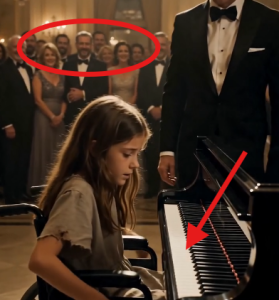
The wealthy guests froze in place with champagne glasses still raised halfway to their lips. The musicians standing quietly near the stage no longer moved a muscle. Even the man gripping the edge of the grand piano looked as though the world beneath him had shifted without warning.
Because the melody filling the room was no longer simply music.
It was proof.
Many years earlier, long before the expensive tuxedos, glamorous charity events, and carefully polished reputation, he had loved a woman whose entire world revolved around music. She used to play on battered upright pianos in tiny apartments and cramped rehearsal studios where the walls were thin and the winters felt endless. She had written that melody during the final months of her pregnancy, pressing each note carefully into existence while dreaming about the child they were about to welcome into the world.
She called it their daughter’s song before the baby had even been born.
At the time, they had nothing except each other, a few unfinished dreams, and a future they hoped would somehow work itself out. But reality arrived faster than they expected.
The baby came early.
There were hospital complications.
Medical bills they couldn’t afford.
Fear that spread through every conversation.
And finally, a decision that disguised itself as responsibility while hiding the truth beneath it.
Cowardice.
He convinced himself he was doing the right thing. He told her he would leave temporarily, earn money, build stability, and return once he could provide the life they deserved. He promised he would come back stronger, successful, and prepared to be the man both of them needed.
And eventually, he did come back.
But by then, it was already too late.
The apartment was empty.
The old neighbors barely remembered details. One said she had moved away suddenly. Another claimed she looked exhausted the last time they saw her carrying boxes downstairs. Nobody knew where she had gone. Nobody had a forwarding address. Nobody even knew whether she was alive.
The silence swallowed everything.
So he buried the memory the same way people bury grief they cannot survive any other way. He never played the melody again. He refused to let anyone mention her name. As the years passed, he built an empire large enough to distract himself from the emptiness underneath it all. Wealth became armor. Public generosity became performance. Success became the polished mask hiding a lifetime of regret.
And now, standing in the center of a glittering ballroom filled with influential people, he heard the impossible.
A young girl in a faded dress sat at his piano playing the melody perfectly.
Not almost perfectly.
Exactly.
Every pause.
Every delicate hesitation.
Every tiny emotional break between the third and fourth bars that only one person had ever used.
Her mother.
The man felt his throat tighten.
“What was your mother’s name?” he asked, his voice rougher than he intended.
The girl looked up calmly and answered without hesitation.
The moment she spoke, the air left his lungs.
There could be no mistake.
No coincidence.
The room itself seemed to tilt sideways as reality crashed into him all at once. His eyes moved again toward the silver-stitched initials sewn carefully into the edge of the blanket draped beside the piano bench. Suddenly he understood something nobody else in the ballroom possibly could.
This child had not simply learned the melody from the woman he once loved.
She had carried proof of him her entire life.
The girl’s fingers slowed slightly over the piano keys, but the music never stopped.
“My mother said you left before you ever saw me,” she whispered softly.
The sentence landed harder than anger ever could.
Because it was true.
He had seen photographs from doctor visits. He remembered the blurry ultrasound image she once pressed into his hands while laughing through tears. He remembered helping paint one side of a nursery wall before panic about money and failure consumed him completely. He even remembered sewing his initials onto a small blanket they bought together from a discount shop downtown.
But he had never seen his daughter.
Not once.
Until this moment.
Somewhere in the crowd, a woman quietly began crying. Others lowered their eyes, suddenly uncomfortable witnessing something so painfully personal unfold in public. This was no longer entertainment for wealthy donors gathered beneath crystal chandeliers.
This was the collapse of a carefully constructed life.
For years, the man had controlled every detail of his image. He had mastered the art of appearing untouchable, composed, and successful. Yet none of that mattered anymore. The expensive room, the applause, the admiration — it all felt meaningless sitting beside the child whose existence he had abandoned before he ever knew her face.
Slowly, he lowered himself onto the piano bench next to her.
He no longer cared how it looked.
His hand hovered over the keys, trembling harder now than hers had when she first touched the piano. Up close, he could finally see the details that made his chest ache even more. The shape of her eyes resembled her mother’s. The concentration in her expression looked painfully familiar. Even the way she sat slightly leaned toward the melody mirrored the woman he once loved.
The girl turned fully toward him for the first time.
There was no hatred in her expression.
No softness either.
Only certainty.
“My mother told me something,” she said quietly. “She said if you heard this song and still walked away… then I should never call you father.”
That shattered whatever remained inside him.
Because suddenly the moment was no longer about heartbreak alone.
It became a question of character.
The entire ballroom remained frozen in silence as he stared at the daughter he had abandoned long before understanding what he was losing. Every excuse he had rehearsed throughout the years now sounded hollow. Fear had guided his decision back then, but fear did not erase responsibility.
Nothing could erase it.
The girl waited without rushing him.
No tears.
No dramatic anger.
Just the unbearable honesty of truth standing directly in front of him.
Finally, with shaking hands, he placed his fingers beside hers on the piano keys.
For a brief second, neither of them moved.
Then together, father and daughter played the final line of the melody her mother created years ago in a tiny apartment filled with hope, fear, and love.
The last note echoed through the ballroom slowly, beautifully, painfully.
Not like an ending.
Like a door opening far too late.