The boy didn’t move.
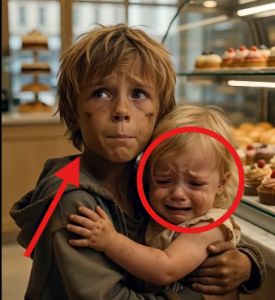
He stood frozen near the bakery counter, holding the little girl tightly against his chest as if letting go for even a second might cause the entire world to fall apart. His eyes stayed locked on the older man in front of him, filled with fear, suspicion, and something far more painful than either of those emotions.
Hope.
Not the innocent kind children are supposed to have. This was the fragile, dangerous hope that only appears after life has already disappointed someone too many times. The kind that makes a child hesitate before believing a kind word because experience has taught them kindness rarely lasts.
The toddler lifted her tear-streaked face from the boy’s shoulder and looked at the older man too. Her cheeks were flushed from crying, and her small body trembled from exhaustion and hunger. She could not have been more than three years old.
The older man noticed immediately how the boy positioned himself between her and everyone else in the bakery. Even though he was clearly exhausted himself, every instinct in his body was focused on protecting her.
Like a father would.
Or maybe like a child who had learned far too early that no one else was coming to help.
The older man softened his voice carefully.
“You don’t have to be afraid,” he said.
The boy’s expression hardened instantly.
“That’s what people say before bad things happen.”
The words settled over the bakery like a cold winter draft.
Nobody moved.
A worker behind the counter looked down at the floor, ashamed of something she couldn’t even explain. A woman sitting near the window covered her mouth with trembling fingers. Even the sound of the coffee machines seemed quieter now.
The older man stood perfectly still for a moment. He didn’t argue. He didn’t try to correct the boy or offer empty reassurance. Instead, he nodded slowly, almost like he understood that a child only says something like that after surviving things no child should ever experience.
“What’s your name?” he asked gently.
The boy hesitated.
His arms tightened protectively around the little girl before he finally answered in a voice barely louder than a whisper.
“Eli.”
“And her name?”
The boy looked down at the toddler.
“Mia.”
The older man’s face changed the moment he heard it.
It wasn’t dramatic. He didn’t gasp or step backward. The shift was subtle, almost invisible, but undeniable. Something deep inside him had been touched unexpectedly, like an old wound reopening after years of silence.
Eli noticed immediately.
His eyes narrowed with suspicion.
The older man carefully took another step closer, moving slowly so he wouldn’t scare them.
“I’m not asking you to trust me for nothing,” he said softly. “I’m asking you to let me feed her.”
At the word feed, the little girl whimpered quietly and turned her head toward the trays of bread and pastries behind the glass counter. Her tired eyes lingered there helplessly.
That nearly broke Eli.
For a second, the tough expression he had been holding together started to crack. He looked at the older man, then at the food, then back down at Mia’s tiny shoulders shaking from hunger.
Behind the counter, the bakery worker had already begun filling large paper bags. Bread. Sandwiches. Muffins. Pastries. Fruit. She kept adding more without asking permission from anyone.
The bakery had become completely silent except for the soft rustling of paper bags and the little girl’s uneven breathing.
Then the older man finally looked carefully at Mia’s face.
Not just casually.
Really looked.
And suddenly everything changed.
His eyes locked onto a tiny birthmark just below the little girl’s ear.
All the color drained from his face instantly.
His hand lifted halfway toward her before stopping in midair, frozen by shock.
He knew that mark.
Eli took one quick step backward.
“What?” he asked sharply.
The older man swallowed hard, but his voice almost failed anyway.
“Who is her mother?”
The question made Eli stiffen immediately.
Why would he ask that?
Why now?
His protective grip around Mia tightened again.
“She died,” Eli whispered.
The older man closed his eyes for a single second, as though the answer had physically struck him in the chest. Pain crossed his face in a way that could not be hidden.
When he opened his eyes again, they were wet with tears.
He stared at the little girl for another long moment before speaking again, his voice shaking badly now.
“She had that same mark,” he whispered. “My daughter had that same mark.”
The worker behind the counter froze completely.
Several customers stared in stunned silence.
Eli’s eyes widened.
The older man inhaled shakily, looking at Mia as if he were staring at a ghost the world had somehow returned to him after years of grief.
Then he looked back at Eli.
And when he spoke again, his voice carried heartbreak, confusion, and regret all at once.
“Why didn’t anyone tell me she had children?”
The bakery remained silent.
Eli didn’t answer right away because he didn’t know what to say. He had spent so long surviving alone that the idea of someone connected to Mia’s mother still existing felt impossible.
The older man slowly lowered himself into a nearby chair, suddenly looking much older than he had only minutes earlier. His expensive coat, polished shoes, and confident posture no longer mattered. At that moment, he looked like a man carrying years of regret he could never escape.
“What was her name?” he asked quietly.
Eli hesitated before answering.
“Claire.”
The older man’s breath caught.
A tear slipped down his face before he could stop it.
“That was my daughter,” he whispered.
Mia shifted slightly in Eli’s arms, too young to understand the weight of the moment unfolding around her. She only knew she was hungry and tired. She rested her head against Eli’s shoulder again, trusting him completely.
The older man watched her with trembling eyes.
“She used to do that too,” he said softly. “When she was little, she always leaned against people when she felt safe.”
Eli didn’t lower his guard entirely, but confusion had replaced some of the fear in his expression.
“You knew my mom?”
The man nodded slowly.
“She stopped speaking to me years ago,” he admitted painfully. “We argued. I thought there would always be time to fix it later.”
He looked down at his shaking hands.
“But later never came.”
Nobody in the bakery spoke. Some customers quietly wiped tears from their eyes as they listened.
The older man finally looked back at Eli.
“How long have you two been alone?”
Eli swallowed hard.
“A while.”
It was the kind of answer children give when the real truth hurts too much to say out loud.
The older man’s face crumpled completely.
No child should ever have had to answer like that.
He stood slowly and walked toward the counter, where the worker had packed enough food for several days. He picked up the bags himself before returning carefully.
Then he knelt slightly so he could look Eli directly in the eyes.
“You protected her,” he said quietly. “You kept her safe when nobody else did.”
Eli said nothing.
But for the first time since entering the bakery, his grip around Mia loosened just a little.
And in that silent moment, surrounded by warm bread, quiet strangers, and years of buried pain, something extraordinary happened.
For the first time in a very long time, neither child looked completely alone anymore.