There is a particular kind of silence that belongs to places where no one comes anymore. It settles over cold gravel and dry straw, over scattered leaves and bare earth, and it is heavy enough that you can hear every small sound inside it. On this day, the sounds were a shaky, wet breath, a soft and endless whimper, and the faint squeak of a puppy too small to understand how much trouble it was in.
Standing in the middle of that emptiness was a mother dog who had almost nothing left.
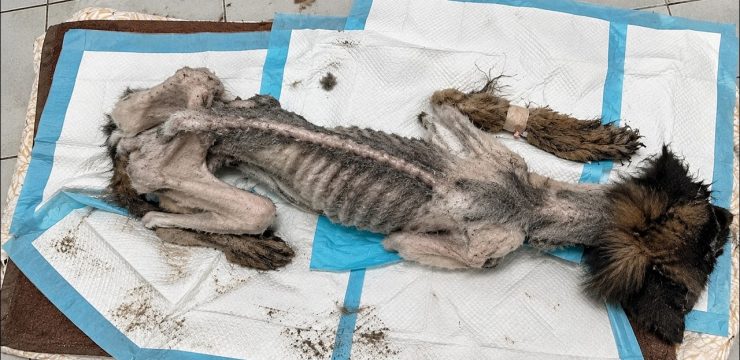
Her body told the story before anyone could ask. Her skin was thin and dull, with bare patches, stretched tight over ribs you could count from across the yard. Her spine and hip bones stood out sharply, and her legs, so thin they seemed barely able to hold her, bent and buckled with every step. She was hunched and swaying on the loose stones, her tail curled low, her heavy head hanging down. Every breath she took was ragged and labored, and her hollow ribcage heaved with the effort.
At her feet stumbled a single tiny puppy.
It was hairless and frail, its small body hunched against the cold, its thin legs folding beneath it each time it tried to stand. It quivered on the sharp gravel, and the stones seemed enormous compared to its size. The puppy was the last one by her side, and the mother kept her head bent toward it as if her whole world had shrunk to that small, shivering body.
If you have ever loved an animal, you understand what that posture means. It is exhaustion, yes. But it is also devotion in its purest form. She had nothing left to give, no food, no clean water, no shelter, and still she stayed close, still she leaned over her baby, still she shook on those weak legs rather than leave it alone.
Everything about the two of them said they had been wandering this empty place for days. There was no bowl in sight, no blanket, no warm corner out of the wind. Just the cold, grey and brown stones, a trampled strip of straw, and a dusty patch of earth where no one was waiting for them.
The shivering was the hardest part to watch. It was not a small tremble. It ran through the mother’s entire frail body, from her quaking shoulders down to her shaking paws, the kind of shivering that comes when hunger, cold and weakness all arrive at once. Beside her, the puppy quivered on the stones in the same helpless rhythm.
Every few moments, a thin, broken cry escaped her. It was not loud. It was the sound of a voice that had already spent most of what it had, fading into weak, trembling sobs that mingled with the tiny squeaks of her puppy. Anyone who heard it would feel it in their chest.
Then, slowly and with great effort, she lifted her head.
It seemed to cost her everything. She turned toward the camera, and the puppy turned its small head right along with her. Their dark eyes were glistening and glazed, wet with tears that rolled down their thin muzzles. They blinked slowly, and they looked straight into the lens, as if they were looking at each one of us.
There was no anger in that gaze. There was no demand. There was only a quiet, fragile plea, the kind that does not need words. It seemed to say: please, stop. Please feed us. Please take us in.
Their heads sank lower, trembling, and then lifted again toward the camera. Their legs buckled slightly on the sharp stones with the effort of it. It was a small movement, and yet it carried so much weight.
For many of us in the later chapters of life, this scene lands differently. We have lived long enough to know what it is to be tired, to be cold, to feel the world pass by without noticing us. We have also lived long enough to know that a single act of kindness can change everything. A warm meal. A blanket. A gentle voice. A hand held out without hesitation.
That is the thing about stories like this one. They are not only about a dog. They are a mirror. They ask what we do when we encounter someone who has nothing left, and whether we stop or keep walking.
Look again at the details. Look at the mother’s hind legs trembling in a half-crouch, because standing at all is almost more than she can manage. Look at the puppy, so small that a gust of cold wind seems enough to topple it. Look at the way they stay together, always together, as if being close is the only protection they have.
No one was there to help them in that moment. No people, no music, no voices, only the soft crunch of gravel under trembling paws and the dry rustle of straw in a cold breeze. It is the kind of stillness that makes you want to reach through the screen and wrap them both in a warm blanket.
And yet, that is exactly what this story reminds us to do, in whatever way we can. Not every one of us can open our door to an animal in need. But every one of us can notice. We can share what we have seen so that more people become aware. We can support the local rescues and the volunteers who spend their days and nights answering calls just like this one. We can speak up when we see an animal alone and suffering.
Rescue always begins with someone who refuses to look away.
A mother who stays with her baby until her body gives out is teaching us something about love. A puppy who keeps trying to stand on weak, shaking legs is teaching us something about courage. And the people who finally see them, and decide that this is not how the story should go, are teaching us the most important lesson of all: that compassion is a choice we can make every single day.
As you read this, take a moment to hold that picture in your mind. A thin mother, a tiny puppy, a cold stretch of gravel, and two pairs of tear-filled eyes looking up and asking for nothing more than a chance.
Then ask yourself what you would do if you were the one who found them.
Maybe the answer is as simple as this: you would kneel down, speak softly, and let them know they were not alone anymore. And in doing so, you would remember why kindness matters most when the world has gone quiet.
She should have been resting somewhere warm with her baby. Instead, she gave every last bit of strength she had to stay beside her puppy. That is a love worth honoring, and it is a love worth answering.
Because no mother, and no baby, should ever have to face the cold alone.