Under a rusted car at the edge of a quiet parking area, where the pavement cracks and the wind carries the smell of wet leaves, a flattened cardboard box sat tucked into the shadows. Most people walking by would never have noticed it. But inside that box was a whole world, a fragile one, held together by nothing more than a mother’s love.
She was a black and white dog, long-haired, though her coat had grown dull and dusty from too many days outdoors. She was thin in the way that makes your heart ache, the kind of thin where every rib shows with each breath. She lay curled on a crumpled blue cloth, her front legs folded weakly beneath her, her heavy head resting low at the edge of the box. Everything about her posture spoke of exhaustion. And yet, tucked against her hollow belly, there was a tiny black puppy, so small and so frail that it seemed the cold itself could take him.
She had clearly been here for days. A scattering of dry kibble lay in the dirt nearby, only a little left, a sad reminder of how little she had to work with. It is a hard truth that mothers will give up their own meals to feed their young, and it looked as though she had done exactly that. She had stayed in this cold, cramped shelter, starving herself to keep her baby alive, and she had no one she dared to trust.
The shivering was the hardest part to see. It was not a small tremble. It came in waves, shaking her from her narrow shoulders down to her paws. Hunger, cold, and weakness had all settled into her body at once, and she could do nothing but endure it. Against her, the little puppy quivered too, pressed close for warmth, letting out faint, tiny squeaks that barely carried over the quiet.
Her breathing was ragged and wet, and her thin ribcage heaved with every labored breath. Now and then, a soft whimper escaped her. Every so often, that whimper broke into something more painful, a thin, cracked cry that faded into weak, trembling sobs. It was the kind of sound that stays with you long after you hear it. It was the sound of a mother who had used up nearly everything she had.
Then, slowly and with great effort, she lifted her head.
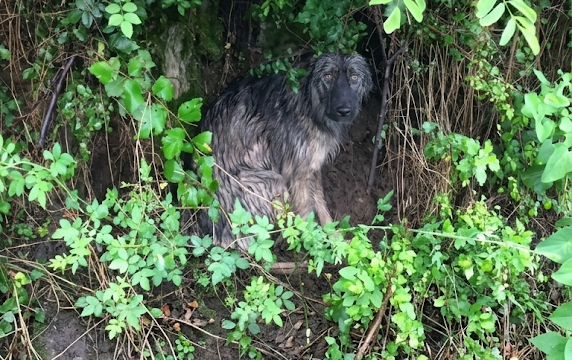
Her dark eyes, glossy and glazed with tears, turned toward the camera. She did not bark. She did not retreat. She simply looked, steady and pleading, blinking slowly as though too tired to do anything else. A single tear rolled down her thin muzzle. If a look could speak, hers asked for so little. Be gentle. Feed her. Save her baby.
For a moment, her head sank back onto the cloth, trembling, as if even that small act had cost her too much. Her front paws shifted weakly against the cardboard. And then, with a fragile kind of hope, she lifted her head again and looked straight into the lens once more. It was as if she was not ready to give up, not while her puppy still needed her.
Around them, the world offered no comfort. A cold, desolate parking area stretched out in every direction. The rusted, mud-streaked car loomed above the box like a low ceiling. Patches of trampled grass and brown fallen leaves lay scattered across the ground, and a cracked concrete curb marked the edge of the space. Far off, a blurred street ran past, with a parked white van and a line of trees standing under a pale, overcast sky. Nobody was coming. Nobody was even looking. The only sounds were her shaky breathing, the soft rustle of cardboard and cloth beneath her trembling body, a faint cold breeze, and the heavy silence of an empty parking lot.
There is something about a scene like this that asks us to slow down. We live in a world that moves fast, and it is easy to walk past what we do not see. But how many quiet places are there, tucked under cars and behind buildings, where a mother like her is holding on with all she has? How many small lives are being kept warm by someone who has nothing left to give except her own body?
For those of us who have lived a while, who have raised children, who have gone without so that someone we loved could have enough, this mother’s story feels familiar. We understand what it means to put another life before our own. We know the kind of tired that goes beyond the body, the kind that settles into the soul. And we know how much it means when someone finally notices, finally stops, and finally says, you are not alone.
That is what this moment is really about. Not only the hunger or the cold, though those were real and heavy. It is about the courage of a mother who kept her baby close when she had every reason to feel she had been forgotten. She stayed. She shielded. She protected, with a body that had almost nothing left to give.
Her puppy, so tiny against her, had no idea how much was being sacrificed on his behalf. He only knew warmth, and the steady rise and fall of her breathing, however labored it had become. That is the quiet miracle of a mother’s love. It works even when the world gives it nothing in return.
When we see a family like this, the right response is not to look away. It is to ask what we can do. A bowl of food, a warm blanket, a phone call to a local rescue, a few kind words to a neighbor who might help. None of these things seem large on their own. But for a mother dog shaking in a cardboard box, each one could be the difference between the end of the road and the beginning of a new life.
She had not asked for much. Only gentleness. Only a meal. Only a chance for her baby to grow strong and see another spring. And if there is one thing her story reminds us, it is that compassion is never wasted. Every act of kindness, no matter how small, reaches someone who is waiting for it.
So tonight, take a moment to think of her. A tired mother, a tiny puppy, and a cold box beneath a rusted car. Think of what they endured, and think of what it means when someone chooses to care. Because somewhere out there, another mother is holding on just as tightly, hoping the world will notice. And maybe, just maybe, it will be us.
She was thin, shaking, and nearly out of strength, yet she never let go of her baby. Moments like this remind us that love is not measured by what we have, but by what we are willing to give. May we all be the kind of people who stop, look closer, and help.