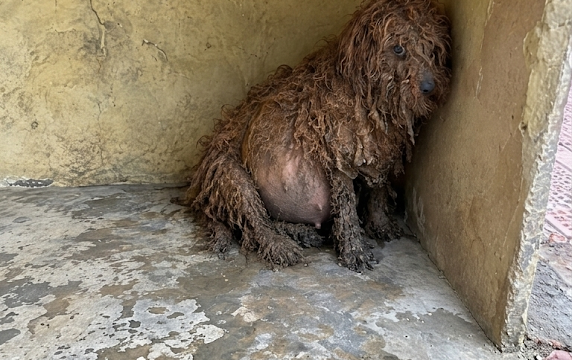
Hidden in a forgotten corner, where the gravel is loose and the wind carries nothing but dry dust, a dog lay on a flattened sheet of torn cardboard. She looked as though she had no strength left to get up.
She was a dark brown dog with a thin black tail and a pale patch on her chest. That patch was the one soft thing about her. Everything else told a harder story.
Her ribs and spine showed sharply beneath her thin coat, each bone drawn like a line on paper. Her long, bony legs were folded and tangled beneath her, as if she had simply run out of the strength to arrange them. Her head rested low and heavy on the gritty ground, her mouth hanging slightly open. It was the posture of someone who had been carrying a weight for far too long.
Behind her stood a rough, crumbling stone wall, stained by weather and spotted with patches of yellow lichen. Scraps of broken wood and crumpled debris lay scattered around her. Far in the distance there was a faint bright opening, a small reminder that the rest of the world was out there, going about its day. But no one was coming through it.
It looked as though she had been lying in that cold corner for days. There was no food within reach. There was no water. There was no sign that anyone had come looking for her.
The light was soft and flat, the kind of dim daylight you only find in the shade. It gave the whole scene a muted, chilly feeling. Soft shadows pooled beneath her thin body, and the cardboard was the only thing between her and the cold ground.
And she was shivering. This was not a small shiver. Her whole frail body shook, from her trembling ribcage down to her quaking legs and paws. Cold, hunger, and pain seemed to travel through her all at once, and she had nothing left to fight them with.
Her breathing was ragged and wet. Her hollow belly and thin ribs rose and fell with every labored breath, and you could almost feel the effort it took just to keep going.
Then came the sounds. A continuous, soft whimpering filled the quiet. Every few moments, a thin, broken cry escaped her and faded into weak, trembling sobs. It is the kind of sound that stays with a person long after they have heard it.
You hear it, and something in your chest tightens. Many of us have known what it feels like to be worn down to the very last thread. We remember how much a single kind gesture would have meant in those moments. So when we see a creature in that state, we feel it deeply, and we cannot simply look away.
Slowly, and with great effort, she lifted her heavy head from the gravel. Her dark eyes were glistening and glazed with tears. She looked straight into the camera, blinking slowly, and a single tear rolled down her thin muzzle. It felt as though she were silently asking someone to stop and take her in.
Then her head sank back down, trembling. A moment later, she lifted it again toward the camera, her front legs shifting weakly on the cardboard with the effort. It was fragile and desperate, and it was all she had to give.
The camera stayed low, at ground level, holding her whole body from nose to tail. It moved gently, like a person holding their breath, with a very slow push-in that never once cut away from her. Sometimes the kindest thing we can do is simply refuse to look away.
The only sounds were the soft scrape of her claws on the cardboard and loose gravel, the faint rustle of dry debris in a cold breeze, and the heavy silence of an empty ruin. No music played. No voices spoke. There was just a starving dog and a very quiet place.
Maybe that is why this moment feels so powerful. There is nothing dramatic here, no noise to pull our attention away. There is only a living being who has been through so much, and the simple truth that she deserves so much more.
If you have ever stopped your car for a stray, left out a bowl of water, or wrapped a shivering animal in an old blanket, you already understand why scenes like this matter. Compassion does not always arrive with a big gesture. Often it begins with someone noticing, and deciding that what they see is worth caring about.
She is still lying on that cardboard in that cold corner, trembling, and still reaching for the camera with the little strength she has. Every animal in her condition deserves to be seen, and every one of them deserves a chance at warmth, a full bowl, and a gentle hand.
So let her story be a quiet reminder. The world is full of forgotten corners, and in each one there may be someone waiting to be noticed. Let us be the kind of people who look, who stop, and who care.
She has already shown us how hard she is holding on. The least we can do is hold on with her.