The funeral parlor was warm, quiet, and carefully arranged, but nothing could soften the weight hanging over the room. Golden light reflected across polished wood, rows of dark wooden pews, and the smooth surface of a casket covered with white lilies. Men and women dressed in black sat with lowered voices and solemn expressions, each person carrying a private memory of the man they had come to mourn. Near the casket stood a young man in a sharp black suit, crisp white shirt, and black tie. His appearance was controlled and expensive, but his expression carried something far less dignified: irritation, pride, and a need to control who belonged near his father.
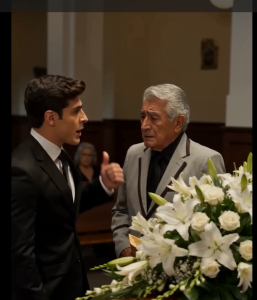
A few feet away stood Don Ernesto, an elderly chauffeur with gray hair, deep lines across his face, and a gray suit jacket trimmed in darker fabric. Beneath it, he wore a black shirt and tie appropriate for the service. In one weathered hand he held a set of car keys. In the other, he carried a plain manila envelope. He looked humble and visibly emotional, not like someone seeking attention, but like a man who had come to honor someone important to him.
The young man noticed him beside the casket and immediately stiffened.
With a dismissive motion of his thumb toward the back of the room, he said harshly, “Employees say goodbye from the back.”
The words were loud enough to travel beyond the flowers and into the first rows of mourners. Several people looked up. A woman in black shifted uncomfortably. An older man lowered his eyes. No one interrupted, but the tension changed instantly.
Don Ernesto did not argue.
“I just came to say goodbye to the boss,” he replied quietly.
There was no challenge in his voice. If anything, the simple answer made the young man’s hostility feel even more out of place. Don Ernesto remained beside the lilies, holding the keys and envelope close, his shoulders slightly rounded under the emotion of the day.
Instead of letting him have a final moment of respect, the young man stepped closer.
“My father doesn’t need chauffeurs here,” he snapped. Then he pointed toward Don Ernesto and added, “Don’t touch that coffin.”
The elderly man’s face tightened with pain. He had spent years serving the deceased, driving him through ordinary workdays, private meetings, late nights, and moments the family may never have seen. Yet now, at the funeral, he was being treated as though loyalty ended when a paycheck stopped.
The mourners watched in troubled silence.
Don Ernesto looked down at his hands.
The car keys rested against his palm, their metal edges catching the warm light. The manila envelope showed no markings that anyone nearby could read. Together, the two objects seemed ordinary, but Don Ernesto held them with unmistakable care.
“I took him home the last night,” he explained.
That sentence caused the young man to glance immediately at the keys.
His expression hardened again.
“Give me those keys,” he demanded.
He reached toward Don Ernesto as if everything connected to his father now belonged automatically to him. The movement was quick, impatient, and possessive.
Don Ernesto drew his hand back slightly, not in defiance, but as if protecting a final responsibility.
“He asked me to bring this…” he began.
His eyes moved toward the manila envelope.
Before he could finish, another voice cut through the room.
“Don Ernesto.”
A professional woman dressed in a black blazer stepped forward, holding a clipboard against her side. Her dark hair was gathered into a neat bun, and her posture carried the calm authority of someone responsible for maintaining order during a difficult ceremony. Until that moment, she had remained in the background. Now she moved directly between the two men.
She looked at the chauffeur with respect.
“Don Ernesto, you must sit with the family.”
The room seemed to become completely still.
The young man stopped moving.
For the first time since the confrontation began, he had nothing to say.
His head turned slowly toward the Official, and the arrogance that had shaped his face only seconds earlier disappeared. Confusion replaced it. Then came something stronger: shock.
He looked from the woman with the clipboard to Don Ernesto, then to the envelope still held in the elderly man’s hand.
Sit with the family?
The instruction did not sound optional, casual, or symbolic. The Official had spoken as if Don Ernesto’s place had already been decided before the service began.
A subtle murmur passed through the pews.
Some mourners looked toward the chauffeur with new curiosity. Others seemed less surprised, as though they understood there might have been a bond between Don Ernesto and the deceased that the young man had never recognized.
Don Ernesto remained quiet.
He did not smile at the young man’s embarrassment. He did not use the moment to answer cruelty with cruelty. He simply stood there, grief visible in his lined face, still holding the keys and the envelope entrusted to him.
That restraint made the moment more powerful.
The young man had judged him by his job title. Chauffeur. Employee. Someone who should stand at the back.
But loyalty is not always measured by a last name, a seat at a table, or a position printed on a company document. Sometimes the person who knows someone best is the one who was present during the quiet hours, the difficult drives, the conversations no one else heard, and the final journey home.
Whatever Don Ernesto had carried into the funeral parlor, it was clearly more than a set of keys.
The envelope remained unopened.
That was the detail no one could ignore.
What had the deceased asked him to bring? Why had he trusted Don Ernesto with it? Why had the Official already been instructed to seat the chauffeur with the family? And why did the young man seem to know nothing about any of it?
The answers did not come. No one in the room looked away.
Instead, the scene ended where its emotional power was strongest: not with a dramatic explanation, but with uncertainty.
The Official stayed between them, composed and firm. Don Ernesto stood with quiet dignity beside the white lilies. The mourners remained seated, watching closely. And the young man, who had entered the confrontation believing he controlled the room, now looked completely lost.
His father’s funeral had become more than a farewell.
It had revealed a gap between what he assumed about his father’s relationships and what may actually have been true.
For Don Ernesto, the moment was never about status. He had come to keep a promise and say goodbye.
For the young man, however, the final seconds brought a harder lesson. Respect cannot be demanded by inheritance, and loyalty cannot always be understood from the outside.
The chauffeur he tried to send to the back had been called forward.
The employee he dismissed had been given a place with the family.
And the plain envelope in Don Ernesto’s hand still held its secret.
As the young man stared at him in stunned silence, one question remained suspended over the funeral parlor: what had his father trusted Don Ernesto to deliver before he died?