The unfinished construction site was the last place anyone would expect to see a woman dressed for a fashionable night out. Exposed concrete pillars rose through the gray interior, steel rebar formed rigid grids along unfinished walls, and metal scaffolding cast angular shadows across a dusty floor. Cement buckets sat between tools and building materials. Somewhere nearby, a trowel scraped steadily against the inside of a bucket.
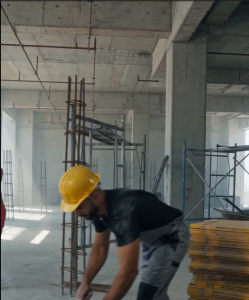
Near one of the concrete columns, a bearded man in gray work overalls bent over fresh cement. Beneath the overalls, he wore a simple black T-shirt. A yellow hard hat covered his head, and dust streaked the fabric around his knees and sleeves. He worked carefully, turning the cement with a trowel in slow, practiced motions. To anyone judging only by clothing, he looked like one more construction worker doing a difficult job.
Then the sharp sound of high heels cut through the industrial quiet.
A young woman with long dark hair entered the site in a bright red mini dress and matching red heels. Her outfit stood out sharply against the concrete, dust, scaffolding, and exposed steel around her. She held a smartphone in one hand and stepped carefully across the uneven floor, but her expression showed more irritation than caution. Each heel strike created a hard echo that announced her presence before she reached the man.
The engineer did not immediately look up. He kept mixing the cement for another moment, focused on the work in front of him. The woman stopped beside him and studied him from head to toe. Her eyes moved over the dusty overalls, the yellow hard hat, the trowel, and the bucket. Instead of asking why he was working there or what his role was, she appeared to make an instant judgment.
“This is what you are? A simple bricklayer?” she asked in Spanish.
Her voice carried through the unfinished space, making the insult feel even sharper. She held her phone loosely at her side and lifted her chin as though she expected him to be embarrassed. In her mind, his clothing and the cement bucket had already told her everything she needed to know.
The scraping sound disappeared, and the sudden silence changed the atmosphere. Slowly, he straightened his back and stood upright. Dust covered parts of his overalls, and the trowel remained in his hand. He did not become angry. He did not raise his voice. He did not rush to explain who he was.
Instead, he reached up and removed his yellow hard hat.
For the first time, the woman could see his expression. He looked tired, calm, and disappointed rather than humiliated. His face suggested that the insult had revealed more about her than it had about him. He met her eyes for a moment, but he gave her no argument to fight and no defensive speech to mock.
He simply stood there.
In one hand, he held the hard hat. In the other, he held the trowel. Behind him were unfinished walls, steel bars, tools, and the ordinary mess of a construction project still taking shape. He looked completely at home in that environment.
The woman remained planted in front of him.
Her posture stayed proud, and her phone remained visible in her hand. She seemed convinced that silence meant she had been proven right. The contrast between them could not have been stronger. She looked polished and carefully dressed, but completely out of place on an active construction site. He looked dusty and ordinary, yet moved with the quiet confidence of someone who understood every part of the space around him.
For several long seconds, neither spoke.
The only sounds came from somewhere deeper inside the building: a faint metallic impact, distant construction activity, and the hollow echo of the unfinished structure. The tension grew because the engineer still refused to defend himself. He seemed willing to let the truth arrive without forcing it.
Then quick footsteps approached from behind the scaffolding.
A second man entered the area wearing a white collared shirt, dark trousers, and a white hard hat. Under one arm, he carried a large roll of architectural blueprints. He moved briskly, clearly searching for someone. When he saw the bearded man, he walked directly toward him.
He barely acknowledged the woman in red.
That small detail immediately changed the balance of the scene.
The assistant reached the engineer, shifted the rolled plans in his hands, and opened them with obvious respect. The paper rustled loudly as the blueprints spread out in front of the man who had just been dismissed as a bricklayer.
“Engineer, everything is ready for your project,” the assistant said in Spanish.
The words landed with more force than any angry comeback could have.
Her confident expression vanished. The smugness in her face collapsed as she looked from the assistant to the blueprints and then back to the man standing beside the cement bucket. The yellow hard hat was still in his hand. The dusty overalls had not changed. The trowel was still there. Yet suddenly, the meaning of everything she had seen was different.
He was not a man trapped in a low-status role.
He was the lead engineer.
The construction site she had used as evidence of his supposed failure was his professional environment. The dust on his clothes did not prove a lack of success. It showed that he was involved directly in the work. The cement, tools, plans, and unfinished structure were not symbols of embarrassment. They were parts of a project he was responsible for leading.
The engineer did not turn toward the woman to enjoy her discomfort.
He did not smile triumphantly or remind her of what she had said. He simply shifted his attention to the blueprints. Calmly, he studied the plans while the assistant stood beside him, ready to discuss the project.
That quiet response made the moment more powerful.
The woman had entered believing that appearance alone gave her enough information to measure another person’s worth. She had seen work clothes and assumed failure. She had seen a trowel and assumed limited ability. She had seen a man mixing cement and decided that his position made him undeserving of respect.
Within seconds, her assumption fell apart.
Nothing about the engineer had actually changed. Only her understanding had.
The final silence inside the construction site carried a simple lesson. Job sites, uniforms, tools, and dirty clothes can tell us what someone is doing at a particular moment, but they do not always tell us who that person is, what responsibilities they carry, or what they have achieved. Real expertise often looks ordinary when it is busy doing the work.
As the assistant pointed to details on the blueprints, the engineer remained composed. The woman stood nearby without a clever remark left to make. Her red heels, expensive-looking outfit, and raised chin no longer gave her control of the scene.
The project moved forward without needing her approval.
And the man she had mocked did not need to prove his value with words. The plans in front of him, the respect of his assistant, and the unfinished building surrounding them had already done that for him.