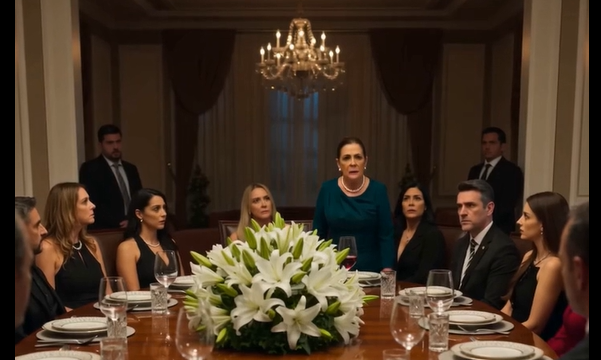
Warm pendant lights cast amber circles across the polished wooden tables of the upscale café. Low conversation drifted through the room, mixed with the occasional clink of cups and silverware. Nothing about the setting suggested a confrontation was about to unfold. It was elegant, quiet, and carefully controlled, much like the woman sitting alone beneath one of the lights.
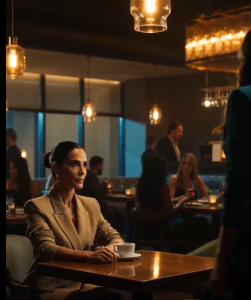
She wore a tailored tan blazer, large gold hoop earrings, and her dark hair pulled into a sleek bun. Her posture was straight but relaxed. She did not fidget, check her phone, or glance nervously toward the door. She simply waited.
Then the younger woman arrived.
With long wavy brown hair falling over the shoulders of a dark green blazer, she moved through the café with the confidence of someone who believed she already understood the situation. A delicate gold necklace caught the light as she approached the table. Her expression carried a hint of smugness, as though she had prepared herself for tears, anger, or perhaps a desperate request.
The wife looked up calmly.
The younger woman sat down and leaned forward slightly.
“I suppose you want me to leave him,” she said.
Her tone was not openly cruel, but it carried assumption. She seemed convinced that the meeting could only have one purpose. In her mind, the wife had called her there to fight for a man they both knew. Perhaps she expected accusations. Perhaps she expected pleading. Maybe she even expected the satisfaction of being told she had won.
None of that happened.
The wife did not blink. She did not raise her voice or tighten her jaw. She simply studied the woman across from her with a stillness that made the silence uncomfortable.
Then she reached beside her.
Her hand rested on a small manila envelope.
Without drama, she slid it across the polished wooden surface.
“No,” she said. “I wanted to meet you.”
The paper made a soft sound against the table, strangely loud in the tension between them.
For the first time, the younger woman’s confidence weakened.
She looked down at the envelope. Her hand hovered above it, but she did not open it. A moment earlier, she had seemed ready for a confrontation. Now she appeared uncertain, as if the conversation had moved beyond the script she had created in her head.
The wife watched her quietly.
Then she spoke again.
“I asked for a divorce three months ago.”
The words were delivered without bitterness. There was no trembling voice, no visible anger, and no attempt to make the statement sound more dramatic than it was. That calmness gave the truth even more weight.
The younger woman looked up.
Her smug expression disappeared.
Until that moment, she had apparently believed she had been chosen. Whatever story she had told herself about the relationship, it likely depended on the idea that the husband had turned away from his wife and toward her. She had walked into the café expecting to face a woman who was losing something.
Instead, she was sitting across from someone who had already let it go.
The wife leaned forward only slightly.
“He didn’t choose you,” she said.
The younger woman’s face changed. Her eyes moved from the wife to the envelope and back again. She no longer looked triumphant. She looked as though she were trying to rebuild the story in her mind before it completely collapsed.
The wife continued with the same steady composure.
“He stayed because I left him.”
The younger woman had not replaced her. She had not won a competition. She had not persuaded a devoted husband to abandon his marriage for a new life. According to the wife, the marriage had already been ending because the wife herself had chosen to leave.
That distinction changed everything.
The envelope remained unopened between them.
It was small, plain, and ordinary, yet it seemed to hold more power than any raised voice could have. Whether it contained paperwork, information, or simply something the wife believed the younger woman needed to see, its presence forced the younger woman to confront the possibility that she had misunderstood the entire relationship.
The wife pushed her chair back.
She stood with the same composure she had shown from the beginning. Her tan blazer fell neatly into place. Her gold earrings caught the warm light as she looked down at the younger woman one final time.
There was no scene.
No shouting.
No public insult.
No attempt to humiliate anyone for the attention of the room.
The wife had come for something simpler. She wanted the other woman to understand the truth as she saw it.
“And now it’s your turn to put up with him,” she said.
The words landed with cold finality.
Then she turned and walked away.
For several seconds, the younger woman did not move.
The warm café lighting had not changed. Conversations slowly returned around her. Cups touched saucers. A server passed in the background. Somewhere across the room, someone laughed softly.
Yet at