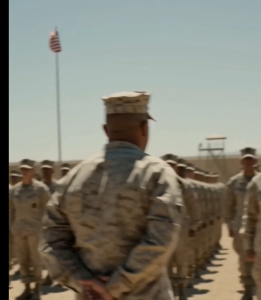
The desert sun hung high over the training ground, turning the earth into shimmering heat. Dust clung to boots, uniforms, and the military installation. In the distance, a flag snapped sharply in the dry wind while rows of soldiers stood at attention. No one spoke. No one shifted. The formation was so still that the scrape of a single boot against dirt carried across the base
 .
.
At the front of the unit stood Lucia, her dark hair secured beneath her cap, her desert camouflage uniform neat. The name LUCIA was stitched across her chest. Her shoulders were square, her chin level, and her eyes fixed forward. She looked exactly as every soldier had been trained to look: disciplined, controlled, and ready.
Then Drill Instructor Ramirez stepped toward her.
His shaved head and hard expression matched the authority in his posture. RAMIREZ was printed clearly on his uniform. He walked with his hands clasped behind his back. When he stopped in front of Lucia, he moved closer than necessary, invading her space without touching her.
“You are not at the level of this unit,” he shouted. “There is no place here for weak people.”
His voice rolled across the open ground.
Lucia did not move.
The soldiers behind her remained silent, but the atmosphere changed. This was no longer routine correction or disciplined instruction. Ramirez was making the moment personal, turning one soldier into a public target while the rest of the unit watched.
He leaned closer, his eyes locked on hers.
“You lack character. You lack strength,” he continued. “That uniform is too big for you.”
The words were designed to diminish her. He did not criticize a specific drill, or a missed command. He attacked who she was. His tone suggested that she did not belong, that simply standing in uniform among the others was something she had not earned.
Still, Lucia said nothing.
Ramirez paced in front of her, boots grinding into the dirt. He spoke with the clipped rhythm of a man accustomed to being obeyed immediately. Every turn of his body reinforced the same message: he believed he controlled the space, the formation, and the person standing before him.
Behind Lucia, the platoon remained rigid.
No one stepped forward. No one broke formation. Military discipline held them in place, but their silence did not erase what they were witnessing. Faces stayed forward, yet the tension in the line was unmistakable.
Lucia’s hands were at her sides. Slowly, almost invisibly, her fingers curled into fists.
It was the only sign that Ramirez’s words had reached her.
She did not lower her head. She did not step away. She did not respond with anger, even as the public humiliation continued. Instead, she held her position beneath the harsh sun while dust moved around her boots and the flag cracked in the wind behind the formation.
Ramirez mistook her silence for submission.
That was his mistake.
For several more seconds, he continued pacing and speaking as if no answer could possibly challenge him. He had rank in his voice, confidence in his movements, and the expectation that everyone would accept his behavior.
Then Lucia raised her eyes.
The change was immediate.
Her expression hardened, not with rage, but with resolve. The tension in her fists eased. She looked directly at Ramirez, meeting the stare he had used to intimidate her.
The sounds around them seemed to fall away.
Ramirez stopped.
Lucia spoke.
“You are mistaken,” she said calmly. “And I will not tolerate any more abuse.”
Her voice was not loud. It did not need to be.
A faint reaction moved through the formation. Someone drew a quick breath. Another soldier seemed to stiffen. No one expected Lucia to interrupt Ramirez, especially not with such controlled certainty.
Ramirez stared at her.
For the first time, he was the one who looked caught off guard.
Lucia did not step backward. Her posture remained straight, and the LUCIA nametag on her uniform was fully visible as the hot wind pushed a thin layer of dust across the ground.
Ramirez’s face tightened as if he were preparing to reassert control.
He never got the chance.
Lucia spoke again, and this time her voice carried the unmistakable weight of a command.
“You are hereby dismissed from service.”
The words landed harder than anything Ramirez had shouted.
His body went rigid.
The man who had spent the previous moments controlling the encounter suddenly had no response at all. His dominance vanished so quickly that the silence itself became startling. Behind Lucia, the soldiers remained frozen in formation, but every person there understood that something far larger than an argument had just been revealed.
Ramirez had believed Lucia was powerless.
She was not.
His eyes moved across her face, searching for uncertainty, hesitation, or some sign that she was bluffing. He found none.
Lucia remained steady.
“Direct order from the—”
She stopped there.
The unfinished sentence hung over the training ground.
Ramirez’s expression changed from anger to shock. Whatever authority stood behind Lucia’s order was clearly enough to make him understand that the confrontation had never been as simple as he assumed. He had judged her by silence, mistaken composure for weakness, and used his position to humiliate someone he believed could not challenge him.
Now the entire unit was watching him absorb the consequences.
The flag snapped again in the wind.
Dust moved between their boots.
No one spoke.
For Lucia, the moment was not about shouting louder than the man who had insulted her. It was not about matching cruelty with cruelty or turning discipline into revenge. Her strength came from refusing to surrender her dignity when someone tried to strip it away in public.
She waited until she was ready, then answered with control.
That restraint changed everything.
Ramirez had tried to define strength as intimidation. Lucia showed another kind: the ability to remain composed under pressure, to recognize when authority becomes abuse, and to draw a firm boundary without losing command of herself.
The soldiers behind her had witnessed both versions.
They had seen a man rely on volume, proximity, and humiliation to establish dominance. Then they had watched Lucia stand her ground without theatrics and deliver a few measured words that completely reversed the balance of power.
The scene ended before the source of Lucia’s direct order was revealed. That unanswered detail only deepened the shock on Ramirez’s face. He had walked into the confrontation certain that he knew who held power. Seconds later, that certainty was gone.
Lucia never celebrated.
She did not smile or taunt him. She simply remained where she had stood from the beginning, shoulders squared beneath the desert sun, calm in the same uniform Ramirez had claimed was too big for her.
Around her, the formation stayed silent.
But the silence now meant something entirely different.
It was no longer the silence of people watching someone be humiliated.
It was the silence that follows a truth no one can ignore: strength is not always the loudest voice on the field. Sometimes it is the person who endures the pressure, refuses to be diminished, and finally speaks with enough courage to make everyone else listen.