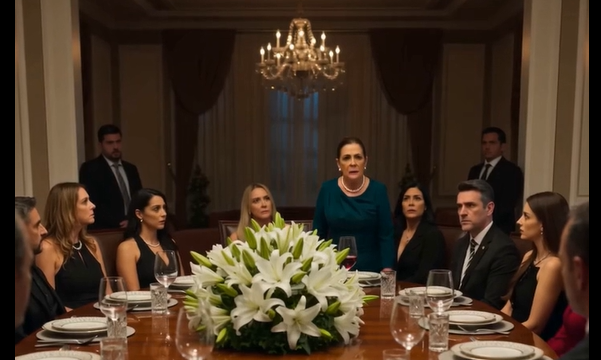
For twenty years, Margaret Collins had believed that loyalty mattered more than almost anything else. In her grand old home, where crystal chandeliers scattered light across polished floors and heavy curtains framed tall windows, she had built a life around family, tradition, and trust. That trust was about to be tested in the cruelest way imaginable.

The evening had begun as an elegant family gathering. Margaret, dressed in a dark green suit with a silver brooch at her collar, moved through the living room with the authority of someone accustomed to being heard. Beside her stood Vanessa, a younger woman in a black strapless evening dress and a glittering diamond necklace. Vanessa had spent months presenting herself as gracious, refined, and devoted to the family.
Then suddenly, she cried out.
Her expensive necklace was missing.
Within seconds, conversation stopped. Guests looked beneath chairs, checked tables, and searched the places where Vanessa had been sitting. Vanessa appeared shaken, pressing a hand to her chest as though she could barely believe someone in the house would steal from her.
Then Margaret’s expression hardened.
“Check the housekeeper’s bag,” she ordered. “The necklace is there.”
Everyone turned toward Rosa, the longtime housekeeper.
Rosa had worked for the Collins family for two decades. She had helped raise children, prepared meals during difficult years, cared for Margaret after surgery, stayed late during holidays, and quietly handled a thousand small responsibilities no one else noticed. She had never been treated as merely an employee. At least, that was what she had always believed.
A black leather handbag sat near the wall.
Someone picked it up.
The zipper sounded unusually loud in the silent room.
When the bag opened, a large diamond necklace lay on a piece of black satin inside.
Gasps moved through the room.
Rosa stared at it as though the floor had disappeared beneath her. Her face crumpled, and tears immediately filled her eyes.
“No,” she whispered.
Margaret looked stunned and angry. Vanessa lowered her gaze, performing what appeared to be sorrow and disappointment.
Rosa began to sob.
“I didn’t do it,” she pleaded. “You have known me for twenty years. I have always been honest with you. You treated me like family.”
Her words made the room even quieter.
To Rosa, the accusation hurt more than the possibility of losing her job. She had given twenty years of her life to this household. She remembered birthdays, illnesses, graduations, funerals, and ordinary mornings when the family depended on her without thinking twice. Now, with one necklace discovered in one bag, all of that history seemed ready to disappear.
Margaret’s son, Daniel, had been watching from across the room.
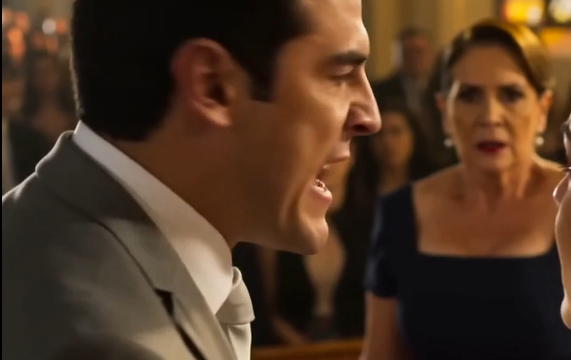
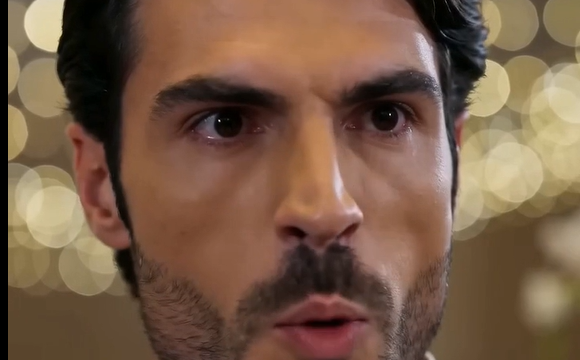
He wore a black suit, white shirt, and black tie, and until that moment he had said almost nothing. But something about the scene bothered him. Rosa’s grief did not look rehearsed. Vanessa’s distress, however, seemed strangely controlled.
Daniel stepped forward.
“Enough,” he said firmly. “Let’s check the security cameras.”
Vanessa’s head snapped toward him.
For the first time, real panic crossed her face.
“Why?” she demanded. “They already found the necklace.”
Daniel looked directly at her.
“That is exactly why we should check.”
The mansion had security cameras covering the main hallways and common rooms. Daniel quickly accessed the footage and brought it onto a screen where everyone could see.
At first, the grainy black-and-white images showed nothing unusual. Guests moved through the house. Rosa carried folded linens. Margaret spoke with relatives. Vanessa walked from room to room.
Then Daniel stopped the recording.
“There,” he said.
He replayed the footage.
The room watched in disbelief.
Vanessa appeared alone near the hallway where Rosa had left her handbag. She glanced in both directions, reached into her own purse, removed the diamond necklace, opened Rosa’s bag, and slipped the jewelry inside.
No one spoke.
The evidence was unmistakable.
Rosa covered her mouth as fresh tears fell, but now her tears carried relief along with pain. She had told the truth, and the camera had proved it.
Margaret stood frozen.
She slowly turned toward Vanessa.
The anger on her face changed into something deeper: shock, disappointment, and humiliation. She had publicly accused a faithful woman without first asking questions. Worse, she had allowed herself to believe a lie created by someone she had welcomed into her home.
Vanessa began talking quickly.
She insisted there had to be some explanation. She claimed the footage was being misunderstood. She looked toward the door, clearly considering escape.
Daniel moved between her and the exit and briefly caught her hand.
“You betrayed my family,” he said. “And you betrayed someone who has taken care of us for most of our lives.”
Vanessa pulled away.
By then, a police officer who had been called when the necklace was first reported missing had entered the room. He had heard enough and seen the security footage.
“Come with me,” the officer told Vanessa.
Her carefully constructed image collapsed.
The woman who had moments earlier acted like an injured victim now looked frightened and desperate. The officer stepped behind her and placed his hands on her shoulders to detain her.
Daniel’s voice remained steady.
“Take her away.”
Vanessa lowered her head.
Then, overwhelmed by the consequences of what had been exposed, she screamed as the officer led her from the room.
Behind her, the handbag remained open.
The diamond necklace still rested on the black satin, sparkling beneath the chandelier like the final piece of evidence in a betrayal no one in the room would soon forget.
After the door closed, silence returned.
Margaret looked at Rosa.
For perhaps the first time that evening, the powerful family matriarch seemed unsure of what to say. She had been so certain, so quick to command, and so ready to believe what appeared to be obvious proof. But obvious proof had been manufactured.
Rosa had not stolen anything.
She had been framed.
Margaret crossed the room slowly and stood before the woman who had served her family for twenty years.
“I should have trusted you,” she said.
Rosa wiped her tears. The apology could not erase the humiliation, but it mattered that the truth had finally been spoken aloud.
The lesson reached beyond the missing necklace. Evidence can be planted. Appearances can be manipulated. A confident accusation can still be false. And loyalty earned over many years should not be discarded in a single emotional moment without careful questions and fair consideration.
That night, the Collins family nearly lost something far more valuable than diamonds. They nearly destroyed the dignity of an innocent woman who had spent decades proving her character.
The necklace was recovered.
The person responsible was exposed.
But the deepest truth was simpler: trust should never mean ignoring evidence, and evidence should never mean abandoning judgment. Real fairness requires both.
It also reminded the family that respect is measured not during easy moments, but when doubt, fear, and suspicion place relationships under pressure.
For Rosa, the security footage restored her name.
For Margaret, it delivered a painful reminder.
And for everyone watching, the glittering necklace became a symbol of how quickly appearances can deceive—and how powerful the truth can be when someone finally decides to look.