At the party, no one expected the older woman near the doorway to matter.
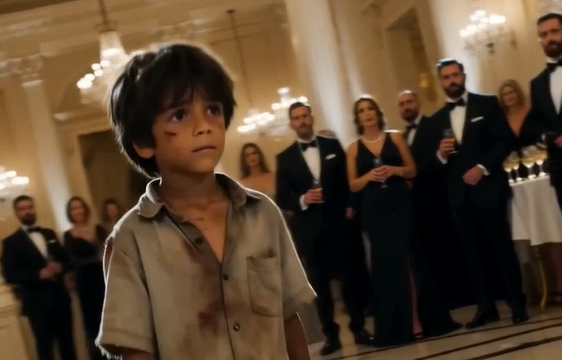
The celebration had been planned carefully. Golden lights hung above white roses and crystal glasses, and every guest looked polished, important, and perfectly placed. It was the kind of evening people photographed before they even sat down, the kind of party where money spoke first.
Near the front of the room, the young couple stood beneath an arch of flowers. Friends raised their phones. Relatives whispered about the ring, the dress, and the future everyone assumed was already arranged.
But near the back wall, an older woman stood alone.
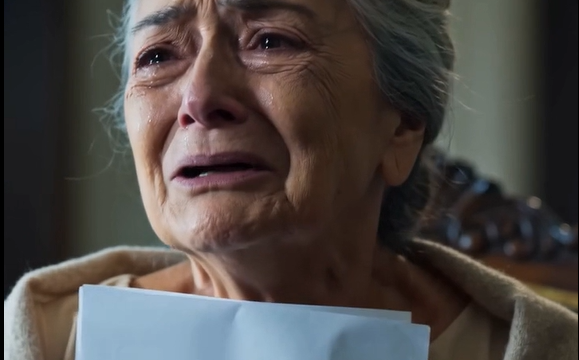
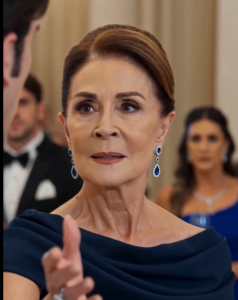
She wore a simple navy dress, the kind someone might save for church, not a glamorous celebration filled with designer gowns and tailored suits. Her gray hair was pinned neatly. Her hands held a small sealed envelope against her purse.
A few guests noticed her immediately.
They did not ask her name. They did not welcome her. They looked at her shoes, then her dress, then the envelope, and decided she did not belong there.
One woman leaned toward her husband and murmured, “Who invited her?”
Another guest gave a dry laugh. “Maybe she wandered into the wrong event.”
The older woman heard them. Her eyes lowered, but she did not leave.
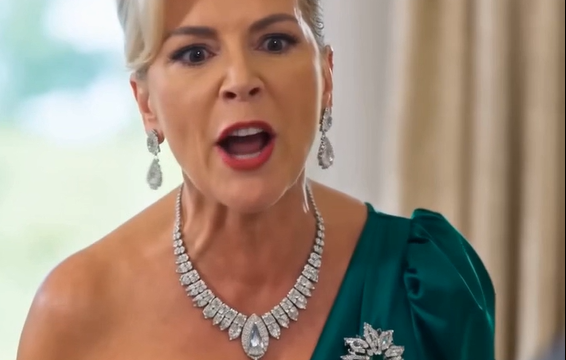
At the center, the bride-to-be smiled for photographs beside her fiancé. Her diamond ring flashed, and the crowd applauded. Her father, a stern man in an expensive black suit, accepted congratulations as if the party were also a tribute to him.
Then the older woman stepped forward.
The room did not stop at first. People kept talking and posing. She moved slowly toward the flower arch until the bride’s father finally noticed her.
His face tightened.
“This is a private family celebration,” he said.
The older woman looked at him calmly. “I know.”
His voice dropped, but the edge sharpened. “Then you understand you should not be here.”
Several guests turned. Phones dipped slightly. The bride’s smile faded, not from kindness, but from annoyance.
“Dad,” she whispered, “who is she?”
“No one important,” he answered too quickly.
That answer chilled the room.
The older woman’s fingers tightened around the sealed envelope. She looked at the groom, then the bride, then her father.
“I was told to bring this tonight,” she said.
The father’s expression changed so fast that few people caught it. For one second, confidence left his face. Then he forced it back.
“Whatever you think you have,” he said, “this is not the place.”
The bride gave a sharp, embarrassed laugh. “Can someone please escort her out? This is a happy night.”
A security guard near the entrance stepped forward.
The older woman did not raise her voice. She did not beg. She simply lifted the envelope.
“It is sealed,” she said. “And it was meant to be opened only at this celebration.”
The groom’s grandmother leaned forward. “What name is on it?”
Everyone grew still.
The older woman turned the envelope so the writing faced the room. On the front, in dark ink, was the groom’s full name.
The groom stared at it.
“That’s my name,” he said softly.
The father’s jaw clenched. “Do not touch it.”
The command was too sudden, too harsh. Everyone heard the fear beneath it.
The groom reached out anyway. The older woman handed him the envelope with both hands. It was old, sealed with gold and marked: To be opened when he chooses his future.
His smile disappeared.
“Who gave you this?” he asked.
The older woman swallowed. “Your mother.”
The room went silent.
The groom’s mother had been gone for years. Her framed photograph sat on a memory table near the entrance, surrounded by candles. But now her name filled the room with a weight no decoration could carry.
The bride’s father stepped forward. “This is nonsense.”
The older woman looked at him without fear. “No, Richard. Nonsense is what you told this family.”
A murmur spread through the crowd.
The groom turned toward the man. “You knew her?”
Richard’s face hardened. “This woman is confused.”
“I cared for your mother during her final months,” the older woman said. “She was weak, but her mind was clear. She asked me to keep this safe until the night you were about to make the most important promise.”
The groom stared at the envelope. His hands trembled as he broke the seal.
The bride gripped his arm. “Wait. Why are you doing this now?”
He did not answer.
Inside was a letter, a small photograph, and a legal document. The groom unfolded the letter first. The longer he read, the paler he became.
Then he looked at Richard.
“What did you do?” he asked.
Richard’s wife gasped. “What does it say?”
The groom could barely speak. “My mother wrote that Richard pressured her to sign away shares in my grandfather’s company while she was sick. She says the transfer was never permanent. He promised to protect them for me.”
Richard shook his head. “That is a misunderstanding.”
The older woman opened her purse and removed another copy of the document. “It was notarized, witnessed, and dated. Your mother kept proof because she feared the truth would be buried.”
The bride stepped back, her face drained of color. “Daddy?”
Richard had no polished answer.
The groom looked at the photograph. It showed his mother beside the older woman, holding the same sealed envelope. On the back, in her handwriting, were five words: He deserves the truth.
The celebration had changed completely. Minutes earlier, the older woman had been treated like an intruder. Now every guest understood she was the only person brave enough to carry a promise across years of silence.
The groom removed the ring from his pocket but did not kneel. He closed his hand around it and looked at the bride.
“Did you know?” he asked.
Tears filled her eyes. “No. I swear I didn’t.”
Maybe she was telling the truth. Maybe she was not. But the evening no longer belonged to romance, photographs, or applause. It belonged to a mother’s final warning and a name written on an envelope that exposed everything.
Richard tried to leave, but two family attorneys blocked his path. Someone had already called for a review of the documents. The music stopped. The champagne sat untouched.
The older woman turned to go, but the groom stopped her.
“Please,” he said, his voice breaking. “Don’t leave.”
She faced him with wet eyes.
“Your mother loved you,” she said. “She wanted you to build your future on truth, not on a lie someone else arranged.”
The groom nodded slowly. Then he walked to the memory table, placed the sealed envelope beside his mother’s photograph, and bowed his head.
No one mocked the older woman after that.
Not one person asked who invited her.
By the end of the night, everyone knew the truth. She had not come to ruin the celebration. She had come to save a son from a future built on silence, greed, and betrayal.
And the name inside that envelope changed everything, proving dignity can stand quietly until truth must speak before an entire room and finally heal.