By sunrise, the parade field at Fort Redstone was already bright with heat. Rows of soldiers stood shoulder to shoulder, boots aligned on white chalk marks, eyes fixed ahead. The battalion had been ordered outside before breakfast. They only knew Commander Harlan Briggs was angry.
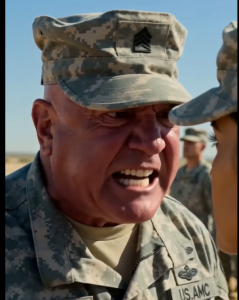
Briggs paced before them with his hands locked behind his back. He believed fear built discipline. He liked silence, obedience, and the reminder that his signature could shape a soldier’s future.
Staff Sergeant Emily Carter, twenty-nine, stood in the third row, steady and quiet. She had served two overseas tours, trained younger soldiers without complaint, and carried herself with hard-earned calm. But that morning, one ribbon was missing from her uniform.
Briggs noticed it immediately.
He stopped in front of her and smiled coldly. “Staff Sergeant Carter,” he said, loud enough for the whole field, “you seem to have forgotten how to wear the uniform.”
Emily stared straight forward. “No, sir.”
“No?” His voice sharpened. “Then explain why your commendation ribbon is missing.”
A few soldiers glanced at her, then quickly looked away. Everyone knew Carter had earned that ribbon during a rescue two years earlier. Rumor said she had pulled three wounded soldiers from a burning vehicle and nearly died doing it. Emily never confirmed any of it.
“It is not authorized for today’s formation, sir,” she said.
Briggs laughed. “Not authorized? Are you rewriting regulations now?”
“No, sir.”
He stepped closer. “Maybe praise went to your head. Maybe those little hero stories made you think standards no longer apply. Let me remind you, Sergeant, this battalion does not run on emotion, gossip, or dramatic tales.”
The formation went still.
Emily’s hands remained at her sides. She did not blink. She did not answer back. Her silence irritated him more than any argument.
“Look at her,” Briggs barked, turning toward the battalion. “This is what happens when a soldier starts believing applause matters more than discipline. You can survive combat and still fail the basics.”
Somewhere near the back, a young private swallowed hard. Emily had trained him during his first week, stayed late to help him pass inspection, and quietly replaced a piece of gear he could not afford. It felt wrong, but no one dared move.
Briggs faced her again. “Remove yourself from formation, report to my office, and prepare for disciplinary review.”
Emily finally turned her eyes toward him. They were not angry. They were tired.
“With respect, sir,” she said, “I request permission to speak.”
“Denied.”
“Sir, this concerns the formation.”
“I said denied.”
A long silence followed. Then Emily did something no one expected. She stepped forward one pace.
The entire battalion seemed to inhale at once.
Briggs’s face flushed. “Staff Sergeant Carter, step back into line.”
Instead, Emily reached inside her dress jacket and removed a sealed envelope. It was cream-colored, marked with the official seal of the Department of the Army. Her fingers trembled once before she steadied them.
Briggs stared at it. “What is that?”
Emily looked toward the adjutant near the reviewing stand. “This document was delivered to me last night, sir. I was instructed not to wear the ribbon this morning because my record has been corrected.”
The adjutant’s expression changed.
“Corrected by whom?” Briggs snapped.
Emily opened the envelope and unfolded the letter. “By the Army Board for Correction of Military Records, sir.”
Murmurs moved through the ranks before discipline silenced them.
Emily continued, her voice clear across the field. “The commendation ribbon was removed because the award has been upgraded.”
The commander went completely still.
She read the next line carefully. “For extraordinary courage under direct threat, for saving the lives of three fellow soldiers, and for continuing the rescue after sustaining injuries, Staff Sergeant Emily Carter is hereby awarded the Silver Star.”
No one moved.
The words struck the field harder than any command. Some soldiers knew exactly what that medal meant. Others only understood enough to realize Briggs had just humiliated one of the most decorated people in the battalion.
But Emily was not finished.
She lowered the letter and looked directly at him. “There is more, sir.”
His mouth opened, then closed.
“The investigation attached to this correction found that my original report was altered before submission. The names of two witnesses were removed. My medical record was omitted. A recommendation for a higher award was downgraded without review.”
The silence became heavy.
Briggs said, “Careful, Sergeant.”
Emily’s voice did not rise. “The reviewing authority also identified the officer who signed the altered report.”
Every eye shifted, just enough to be felt.
“You are out of line,” Briggs said.
The adjutant stepped forward. “Commander Briggs, the brigade office received the same findings this morning.”
Briggs turned sharply. “Stay out of this.”
But it was too late. A black government vehicle rolled quietly to the edge of the field. Two officers in service dress stepped out, followed by a woman carrying a folder against her chest. The battalion commander above Briggs arrived behind them, his face unreadable.
Emily folded the letter and held it at her side.
The senior officer approached. “Colonel Briggs,” he said, using the rank that suddenly sounded colder than any insult, “you are relieved of command pending investigation.”
Gasps broke through the formation.
Briggs looked from the officers to Emily, disbelief cracking across his face. The same man who had controlled the field with absolute confidence now seemed smaller than his own shadow.
“This is absurd,” he said. “You’re taking her word over mine?”
The woman with the folder opened it. “We are taking the official record, witness statements, medical documentation, and your signed submissions, Colonel.”
For the first time that morning, Briggs had nothing to say.
The senior officer turned to Emily. “Staff Sergeant Carter, the Army owes you a formal apology. Your award ceremony will be rescheduled with your family present, if you choose.”
Emily nodded once. “Thank you, sir.”
Then she looked back at the battalion. Hundreds of soldiers stood in stunned silence. Some had tears in their eyes. Others stared at her with a new kind of respect, not the loud kind that comes from stories, but the quiet kind earned when someone survives humiliation without surrendering dignity.
The senior officer faced the formation. “Let this be understood,” he said. “Discipline is not cruelty. Authority is not a weapon. And a soldier’s silence should never be mistaken for weakness.”
No one forgot those words.
As Briggs was escorted away, Emily stepped back into line. She did not smile. She did not celebrate. She simply stood where she had always belonged, shoulders straight, eyes forward, the missing ribbon no longer a mark of shame but the beginning of a truth no one could bury again.
By noon, the whole base had heard what happened. By evening, younger soldiers repeated the lesson in barracks halls and mess tables. The commander had expected her to stay silent. Instead, her courage exposed the truth, restored her honor, and reminded every person on that field that real strength does not always shout.
Sometimes it waits.
Sometimes it stands still under fire.
And sometimes, when the moment finally comes, it steps forward one pace and changes everything.