The dress was hanging near the front window, where afternoon light made the soft fabric look almost golden. It was elegant, with clean lines, gentle folds, and a shade that reminded the elderly woman of spring mornings she had once believed would last forever. She stood before it, one hand on the hanger, and a quiet smile warmed her face.
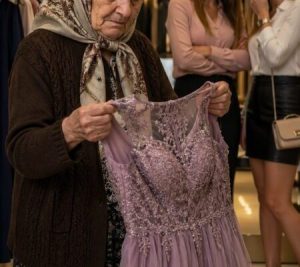
To people passing by, she was just an old woman in a modest coat, carrying a worn handbag and moving slowly. But to her, that dress was not just clothing. It was a memory, a promise, a doorway back to a time when someone had looked at her as if she were the most beautiful woman in the room.
She lifted it carefully and held it against herself. In the mirror, she saw the lines around her mouth, the silver hair pinned back, and the hands that had cooked meals, raised children, held grandchildren, and wiped away countless tears. Then, behind the counter, one saleswoman gave a sharp little laugh.
“This is no longer for someone your age,” she said, her voice low but clear enough for everyone nearby to hear.
The grandmother blinked and turned. She thought she must have misunderstood. “Excuse me?”
“These clothes are for young girls,” the second saleswoman said, crossing her arms as if she had already made a decision. Her eyes moved from the grandmother’s shoes to her coat, then back to the dress. “You should look for something more appropriate.”
A hush spread through the boutique. A woman by the scarves froze with her hand in midair. A mother with a stroller looked down, embarrassed, as if the insult had landed on her too. Near the fitting rooms, customers exchanged uncomfortable glances.
The grandmother held the dress closer. “Are you serious?” she asked softly. There was no anger in her voice, only disbelief.
The first saleswoman smirked. “Why would you need a dress like that? Do you have a date?”
The second one laughed. “Maybe try a flea market. You might find something more suitable there.”
The words hung in the air like smoke. Some customers turned away, unsure what to do with cruelty spoken so casually. Others stared, shocked by how easily the saleswomen had stripped dignity from a woman who had done nothing except admire a dress.
One customer whispered, “That’s awful.”
But the grandmother did not answer right away. She looked at the dress again. Her thumb brushed the sleeve, and her face changed. The smile faded, not from shame, but because something old and tender had risen inside her.
The saleswomen took her silence as weakness.
“Ma’am,” the first one said, this time louder, “we need to keep the merchandise in good condition. If you’re not buying it, please put it back.”
The grandmother slowly placed the dress on the hanger and adjusted it so it would not wrinkle. Then she stood straighter. She was seventy, but in that moment, she seemed taller than everyone there.
“Young lady,” she said, looking at the one who had mocked her first, “do you think beauty expires?”
No one moved.
The saleswoman’s smile faltered. The second one opened her mouth, but no words came out.
The grandmother continued, still calm. “I came in today because this dress looks almost exactly like the one my husband bought me fifty years ago, on the day he asked me to marry him. He passed away last month. Tomorrow would have been our anniversary. I wanted to wear something beautiful to visit his grave.”
The store went silent so suddenly that even the faint drip of the air conditioner could be heard near the back wall.
The young mother covered her mouth. The woman by the scarves lowered her eyes. A man near the register stepped back, as if the floor had shifted. The two saleswomen stood frozen, their faces drained of color.
The grandmother looked around the boutique, not with bitterness, but with a sadness that felt heavier than anger. “I have been young,” she said. “I have been a bride. I have danced until my feet hurt. I have carried babies on my hip, buried people I loved, and kept walking when life gave me every reason to sit down. I may be old now, but I am still a woman. I still remember joy. I still deserve kindness.”
No one interrupted her. The sentence had not been shouted, but it had struck harder than any argument could have.
The first saleswoman swallowed. “I’m sorry,” she whispered, but it sounded too small for what had happened.
The grandmother nodded once, not accepting or rejecting the apology. She simply acknowledged that the words had been spoken.
Then an older customer stepped forward, reading glasses hanging from a chain around her neck. “I’d like to buy that dress for her,” she said.
Another customer spoke up immediately. “No. Let me contribute.”
“So will I,” said the man near the register.
Within seconds, people began opening their wallets, not because the grandmother had asked, but because they wanted to repair the ugliness they had witnessed. The grandmother raised her hand gently.
“Thank you,” she said. “But I can pay for my own dress.”
That second sentence changed the room again. It was not pride. It was dignity. She reached into her worn handbag and pulled out an envelope. Inside were crisp bills she had saved carefully, perhaps from a pension, perhaps from months of setting aside a few dollars. She laid the money on the counter.
The saleswomen could barely look at her. The first one rang up the dress in silence. The second carefully placed it in a garment bag, her earlier arrogance gone. When she handed it over, her voice shook.
“I hope your anniversary is peaceful,” she said.
The grandmother looked at her for a long moment. “I hope you remember this the next time someone older than you walks through that door.”
Then, with grace, she turned to leave.
As she passed the customers, several stepped aside respectfully. The young mother whispered, “You look beautiful.” The grandmother smiled, and this time the smile reached her eyes.
Outside, the city continued rushing by, loud, restless, and unaware of her quiet victory, unaware of what had happened inside that little boutique. Cars honked. People hurried down the sidewalk. The world did not stop for one elderly woman, one memory, and one dress.
But inside the shop, something had changed. Every person there had been reminded of a truth too many people forget: age does not erase desire, memory, grief, elegance, or worth. A woman does not become invisible because her hair turns silver. She does not stop needing beauty because her hands tremble. She does not lose the right to be treated with respect simply because the world has decided youth is easier to sell to strangers.
The grandmother walked down the street holding the garment bag close, not as a trophy, but as a piece of love she had come to reclaim. And the saleswomen, left behind in the silence they had created, finally understood that the cruelest thing in the room had never been age. It had been their own empty hearts.